The Newsroom (Tirana)
Fifty percent. That is the share of new car sales in Albania that were fully electric in 2025, according to Argjent Goci, founder and CEO of Electric Cars Albania, speaking on Prime Minister Edi Rama’s podcast Flasim this week. The figure has not been independently verified against official statistics from Albania’s General Directorate of Road Transport Services, which recorded 16.6 percent fully electric and 40 percent electric-or-hybrid-combined shares of new zero-kilometre registrations for 2024. But even discounted, the trajectory the number points to is real.
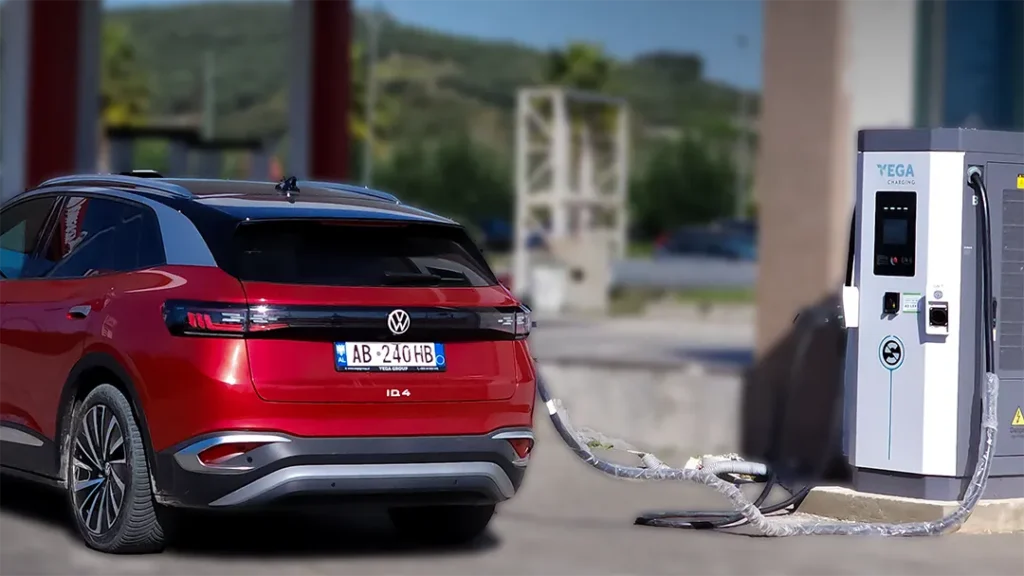
The registered data are striking on their own terms. By the end of 2024, the total cumulative all-electric vehicle fleet on Albanian roads stood at 6,378 units, a 92 percent increase year-on-year, according to official DPSHTRR figures. In 2025, Goci estimates that 6,200 new electric vehicles were sold in a single year, effectively doubling the fleet. He projects the total on-road count will reach 20,000 by the end of 2026. Three years ago, the idea of Albania as a meaningful EV market would have been met with polite skepticism.
What drove this? Not policy in the Norwegian sense. Norway closed 2025 with 96 percent of new car registrations as fully electric, built on three decades of aggressive fiscal incentives: purchase tax exemptions, zero VAT on EVs, cheaper tolls and ferry fares, and sustained disincentives on combustion vehicles. Albania’s policy environment is more modest. There are no Norwegian-style purchase subsidies, and while official DPSHTRR reporting references fiscal incentives contributing to fleet growth, the specific instruments in place are narrower than they appear in government communications. The structural explanation is more persuasive. Albanian consumers are buying Chinese-manufactured electric vehicles at prices that European certification requirements render impossible to replicate in EU markets. Goci is direct about the mechanics: the same vehicle that carries European homologation can cost an additional five to ten thousand euros to certify, a burden absorbed in China and passed on in Albania at a discount. According to Goci, approximately 80 percent of the electric vehicles currently on Albanian roads are Chinese-manufactured.
The economics at the operational level reinforce the trend. Albania generates the overwhelming majority of its electricity from hydropower, with hydropower accounting for approximately 95 to 99 percent of domestic generation in recent years. However, because Albanian hydropower output fluctuates significantly with seasonal rainfall, the country regularly imports electricity to meet demand, meaning the clean-charging argument is not as straightforward as it first appears. On balance, the grid remains predominantly renewable, and the per-kilometre charging cost is a fraction of petrol equivalents. For the taxi sector, where Electric Cars Albania built its original business, the calculus became unambiguous: no engine oil, no fuel filters, near-zero scheduled maintenance, lower running costs per kilometre. When one operator makes the shift profitably, others follow.
None of this is without friction. Goci flagged Kosovo as a case study in how quickly the regional picture fragments. Kosovo currently applies import VAT to electric vehicles, a barrier Albania does not maintain to the same degree, which constrains cross-border market development and penalizes what could otherwise be a natural expansion corridor. The charging infrastructure, while growing, is acknowledged to lag fleet growth, a structural tension common to every market at this stage of transition but one that Albania will need to resolve as volumes accelerate.
The broader regional picture is also uneven. Serbia, North Macedonia, and Bosnia and Herzegovina are nowhere near Albania’s adoption curve. Montenegro edges closer but from a much smaller base. What Albania has demonstrated, largely without fanfare and without the policy scaffolding that Western analysts tend to treat as a prerequisite, is that price accessibility and operational economics can drive adoption faster than incentive design. The lesson may be limited in its transferability, given Albania’s specific regulatory environment and energy profile, but it is a lesson nonetheless.
The question now is whether Albania capitalizes on the transition or simply rides it. Goci spoke about assembling vehicles domestically as a future aspiration, a long road from current import-and-sell operations. The more immediate opportunity is infrastructure: a reliable, dense, fast-charging network would extend range confidence, accelerate tourism adoption, and reduce the one legitimate objection that still gives Albanian consumers pause. OSHE, the state electricity distributor, has begun installing charging points at border crossings and along major corridors, a necessary first step that remains well behind the pace of fleet growth.
Albania did not plan to become an EV outlier in the Western Balkans. But it finds itself in that position, and the story deserves to be told clearly, without the triumphalism that tends to obscure what it actually took to get here and what remains unfinished.