Seventeen days separate the Commission’s statement on the Tirana riots from its Albania report, and the wording is the same. The Serbia report, published the same afternoon, is addressed to the state alone.
By Ardit Rada (Tirana)
The European Commission’s Albania 2026 Report, SWD(2026) 690 final, was published in Brussels on 4 November. It covers the period from 1 September 2025 to 1 September 2026 and runs to 115 pages. One sentence in it refers to something that happened on Tirana’s main boulevard and can be checked against it. “No dialogue has taken place so far,” the report says of the October protests, on page 4 and again on page 23. “All sides should make genuine attempts to engage in constructive dialogue.”
Through the weeks of the protests, the Prime Minister had chairs and a table set out on the boulevard, day after day, as an open invitation to talk. The protesters burned them. This publication has reported on it. The offer is a matter of record, and so is the refusal. The report records neither.
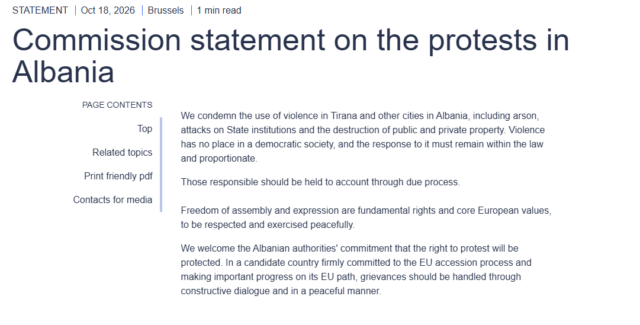
On 18 October, the sixth day of the riots, the Commission issued a statement. It condemned “the use of violence in Tirana and other cities in Albania, including arson, attacks on State institutions and the destruction of public and private property”, added that “the response to it must remain within the law and proportionate”, and closed with the line that grievances “should be handled through constructive dialogue and in a peaceful manner”. Seventeen days later, the report’s account of October uses the same vocabulary: “destruction of public and private property by protestors”, “constructive dialogue”. The statement was written in the middle of the events. The report, by its own account, was written with input from “the government of Albania, EU Member States, European Parliament reports and information from various international and non-governmental organisations”. The wording did not move.
“Violent incidents occurred between protestors and the Albanian State Police, with destruction of public and private property by protestors followed by allegations of excessive violence by the police against protestors and journalists.” The protesters’ destruction is reported as fact, the police violence as allegation. That distinction is defensible on the evidence. The paragraph then gives no figures for either. The Interior Ministry’s count on the sixth day, carried by Euronews on 19 October, was 272 injured, 169 of them police. The recommendation that follows is addressed to the police: Albania should “further increase capacities for law enforcement bodies to handle cases of violence, including on the margins of protests, and other criminal cases involving journalists”.
The movement, the report says, “developed into a broader movement of dissatisfaction with the government and the main opposition party, calling for increased transparency, accountability, anti-corruption and good governance as well as pointing to the cost of living and a lack of investment in areas such as education and healthcare”. That is a fair summary of what the movement says about itself. It is presented without attribution, as the Commission’s own characterisation. Chapter 27 assigns a cause: the 2024 amendments to the Law on protected areas and the extension of the Law on strategic investments “became a root cause of the protests”. The report does not say how it established that.
The Serbia 2026 Report, SWD(2026) 695 final, was published the same afternoon by the same directorate, with the same footnote on sources and the same grading scale. It also describes a year of mass protest. Its democracy chapter records “cases of violent incidents and attacks against students, activists and peaceful protesters, with institutions such as the police failing to take follow-up action in most cases”, “very few public reports of measures being taken against officers allegedly involved in cases of excessive use of force by the police”, and government members who “made inflammatory, insulting and potentially threatening statements against students and the student protest movement”. Its recommendations are addressed to the state: amend the law on assembly, ensure “effective investigations of cases of police ill-treatment”, have high-level officials “stop verbal attacks”. There is no sentence in that chapter asking “all sides” to seek dialogue.
The two reports describe opposite events and reach the same addressee. In Serbia, the Commission found the state’s agents attacking protesters and told the state to stop. In Albania, it found protesters attacking the state and told the state to talk. The Serbian protests are described as held “over allegations of government corruption and the perceived lack of accountability and transparency”. The Albanian protests are described as a movement for “transparency, accountability, anti-corruption and good governance”. The qualifying words, allegations and perceived, appear in the Belgrade text and not in the Tirana one.
The Albania report’s own treatment of Serbia is brief. “Relations with Serbia remained good overall,” it finds, citing the February op-ed co-signed by Edi Rama and Aleksandar Vučić. In the same paragraph it records that “Serbia continued to react negatively to the signing of Albania’s joint declaration of defence cooperation with Croatia and Kosovo”. The reaction is noted; it is not assessed. The Serbia report, for its part, carries a full chapter on normalisation with Kosovo and finds Serbia’s purchase of Chinese missiles “inconsistent with its commitment to the EU path”. The Albania report’s one paragraph on its neighbour assesses only Albania.
On parliamentary oversight, the report’s criticism rests partly on the finding that “opposition requests to establish inquiry committees were systematically rejected without debate”. It does not say what the committees were to inquire into. It records, correctly, that Parliament voted against SPAK’s request to lift an MP’s immunity, and that both majority and opposition “employed rhetoric discrediting the judiciary”. On the judiciary itself the report is favourable: vetting completed, SPAK independent, “good progress”. Those chapters were written from the files, and the files support them.
The report is also an instrument. It accompanies a performance-based facility under which “up to over EUR 920 million” is available to Albania, with 33 of 66 reform steps assessed as completed and the government’s stated aim of “closing all chapters of negotiations by the end of 2027”. A political chapter in a document with that function is read in Tirana by the government, by the opposition and by the movement on the boulevard, and each will find a sentence addressed to it.
Whether dialogue has taken place in Tirana is a question of fact. The record shows chairs set out by one side and burned by the other. The Commission’s report, written seventeen days after its statement and with a year’s input from its sources, found no dialogue and addressed both sides. Nothing in the report indicates that anyone checked the boulevard.