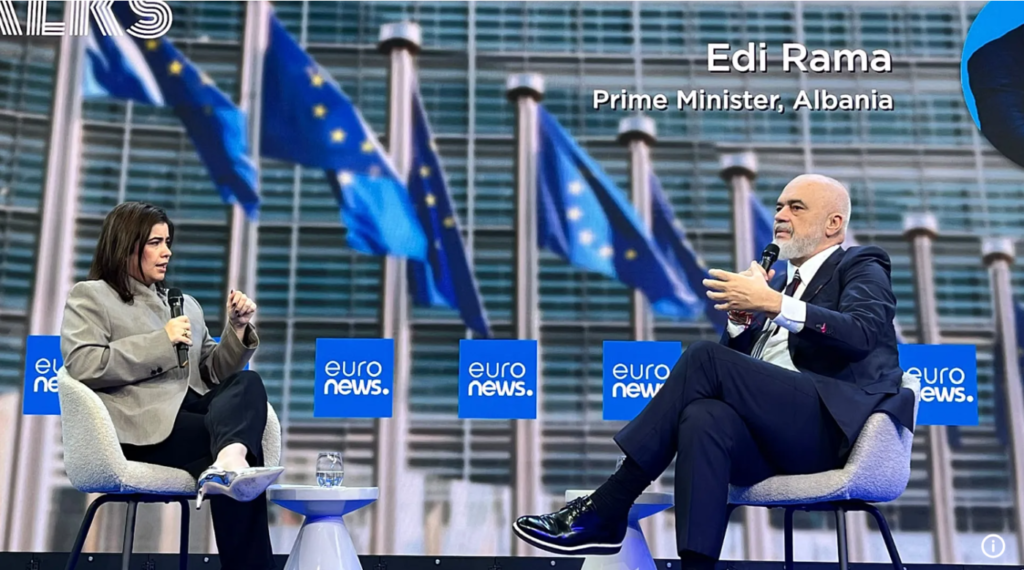
A full readout of what Edi Rama told Maria Tadeo at the Euronews Enlargement Summit in Brussels on Tuesday, the day before the Commission’s Enlargement Package.
Tirana Examiner Newsroom
Edi Rama was the last of the candidate-country leaders on the Euronews stage in Brussels on Tuesday, 3 November, interviewed by the channel’s Europe editor Maria Tadeo. The interview ran thirteen minutes over, and Rama complained twice that he was being made to leave on time.
Nothing better
Tadeo opened with the state of enlargement: Montenegro likely to join within two years, the United Kingdom apparently wanting a way back, Canada offered a new kind of membership. Rama’s answer was one sentence. “There are many complex issues nowadays, but at the end of the day there is nothing better than the European Union. This is how I see it.”
Serbia and Kosovo
Tadeo asked about the change of leadership in Belgrade, recalling the text Rama co-signed with Aleksandar Vučić, and whether the Student List, “which we don’t know who they are or what they think”, would accelerate or complicate the process. Rama first turned the question around: if Euronews does not know, how can he, he is waiting to learn it from them. The winners in Belgrade, he said, have “no openness towards what is the dearest subject to me and to us as Albanians, the subject of recognising Kosovo”. They are “completely closed towards it, so this means that the music in Belgrade will not change.”
Tadeo pressed on Serbia’s weight, citing António Costa’s line that it is a country too big to ignore, and asked whether the new government had a responsibility to get along with its neighbourhood. Rama refused the framing. “I’m not going to lecture anyone. I’m the one who is being lectured, because we are part of a region that is not yet fully part of the European Union. So we get the lectures, we don’t lecture. This is the rule here in Brussels.” He went on anyway. Serbia is “a very important part of the puzzle of the Western Balkans”; he has always argued it should not be allowed to take “the wrong path” and abandon the European project, “because this would harm first and foremost our region”. But “we know the drill”: Serbia “has a reluctancy” on “certain aspects”, and “it’s not just the normalisation with Kosovo, but it’s also its stance towards Russia and the sanctions”. “We need Serbia with us. But again, Serbia has to deliver, and to deserve that belonging in full, by delivering in full what is unnegotiable when it comes to the European Union.”
Dates
Tadeo laid out the two Brussels theories: Montenegro in by 2028 and then the process stalls, or Montenegro in by 2028 and Albania in pole position for 2030. Rama declined the date. “I’m not so young anymore in this job. I’ve seen things you won’t believe, as that guy in Blade Runner said. I have seen how dates and deadlines evaporate on the way. I’ve seen how the European Union is able to not deliver on its promises. I’ve seen how the European Union is able to deliver much more than you expect. So with the European Union, you never know.”
What he does know, he said, is that Albania is working on “a common plan, fully supported by the Commission”, to close the negotiations at the end of 2027. “As we speak everything is going according to the plan. If this will be the case until the end of next year, we will end the negotiations, and this will be absolutely crucial, because this would mean that we did our job.” What comes after is in other hands. “It’s about 27 doctors having to get together and have the same idea about a patient. And they are pathologists.”
The report
Tadeo recalled last year’s country report, on track but with checks and balances, corruption and judicial independence flagged, and asked whether he expected anything different on Wednesday. Rama said dealing with such issues is “part of all this, until the end of the days”, and that a country without issues would be Switzerland, which would tell Brussels “maybe we are not coming to stay with you, maybe you will come to stay with us”. Albania has issues, and so “we are in a stage in which we are not yet ready to be members of the European Union in full right”. He called the accession process “the most efficient, the most miraculous process for countries to become functioning states and functioning democracies”, and said Albania needs it “for our own sake, for the sake of our children”, because it supplies means “that otherwise we would not have”. It is “a big blessing to be in the middle of Europe”, given the “brutal history” the country came from. The comparison he reached for was Afghanistan and Iraq: countries promised democracy, functioning institutions and a bright future, which did not get them “because they do not have the European Union as a horizon and as a source of know-how in how you build a state”.
On the report itself: “It’s never fundamentally different with the European Union. It’s a marriage where everything is predictable.” He corrected himself: “It’s predictable when it comes to getting more. When it comes to getting less, sometimes you’re surprised.” He expects nothing but good news for Albania, “because we worked really hard”, with the negotiating team “in Brussels every week, every day” sitting with officials he described as “the most incredible aliens you can find in real life”, who “know so well how to torture you and know so well how to get the best out of you. If you resist the torture, you win.”
The protests
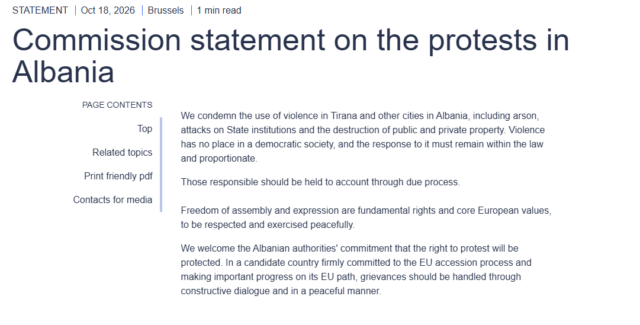
Tadeo turned to the nine months of protest that began over a hotel resort and are now aimed at his government, and gave him the two readings: a society in turmoil and disenchanted, or a democracy where people protest. Rama said both stereotypes miss it and that explaining it “is for another day”. Albania, he said, has made “a historical jump from a country of needs into a country of high expectations”, and history shows a moment when governments must deal with expectations rather than needs. And it is happening everywhere, and will be harder still “for countries that maybe are not yet seeing it coming”, because of “a new reality that is challenging our common reality, which is the reality of the social media”.
He gave one example from Albania of what he called “a totally schizophrenic clash of realities”. The protests were violent, and “unlike any other country that went through the same painful moment, we had more than double of the wounded that were from the police. So the police was the most harmed part in these demonstrations.” On social media, and on television taking its material from social media, “you think that what happened in Albania was unique in the brutality of the police”.
Tadeo put the protesters’ answer to him: police have tools and weapons, protesters do not, the injury count reflects how the operation is managed on the ground. Rama cut across her: “Are you kidding me? Or is it just to provoke me?” He declined the debate on “what police can do or cannot do” and said it was one example among many.
Asked whether his message was that everyone should calm down or that his government was ready to change, he said: “The day that I will think I don’t need to change and the government does not need to change, I will not do this job. I live for change. My life is a life of change, in all aspects, even in marriages.” He would not “bore” the audience with what has changed in the government’s working methods “since the flamingos got in the street”, including the use of artificial intelligence. “It’s not about Albania or myself or my government, it’s about the new world we are living in”, about democracies “spending billions and trillions to shield their own skies and fortify their own borders” while “not yet understanding that what needs to be shielded is the brain of our youngsters and of our kids, which are completely unprotected”. If that goes unaddressed, “God forbid, Europe tomorrow will have to be managed by totally different kind of people.”
He said he was not relativising what the protesters say or “what the real reasons are”. He likes to debate and to be challenged. But the offer of dialogue has been refused: “You are protesting, you want to be listened to, come, I want to listen to you, I want to talk to you. No, we don’t have to listen to you, we don’t have to talk to you, you have to go. Sorry, it’s not you that gave me this job. I have this job that was given to me by the Albanian people and I have a contract.” He added that “this new phase of violence has been characterised by a very low number of people. It’s not the people of Albania in the street.” Far more people who want the government to go are not on the street than are, he said.
Tadeo asked whether any of it affects his policy. “Yes, I’m affected, because I’m trying to understand how to do more, how to do better.” Albania is “doing great” on growth, on the European path, on tourism; “but on the other hand it’s very clear, people want more from what is being created by the economy, and this is what we are trying to address.”
Italy
On the Italy migration deal, signed for five years and due to collide with Albania’s own membership timetable, Rama said it was “not such a big deal to occupy the minds of Europe”. Migration will not go away by strengthening borders or by deals of this kind, and will not go away “for as far as it is used for internal politics among different parties that want to get pieces of electorate”. He called it “a civilisational challenge about who we are and who we want to be tomorrow”. Asked whether his message to Rome was to prepare for a world in which Albania is inside the Union, he refused: “Who am I to give messages to Italians? Albania grew up looking at Italian TV. I expect Italians to give messages to me.” Pressed on whether the deal would survive 2030, he accused Tadeo of fishing for “a headline against my sister in Rome” and gave her a different one: “The deal will stay for as long as need be. 2030, 2040, 2050, until she will be prime minister in Italy.”
Ursula’s kids
Tadeo’s last question was on the Franco-German paper tabled at the Tivat summit in June, proposing benefits unlocked by reforms before membership, which she said she had not heard discussed since. Rama said it is discussed “on every occasion”, and that it is about the Union itself, “who Europe is, who Europe wants to be”. In “a world that is going crazy”, the Union “should do something that is also bold and goes beyond this business as usual”.
On merit he gave no ground: “Everyone has to go through a merit-based process and we should not ask for any gift, for any bypass, for any flexibility.” His image was a driving licence: get it without learning to drive and “you go and crash”. Alongside it he put what he called the “Helmut Kohl moment”. Kohl at the Wall did not tell East Germans “now you are free, but I have news for you, you have 33 chapters to go through”. He said welcome, “we are all in this together, and then the rest followed”.
Ursula von der Leyen has seven children; by his count the Union has seven candidates, five in the Western Balkans plus Moldova and Ukraine. She did not raise hers in the neighbourhood and call them in to eat with the parents once grown; she kept them around the table, and they earned more say as they went through school, university and started bringing money into the family. “When someone grows enough, it’s a member. When someone is not yet grown enough, is there, not fully member, but still gets more from the table. And when someone like Serbia doesn’t want to deliver, stays around the table, but doesn’t take anything from the table.” The point, he said, is the message to Russia and “the other actors”: nobody can tell the Moldovans, the Ukrainians, the Serbs “that they’ll never be part of us, because they are here, they are part of us”.
Leave the children in the neighbourhood, he went on, and “your daughter will not come home anymore because she’ll fall in love with a Russian gangster”, and your boy will prefer “Chinese toys” and “maybe marry a Chinese robot that looks like a beautiful blonde”. So: “Bring us home. It’s our home as it is your home. And then you have all the time to beat us up, to shut us down in the toilet, to tell us to stay in the room and do the homework, to not give us breakfast, to take the lunch from us because we are not delivering in fighting our own vices.” If not, Albania will stay in the neighbourhood “crying for you and fighting for you and waiting for the rope to come from the window”. But, he said, “it’s not about the Albanians, it’s about others”.
The Brits
Tadeo noted he might end up in the waiting room with the British. Rama took it. “The Brits should wait for now, because we waited enough for them. So they are behind Montenegro and Albania. They have to go back to basics.” It was, he said, “so funny to be ahead of the Brits finally after thousands of years; they were ahead of everyone and they were beating the head of everyone.” Albania “will salute every progress they make in the path towards the European Union, we encourage them to fight organised crime and corruption, and we encourage them to be brave and overcome this madness and come back home, because they are not doing well there in the middle of the ocean.” He then withdrew it on the record: “It’s a joke, because the Brits are very revengeful and I don’t want them to go after me. You are a kingdom, it’s up to you, I’m nobody to give you lectures.”
Tadeo thanked him. “We’re thirteen minutes over,” she said. “I start to feel you are more interested in me than last time,” he said, “because you gave me more minutes.”