Berlin does not need Albania in the Union. It needs Albania to believe it might be. That belief is the cheapest instrument Berlin owns in Tirana: it costs nothing to keep, it stops the government answering back, and it is all an embassy needs to run a street, pick a successor and set a table against an elected government. Two former foreign ministers, one embassy and one Russian ideologue have shown this autumn what it is for.
Albatros Rexhaj
Everyone knows the landlord who promises to sell you the flat. He says it every year. So you fix his roof, you repaint his stairwell, you pay the rent on time and you never complain about the boiler, because one day the flat will be yours. The flat is never sold. The promise is the point. It is the cheapest way ever found to make a tenant behave.
That is what the European Union is for Albania, in Berlin’s hands. It is the promise that keeps the tenant working.
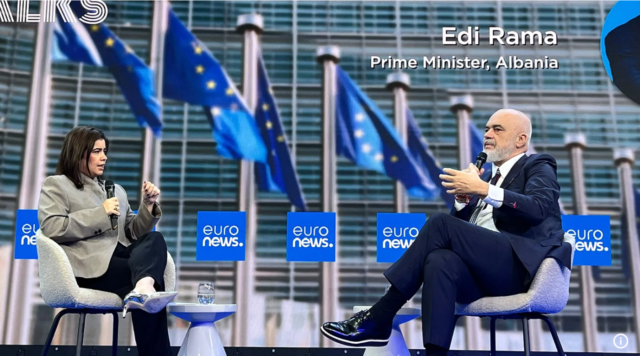
Edi Rama believes the flat will be sold. So does Ferit Hoxha. I say this without malice, because I know both men and I know the belief is sincere. Rama opened the negotiating clusters. He staked his mandate on closing them. He has accepted every condition put to him on courts, on prosecutors, on who may sit in which office, and he has paid for each one in votes and in enemies. Hoxha carries the same belief into every room in Brussels with the patience of a man who thinks patience is rewarded. They are two naïve politicians who believe in the European utopia and will swallow anything as the price of it. We at Tirana Examiner do not. We think the roof is being fixed for a landlord who has no intention of selling, and we think the landlord knows it.
What the promise is used for in Tirana is visible on the street, not in the speeches.
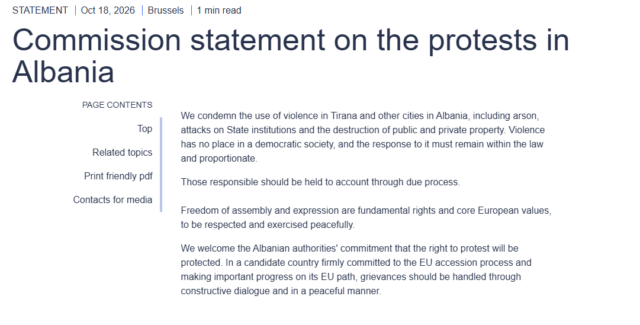
In the first week of the Flamingo movement, Qëndrim Kryeziu, a politician from Pristina, sat in a meeting in Tirana with the people who had by then become the loudest voices of the movement, well-known media personalities among them. They told him the protests could not stop, because the German embassy was behind them. Kryeziu told us this directly and he said it on air, on ABC Albania. We have not printed the names of the people in that room. When we put it to them, they pleaded consequences from their employers and other excuses. Ardit Rada, a journalist this city knows, said on air that he has had several encounters with people inside the protests and the unrest who told him they were in contact with the German embassy. The same thing has been said in television studios, openly, for months. All of Tirana has been saying it. It was put to the ambassador through official channels and he did not deny it. He has had every day since to deny it and he has not. And the government cannot answer any of this, because answering costs chapters. That is what the promise is for.
The same mouths that say the embassy is behind the street say who comes after Rama. Elisa Spiropali, they say, with the embassy and Berlin behind her. Rama dismissed her as foreign minister on 26 February. By March the Tirana press had her inside Berlin’s China Club. On 12 June, the hardest week of the early Flamingo movement, with tens of thousands in front of the Prime Minister’s office, she was not on the boulevard and not in Tirana. She was in the Bundestag, and posted from there that she was in Berlin for something “Shakespearean and durable”. A dismissed minister does not get an audience in Berlin in the week her country’s capital is in the street unless somebody in Berlin wants to hear what she has to say. Within days of coming home she became the first Socialist to declare that everyone has the right to protest, and on 21 June she called for a New Deal for Albania. That is why, when Tirana burned in October, she had the audacity to write an open letter telling the Prime Minister to listen to the street, which in Albanian means step down. That is why she quotes Friedrich Merz in her statements the way a member of the German government would. She is acting on a promise, and the promise was not made to Albania. It was made to her.
Spiropali is not alone. Ditmir Bushati, foreign minister for five years in Rama’s governments, now writes under the roof of the Friedrich-Ebert-Stiftung in Tirana: a monthly column on the foundation’s front page, a podcast the foundation supports, a dozen papers in its catalogue. In June he told the country the protesters were not incited by Iran or by algorithms but revolted by “the treatment of the homeland as loot”. In July the protests were “the best investment in our road to the EU”. On 20 October, with three ministries burned, he was “with the young” and “against police brutality” in the same breath, and had a message for “the honest socialists”. On 23 October, the day after Budva, he wrote that Merz had “told us a simple truth that knocks down many of the nonsenses thrown into public opinion”, that the protests help the road to the EU, and that they “are more than an internal matter of Albania”. A former foreign minister, on a German party foundation’s platform, tells Berlin that what happens on Tirana’s boulevard is Berlin’s business. That is the promise working from the inside: the lever has found hands in Tirana that pull it for Berlin and call the pulling Europe.
Berlin will say its concern is the link between politics and crime. At the core of that concern is Ergys Agasi and the alleged kidnapping of a German citizen to pressure him into withdrawing from a bid for a public project. We do not dispute the grievance. On the incident our reading and Berlin’s are the same. On the context they are not. There was no political cover for Agasi and no political support for what he did. He was never a wing of Edi Rama. He is in detention, the case against him looks strong, and the trial will show what he is: a manipulator who built a network through deception, blackmail and coercion. This publication holds material on that network, on his collusion with media owners, on members of the establishment who worked behind the Prime Minister’s back, on their dealings with Rama’s opponents, on a plan to work the incoming American ambassador and other members of the diplomatic corps, on a plan to remove rivals through the judiciary. It will be published in due time. Berlin has none of it, because Berlin does not ask. A serious state does not build a policy on rumour. It does not take its picture of a country from one side, from people who want power in that country and have every reason to paint it that way. And it does not skip the layers and the nuances, the difference between a criminal and the state he claimed to serve, between a lie told about a prime minister and the prime minister, because those layers are where the truth is. Berlin has done all three, for a year, and called it an assessment.
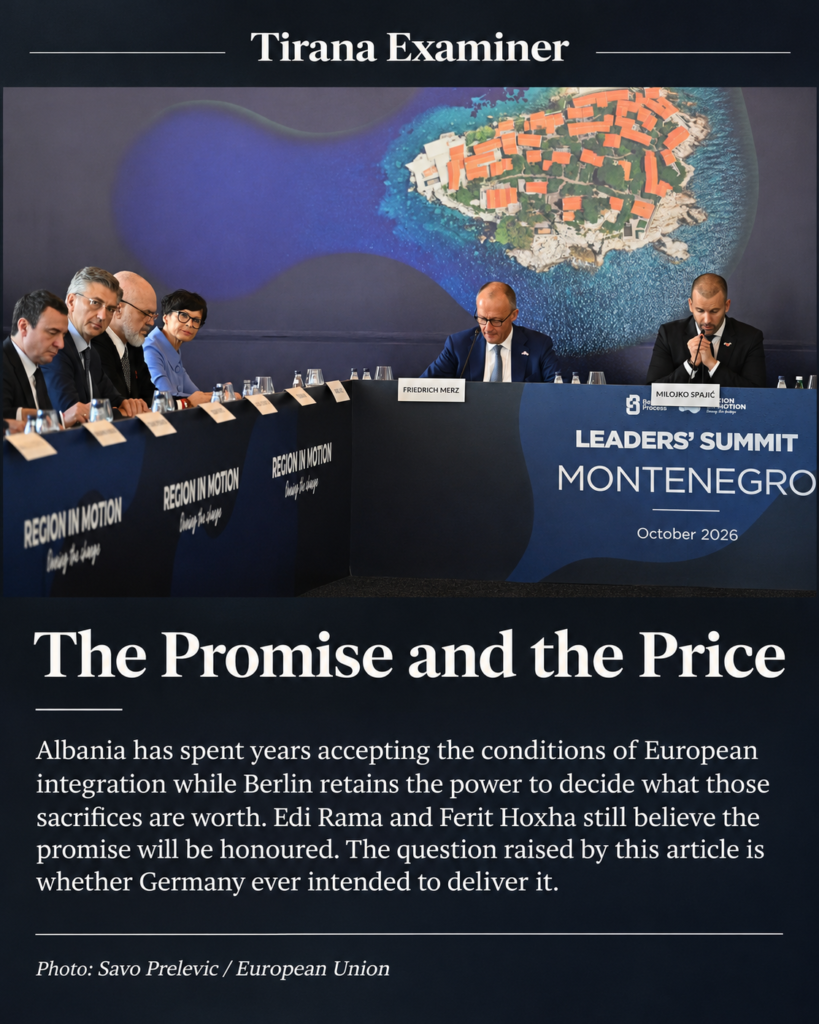
The flat, meanwhile, is being sold. To Montenegro: 620,000 people, the Commission’s “frontrunner”, 21 chapters closed, nine of them this year, membership pencilled in for 2028. Its speaker of parliament sent condolences to Ratko Mladić’s son in August, the ruling party kept him in the chair in September, and the EU closed three more chapters in October. Berlin is pressing Podgorica to settle its quarrels with Zagreb so the date holds. This is the only candidate whose prime minister Italian prosecutors indicted as the head of a mafia group, in a country whose Kotor clans run Europe’s cocaine and have buried seventy people across eleven countries. The pro-Russian parties sit inside the governing majority. None of it has cost Montenegro a single chapter. Merit does not open that door. Size does: small enough to be a box, and the box needs ticking. Albania is too big to tick and too Albanian to want, and with the AfD rising, a German government guided by its own prejudices about us and about this region is not going to spend a vote on a country it has never meant to admit. Berlin is hypocritical to the core on enlargement. With the populists where they are, the honest question is no longer when Albania joins the Union but whether there will be a Union to join.
Berlin’s governing party does have a partner in this region. On 27 October, two days after Serbian voters removed Aleksandar Vučić, the CDU’s Western Balkans rapporteur Peter Beyer praised the Frankfurter Allgemeine’s Michael Martens for his sober reading of the student movement’s foreign policy. Martens thanked him and asked the question Beyer did not answer: why the CDU and the Konrad Adenauer Foundation still see a partner in Vučić’s SNS, when a party that has not fundamentally changed is no partner for European conservatives but “the enemy of Adenauer’s idea” (“Feinde der Idee Adenauers”). A year earlier Beyer had invited CDU/CSU deputies to an internal Bundestag discussion on the future of relations with Vučić and the SNS. That is the party whose state shielded the Banjska gunmen, flew a government aircraft to collect Mladić’s body, and courted Moscow on election eve. And the list that beat it? Four days after the vote, on Sputnik, Aleksandr Dugin said he keeps “very good, trusting relations” with “many representatives of this student list”, that “the Serbs listen to me very attentively”, and that at their rallies “not a single EU flag” flew, only Russian and Orthodox ones. Berlin congratulated that list within hours and kept its predecessor as a partner. Moscow has the ear of both. Only Tirana’s government, the one that flies the EU flag without being asked, gets a table instead of a partnership. A Balkan policy would treat them alike. This is a preference.
So the promise is a lever. It is the only reading that fits what the embassy does. You do not run a candidate’s street, name its next prime minister and set a table against its government if you expect that government to sit beside you in Council in five years. You do it if you expect to keep the tenant.
Berlin did not need me to tell it what was on Tirana’s boulevard. Aleksandr Dugin told it, twice. On 17 October, the night the High Court burned and a drone was stopped over the Prime Minister’s office, he posted that the Albanians “are waking up now”. On 29 October, on Sputnik, he said it in full. What is unfolding in Albania is “not simply a spontaneous revolt, but a genuine, deep anti-globalist revolution”; the students have “risen against the suffocating liberal-globalist dictatorship”; the Albanians, “historically opponents of our brother Serbs”, have “powerful anti-systemic potential”, and “the Albanian events may well end in a real revolution”. Europe’s other protests, Frankfurt’s included, he dismissed as “managed processes”, ultra-left networks someone switches off through the telecom operators when the result is achieved. Only Tirana’s was the real thing. Germany knows this man. Its Foreign Office named his Center for Geopolitical Expertise as the author of the Storm-1516 operation against the Bundestag election, with the GRU behind it; the Union sanctioned it in July. Two readings of the same street, then. The founder of a GRU front says it is a revolution against a pro-European government and hopes it finishes the job. The German embassy in Tirana says it is a side to be seated at a table. One of them has understood what the boulevard was for. It is not the one with the diplomatic passport. And that is the weakness Dugin exposes without meaning to: a Berlin that can name the hand when it reaches for the Bundestag and cannot see it when it reaches for an ally, because in the ally’s case Berlin had its eye on the same chair.
Friedrich Merz says Russia wants to destabilise Germany. His services say it. His interior minister says it. Meanwhile his diplomats in Tirana play elitist power games in an allied capital while that capital’s court is on fire and a drone is stopped over its government, and Gunther Krichbaum, his Minister of State for Europe, acts on what they feed him. Nobody blames the minister for what he was told. That is not a defence. A minister who speaks about Albania on the strength of one embassy’s reporting owns what that reporting makes him say.
Count them. A former foreign minister received in Berlin in the week the capital stood in the street, telling Rama to listen to it. A former foreign minister on a German foundation’s platform, telling Berlin the street is its business. An embassy that will not deny it is behind the street and goes to the President to set a table. A rapporteur in the Bundestag who keeps Vučić’s party as a partner and finds none in Tirana’s government. A minister of state who speaks about Albania on what that embassy feeds him. One of these is a coincidence. Two is a habit. Five, all pointing at the same chair in the Kryeministria, is a pattern, and a pattern has an author.
Now ask who gains. Not Germany. Not Albania. What Berlin’s year in Tirana has produced is this: an elected government of a NATO ally told to listen to a street it cannot name; the one Socialist faction Moscow could wish for, a successor without a mandate; a candidate country taught that the EU promise is a leash; an ambassador who could not condemn masked men and would seat them; a Chancellor who stood beside Rama in Budva and gave the arsonists “either side”. Every item on that list is an item on Dugin’s list. He wants Albania’s pro-European government down by the street, he said so twice, and Berlin spent the autumn making it easier. He wants the Western Balkans to learn that the Alliance’s vocabulary stops at the old borders of the Union, and Berlin taught the lesson in one sentence from a podium. He wants Serbs and Albanians told that Europe is a liberal dictatorship with no room for them, and Berlin’s embassy in Tirana behaved as if Albania were a province to be administered rather than an ally to be defended. Moscow did not have to lift a finger. It filed its claim on Saturday night and let Berlin do the rest.
Germany has been here before. It once had a chancellor who went from the Chancellery to Gazprom’s board and defended Putin until the tanks were in Kyiv, and a foreign service that wrote the cables he wanted to read. Berlin says those years are over. Then it has to explain Tirana, because there are only two explanations and both are Berlin’s to give. Either German policy in this region is being made, again, by people who have decided that Moscow’s preferences are a reasonable price for a quiet life, another Schröder with better manners. Or Germany has lost control of its own diplomatic service, and an embassy in a NATO capital has been running a policy for a year that no minister ordered, no Chancellor saw, and no counter-intelligence officer checked. The first is a scandal. The second is a security breach. There is no third reading in which this is how allies behave.
Albania is not a protectorate. Ambassadors had better remember that. They are guests here, not administrators. The government of this country is chosen on Albanian ballots and nowhere else. Albania did not accept a leader chosen by others in 1914 and will not accept one now.
Germany is an important partner, and this publication says so without hesitation. It is not, on the evidence of this autumn, an ally. An ally does not run your street. An ally does not pick your prime minister. An ally does not hand a Russian ideologue the week he asked for and call it dialogue. Until Berlin can say which of the two explanations is true, and act on it, Albania should treat Germany as what it has shown itself to be: a partner to deal with, carefully, and an ally to be earned back.
Read also: What Berlin Said About Frankfurt