Four days ago we said Berlin would not reply to Tirana. It then thanked thirty other governments for saying what Albania had already said.
Drizan Shala (Security Desk)
States that have just been attacked do not run thank-you rounds for manners. They run them to show who is standing next to them. When the Federal Government on 1 September formally attributed the attempted attack at Leipzig/Halle to Russia, it was making an attribution, and an attribution held alone is a claim. Held by thirty governments it acquires weight. The thirty hours that followed on the German Foreign Minister’s account built that weight in public.
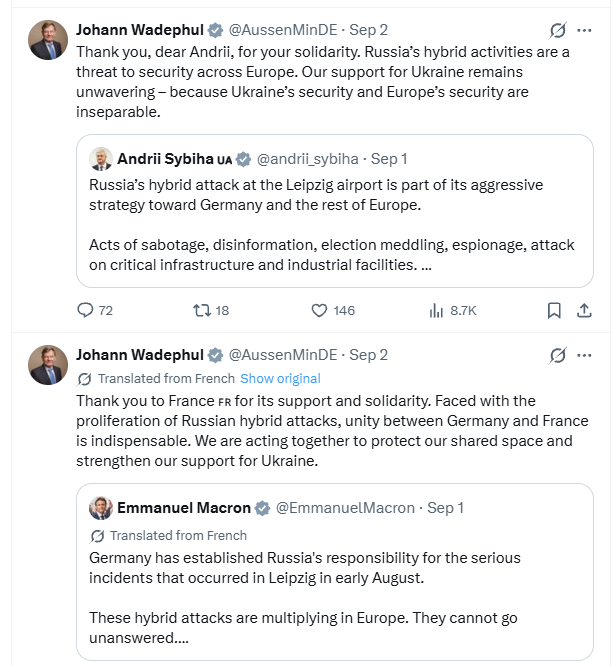
Johann Wadephul quoted and thanked, one at a time, the states whose leaders or ministers had named Russia. Presidents in Paris, Chișinău and Bratislava. Prime ministers in Oslo, Luxembourg and Lisbon, the Greek and Danish premiers’ offices. Foreign ministers from Warsaw to Canberra. To Antonio Tajani: “Grazie, caro Antonio. #Germany and #Italy stand united.” To Anita Orbán: “Thank you, dear Anita. #Hungary standing by our side.” The ministries of Czechia, Slovenia, Croatia, Montenegro, North Macedonia and Bosnia and Herzegovina. The Chancellor answered NATO’s Secretary General with four words and Zelensky after a call.
Albania’s Prime Minister had posted the same evening: “A drone carrying explosives into Leipzig/Halle Airport is not a grey zone. It is a Russian act of aggression against Germany and against the security of Europe.” He named the perpetrator, named the act, and added a sentence Berlin itself had not used: “Hybrid warfare cannot be rewarded with hesitation.” He tagged the Chancellor. He was not answered on any of six official German accounts, the Foreign Minister’s, the ministry’s two, the Chancellor’s two, the government spokesman’s.
The record ends there, and it describes no rupture. Nobody in Berlin decided anything about Tirana on the evening of 1 September, and the substance of the two positions is identical. The record describes a roster, assembled in the open, of the governments Berlin acknowledged as standing with it. Albania was absent.
On Tuesday night, with one Albanian statement to judge and the German round not yet begun, Tirana Examiner’s editorial board wrote that it did not expect a reply from the Chancellery. That was a forecast about a habit. What happened over the following day turned the habit into a measurement. Berlin spent thirty hours thanking government after government, Albania’s neighbours among them, and passed over Tirana’s statement inside the same window.
Rosters like this are built fast. That is why they are worth reading: they show a diplomatic reflex before there is time to turn it into considered policy. On the evening Berlin most needed to display who stood with it, the roster contained Sarajevo and Skopje and Podgorica, from a region where Tirana had named the aggressor, named the act, and told Berlin not to hesitate. What Berlin shares with Tirana in closed channels cannot be seen from a public feed, and a public feed is all this count measures. What it measures is where Albania sits in Berlin’s diplomatic reflexes.
The Leipzig investigation now reaches the Western Balkans. SPIEGEL’s reconstruction this week identifies Serbia as a focal point for Russian sabotage recruitment and reports that a Leipzig-linked suspect travelled on there. Albania is a NATO member in that same security space. Its head of government named Russia in the Leipzig case on the night of the attribution. When the attributing capital counted those standing with it, Albania was absent. The positions did not differ.
Thirty governments were thanked. The NATO member designated to host the Alliance’s next summit was not. Its statement came the same evening, without a qualifier, and said what Berlin had said, in fewer words and with less hesitation. Berlin built the roster itself, over thirty hours.
Both facts are now on the record. Tirana stood with Germany. When Berlin made its public count, Tirana was not on the list.
Drizan Shala is a security researcher and doctoral candidate at the University of Sarajevo. He writes on defense, private security, and the security architecture of the Western Balkans.