The head of government of the EU candidate country has just presented a show in Berlin of bronze sculptures created from 3D prints
By Igor López — EL PAÍS Semanal, August 19, 2026
“Art is an attempt not to go mad, because politics can be madness. And the risk of becoming stupid is imminent when you devote yourself to politics.” Edi Rama (Tirana, 62), the man behind this confession, knows what he’s talking about. Since 2013 he has served as Prime Minister of Albania, the highest executive authority of the small Balkan country (2.75 million inhabitants), and the only one to have strung together four consecutive terms. He is also chairman of the Socialist Party, and before that served as Minister of Culture, Youth and Sports and as mayor of Tirana.
He defines himself first and foremost as an artist. He trained as a painter at the Academy of Fine Arts in Tirana, where he went on to teach, and today his work hangs in galleries as influential as Marian Goodman (New York and Paris), Nuno Centeno (Porto), and Berlin’s Société, where we meet on a sunny first of May. It is the morning after the opening of his first exhibition at this gallery, titled Chrysalizing, in which he has presented his new bronze sculptures.
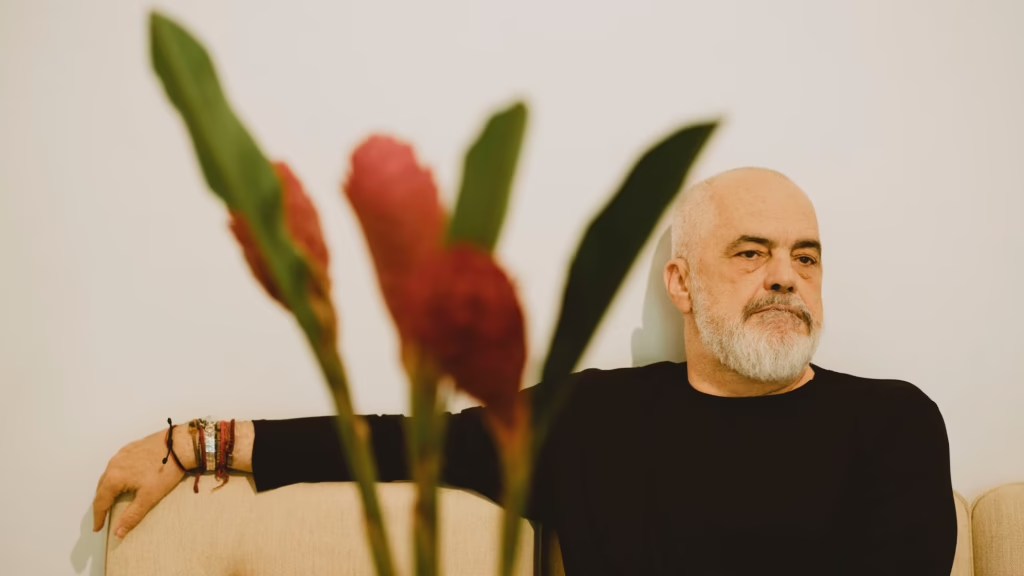
The show’s title evokes the transformation of Rama’s current artistic practice: a passage from painting — the discipline for which, until now, he was best known to the public and the critics — to these sculptures of zoomorphic forms that belong to no known biological taxonomy. All of it while dodging the famous quip by the American conceptual artist Ad Reinhardt: “Sculpture is what you bump into when you back up to look at a painting.” For Rama: “It’s something that came about naturally.” He appears sprawled on a sofa, bare feet on the carpet in one of the rooms of Société, the firm that has brought him to Berlin for Gallery Weekend, the German capital’s great annual art melee. “Besides, all these works come from my earlier paintings, which have been transformed into sculptures. Using artificial intelligence I create a digital model, and from there I make a 3D print. And then I work on it by hand.”
Dressed in black (except for the white sneakers resting beside the armchair), Rama is somewhat intimidating — not only because of his height (1.98 meters) and bulk, but also because of his initial gravity. A gravity that begins to crumble when he recalls his university years at the Academy of Arts in Tirana under the dictatorship of Enver Hoxha, one of the most hermetic and criminal regimes of the communist sphere. “It was a school built on the discipline and method of the Soviet programs,” he recalls. “It emphasized realist drawing, painting, and composition. Professionally it was a very solid school, but there was no freedom. There was socialist realism, period.” Unlike in other communist states, in Albania twentieth-century art was banned. “In fact, in 1986, when I finished my studies, art history at the Academy stopped being visual with Gustave Courbet. The last image we were shown was his painting The Painter’s Studio, from 1855. After that, there were only lectures without images — nothing but accusations and reproaches against the degenerate artists and that degenerate society that turned shit into art.”
Alongside his studies, Rama carved out a modest career as a semi-professional basketball player. “My height was key,” he concedes. “Besides, I had asthma, and my parents thought it would be a good idea for me to take up a sport. And that’s how I ended up on the national team at 20.” Though the main reason he played basketball was his hunger to travel abroad. “One of the few ways to get out of the country was playing sports at the European level. And I wanted to get out to visit museums. That was my goal.”
The plan, however, didn’t work out. In 1984, his first international destination was Paderborn, near Düsseldorf. “We had a layover in Vienna because there were no direct flights. In the afternoon I slipped out of the hotel to visit the Kunsthistorisches Museum,” he recalls. “I didn’t know how to find my way — I didn’t even have a map. I didn’t want to take the bus either, for fear of getting lost. It was November and it was snowing, so I walked without stopping, asking people on the street how to get to the museum. Night was already falling when I arrived. I walked up to that great door and found a sign that read: ‘Closed Tuesdays.’ I had to wait five more years.” After that thwarted visit, he made up for it in 1989 at the Kunsthalle in Bremen, again on a trip for a sporting competition. “It was staggering, like meeting the ghosts I had always dreamed of. At the entrance there was a staircase that I climbed trembling, and when I reached the top I came face to face with a Rodin sculpture and a Picasso painting. It was like being a virgin walking into a brothel. It was a very erotic feeling, very intense.”
After the fall of the Iron Curtain he moved to Paris in 1994, on a fellowship at the Cité Internationale des Arts. “My goal was to travel the world. So for a while, all I did was sell paintings, buy plane tickets, and stay with people I knew.” And in 1998, Albania’s new administration came knocking, offering him the Ministry of Culture. “Politics makes a great deal of sense, and it’s a shame it has lost it,” he protests. “It is the highest form of commitment and of intellectual process: you have to make things happen — not with ink, not with a piano, but with people. And that is very hard. It’s a struggle to bring about change.”
Three years later he took over as mayor of Tirana, a city he governed for a decade. In that period he transformed some of the communist-era buildings, giving them colorful geometric façades. “The capital was devastated and we had no money. Tirana had only 78 working streetlights. Some flickered and the rest were useless. The situation was horrific. There were illegal constructions everywhere. And our entire investment budget came to just 6.3 million dollars.” Then he was told about a project to restore the sidewalks and façades. “‘What colors are you going to paint the houses?’ I asked. ‘The original ones,’ they answered. But the buildings weren’t the originals anymore!” The blocks had been disfigured by residents’ interventions: enlarged windows, extra floors sprouting out of nowhere, balconies enclosed any which way. “Until then I had only worked in black and white. And that was the moment colors arrived on my work table, to paint the exteriors and bring them to life,” he says.
That intervention, he says, reversed the trend of the nineties in his city of thinking only about private space and never about common space. “For the previous five decades, citizens had had no private property; they were told everything was theirs, but in reality they didn’t own shit. That’s why they felt the need to assert their individual rights.” Public space had become a place to invade or to dump garbage. But that dynamic changed with those unprecedented colored façades. At a time when Tirana as a whole was barely collecting 4% of its municipal fees, on the streets that had been repainted, collection reached 100%. “People started paying their taxes because they realized City Hall was doing something for them,” he explains. “And security improved too. I learned that beauty and cleanliness are more intimidating than the police. If you want people to be less aggressive toward public property, make sure they feel intimidated by its aesthetics.”
In 2013, Rama became Prime Minister of Albania — the summit of his political career — without ever abandoning his life as an artist. His appearances at the Venice Biennale in 2003 and 2017 attest to it. This year’s edition was born amid controversy when the jury decided to exclude Russia and Israel from competition for the official prizes. When the organizers refused to bar the two countries’ pavilions, the jury resigned en masse. “Politics should not be mixed with art,” he rules. “And the decision to accept a country into the Biennale or not is not the jury’s to make. That decision belongs to the organizers. And if they want those nations present at the Biennale, they should be there. The jury’s job is to judge the art, not world politics. Nor to determine who is good and who is evil on this planet.”
Asked whether he believes art shouldn’t engage with these issues at all, the prime minister answers flatly: “The purpose of art is not to change the world. It should change people’s perspective and create a space where they can process their ideas and move forward. Its mission is not to stop wars or hand down condemnations, and it should not offer the solutions that belong to politics. Mixing the two realms is terrible.” But how does he feel about the present moment? “I feel blessed not to be among those who occupy the places where the big decisions are made today. Albania is so small that no one expects me to make any great resolution for the planet. And that’s lucky, because I have no idea what I would do or could do. Things are going rather badly on this side of the world, yes.”
And yet, in Rama’s case, his art is political, at least tangentially, since he creates part of his paintings during official conferences and meetings at the Kryeministria, the seat of the Albanian government. Stream of consciousness? Subconscious creations? “I don’t know. All that terminology isn’t for me,” he replies. “I do it because it makes me feel good. It’s similar to what happens when I have to get infusions to relieve my migraines. It’s a way of detoxifying myself, of diluting the poison of politics.” Though he is wary of the image of politicians as wicked and artists as beings of light. “It’s not true. Artists can be evil, and politicians, angels.” A duality — art/politics — that he doesn’t find problematic. “The only thing I don’t do is sell my works to Albanians or to anyone who has business dealings in Albania,” he explains. “The point is to vet everyone who wants to buy one of my pieces. If any of the galleries I work with receives a purchase request, they refer it to me and the person’s background is checked to make sure there is no connection to my work in government.”
Meanwhile, his paintings — a kind of ultra-colorful doodling — keep accumulating on the walls of his office in the Albanian capital, an obligatory stop for world leaders on official visits. “If I regret anything, it’s not having filmed them,” he jokes. “I started doing it too late. You get every kind of reaction, and it’s great fun. It would have made an incredible movie. I think I have John Kerry and Mark Rutte on tape.” And Pedro Sánchez too. “He has excellent taste. And he organized the most memorable NATO summit in history, at the Prado Museum! That’s something I will never forget,” he notes.
In his office, standing before those creations, some leaders act as if nothing were unusual, others look astonished, and the rest are left wondering what to say. “One of them — I won’t say the name — wasn’t very comfortable,” he admits. “Suddenly he asked me: ‘Where is your office?’ I answered: ‘This is my office.’ ‘And what is this?’ he insisted. I explained that they were my drawings. ‘You paint on the wall?’ he shot back. I clarified that I do it at my desk and then produce the wallpaper that gets pasted onto the walls. He exclaimed: ‘You are a strange man, Edi Rama. I thought this was the place where they look after the employees’ children when they can’t take them to daycare.’ All I could say was: ‘No, the only child here is me.'”
Translated from the Spanish. Original published by EL PAÍS Semanal on August 19, 2026