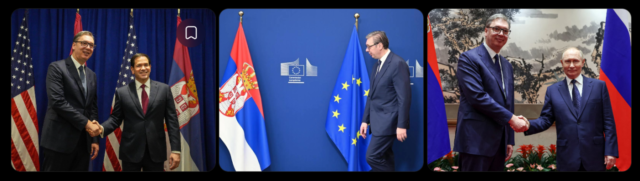
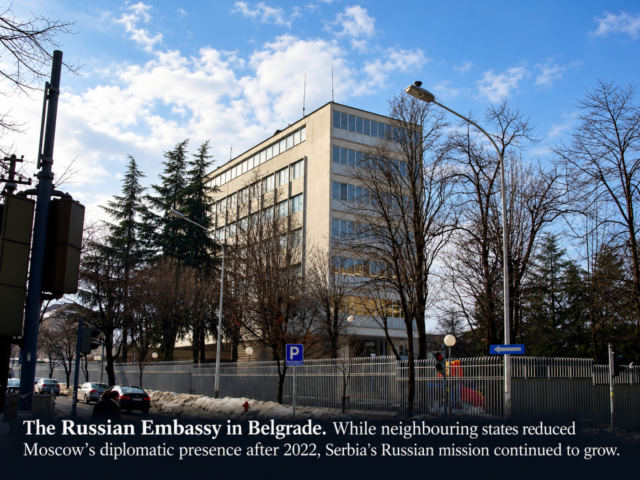
The same week Washington reaffirmed Dayton and signed into law sanctions on actors who threaten Bosnia’s territorial integrity, the host of the Banja Luka summit publicly aligned Flynn’s project with Putin’s strategic posture. The architecture, in the host’s own words.
Drizan Shala
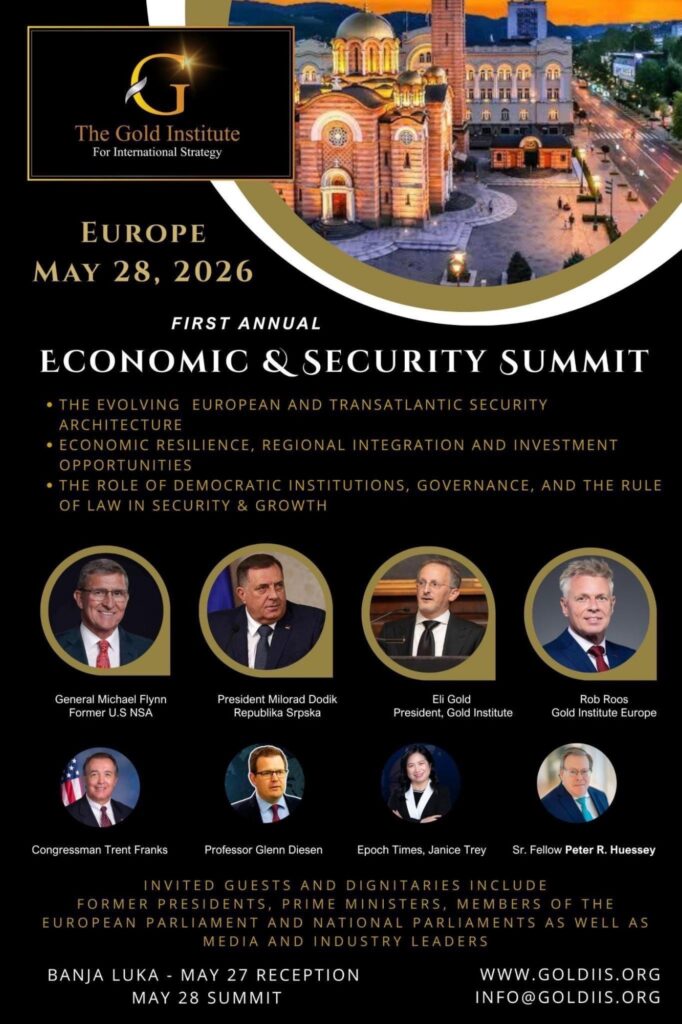
The First European Economic and Security Summit, convened by the Gold Institute for International Strategy in Banja Luka on 27 and 28 May 2026, has been described in its promotional materials as a forum for transatlantic security dialogue, economic resilience, and democratic stability. The convening body is chaired by retired Lieutenant General Michael T. Flynn, briefly President Trump’s first National Security Advisor in 2017. The summit’s principal political beneficiary on the ground is Milorad Dodik, removed from the presidency of Republika Srpska by the Court of Bosnia and Herzegovina on 26 February 2025 and sentenced to one year in prison with a six-year ban from political office for defying the binding rulings of the High Representative. The summit proceeds as if neither the removal nor the conviction had legal consequence for the convening’s character.
The analytically significant question is not whether the summit constitutes a foreign policy event or a private commercial activity. The host has resolved that question himself.
On 26 May, the day before the summit’s opening reception, Dodik posted from Moscow that it was his honour to participate in the International Security Forum in the Russian capital, where he would meet with officials of the Russian Federation and friends of Republika Srpska. In the same post, in his own voice and over his own name, he described the ties between Republika Srpska and the Russian Federation as unbreakable, founded on mutual respect, cooperation, and understanding that has, in his formulation, been symbolised for years by President Vladimir Putin. He stated that Republika Srpska supports the resolve of Russia and President Putin in their just struggle to preserve their national interests, the current Russian-aligned formulation for the war in Ukraine. He described Putin as having been, over the years, one of the most important bulwarks against attempts to undermine Republika Srpska. He announced that he and his Russian interlocutors would specifically discuss the question of the High Representative and foreign interference in the internal affairs of other states, where, in his framing, Republika Srpska and the Russian Federation share positions. He then noted, in the same post, that General Michael Flynn, friend of President Donald Trump, would this week be in Banja Luka to establish his Gold Institute, and that they would discuss economic cooperation, opportunities for new American investments, and connections between Republika Srpska and business and development initiatives from the United States. He closed by describing Republika Srpska as a pioneer of freedom, stability, and cooperation among peoples, willing to speak with both East and West.
The post resolves the interpretive question the summit’s promotional language is designed to leave open. The host has placed the Moscow security forum and the Banja Luka summit on the same strategic plane, in the same week, in the same statement, in his own voice. He has named Putin and Flynn as complementary nodes of a single posture. He has identified the High Representative, the institutional mechanism through which the Dayton Peace Agreement is enforced on the territory of Bosnia and Herzegovina, as the joint object of coordination between Republika Srpska and the Russian Federation. The Gold Institute convening, in the host’s own framing, is not a private think tank event. It is the Western face of a coordinated posture whose Eastern face is the International Security Forum in Moscow.
The strongest contrary reading should be acknowledged. The Trump administration is conducting a legitimate doctrinal shift toward stability over transformation in the Western Balkans, well within the historical pattern of American foreign policy when direct interests are limited. Sanctions are policy instruments administrations have the right to adjust. Flynn is a private citizen whose contractual relationships do not bind the United States government. The host’s Moscow post is a Dodik performance whose strategic significance is overstated when read against the actual constraints under which Republika Srpska operates. None of these propositions is unreasonable on its face. None survives the integrated record. An administration may legitimately shift doctrine. It cannot legitimately, in the same calendar year, lift Treasury sanctions on the figure most directly named by previous determinations as the principal threat to a peace settlement the United States itself brokered, sign into law a statute mandating sanctions on exactly that conduct, register its most senior retired military officer in the relevant theatre as that figure’s paid foreign agent at $100,000 per month, and issue a State Department doctrine paper claiming credit for crisis resolution in the country whose constitutional crisis it produced. The contrary case is available. It does not accommodate the architecture.
The contract
Flynn is not a guest at the Banja Luka convening. He is its architect. According to his Foreign Agents Registration Act filing received by the United States Department of Justice on 12 October 2025, he is contracted through Chicago-based RRB Strategies LLC at $100,000 per month to provide, in the language of the filing, strategic advice and counsel, analysis and information research, and introductions on behalf of the government of Republika Srpska. The contract is the most senior FARA registration in the broader Republika Srpska lobbying ledger documented by the Organized Crime and Corruption Reporting Project, which found that the entity paid at least $8.9 million to eleven Washington firms across 2025 and 2026 to rehabilitate Dodik’s image, lift sanctions imposed by previous administrations, weaken the authority of the High Representative, and build support for eventual independence from Bosnia and Herzegovina.
The same month Flynn registered, the Trump administration lifted United States sanctions on Dodik. Those sanctions had been imposed under Executive Order 14033 and its predecessors for corruption and for actions undermining the Dayton Peace Agreement. Weeks after Treasury acted, in December 2025, the same President signed into law the Western Balkans Democracy and Prosperity Act, attached to the Fiscal Year 2026 National Defense Authorization Act, which mandates sanctions on actors who have undertaken actions or policies that threaten the peace, security, stability, or territorial integrity of any area or state in the Western Balkans. The executive removed the sanctions in October. The statute requiring their imposition was signed two months later. The contradiction is not between branches. It is between the law and the operational conduct of the executive that signed it.
The ecosystem is not Flynn’s alone. Rod Blagojevich, the former Illinois governor pardoned by President Trump after a federal corruption conviction, is also registered under FARA on behalf of Republika Srpska. Jonathan Moore, a former United States diplomat who once defended the Dayton framework professionally, is contracted at $30,000 per month. The Montreal-based firm Dickens and Madson, whose contract objectives include the removal of the High Representative, is on file. Ric Grenell has received the Order of the Serbian Flag, the same decoration awarded to Russian Foreign Minister Sergei Lavrov. Rudolph Giuliani has visited Banja Luka and been photographed with merchandise reading Make Srpska Great Again. The Banja Luka summit is the moment this ecosystem makes itself visible as an ecosystem.
The framework
What Flynn brings to the Gold Institute convening is a worldview, documented across a decade, consistent in its core proposition, and now being broadcast on the territory of an entity whose recent history makes that worldview particularly consequential.
In 2016 Flynn published, with the late neoconservative scholar Michael Ledeen, The Field of Fight: How We Can Win the Global War Against Radical Islam and Its Allies. Ledeen was the translator between the older neoconservative Iran-focused interventionism and the harder counter-jihad register that emerged from the Iraq war. The book describes Islam as a political ideology that hides behind being a religion. It compares the faith of approximately two billion people to a vicious cancer that must be excised. The argument has been articulated consistently. In a Dallas speech in 2016, Flynn likened Islam to a malignant cancer that has metastasised. In July 2016, while serving as an advisor to the Trump presidential campaign, he posted on social media that fear of Muslims is rational. In February 2026, in a lecture broadcast live by Radio Television of Republika Srpska, he stated that Islam is not a religion but a political ideology. Balkan Insight reported the statement. Bosnian-language coverage acknowledged it at the time.
The framework’s content is its political function. The proposition that Islam is not a religion but a political ideology is not an analytical claim about comparative religion. It is the legitimating premise of a category of policy. If Islam is a political ideology, then the security of states with Muslim citizens becomes a question not of co-citizenship and equal rights but of ideological containment. The constitutional architecture of Bosnia and Herzegovina, built at Dayton precisely to enable Muslim, Serb, and Croat citizens to share a single state, becomes structurally incoherent in the terms Flynn’s framework supplies. The framework does not need to advocate the dissolution of Bosnia. It needs only to undermine the conceptual basis on which Bosnia’s constitutional order rests.
The city
The framework’s delivery in Banja Luka is not analytically separable from the city’s documented record. Banja Luka was, before April 1992, a multi-ethnic city of the Socialist Republic of Bosnia and Herzegovina. Its single most architecturally significant building was the Ferhat Pasha Mosque, completed in 1579 by a pupil of the Ottoman master architect Mimar Sinan. The mosque was destroyed with explosives on 7 May 1993. The International Criminal Tribunal for the former Yugoslavia, in the case of Radoslav Brđanin, established as a matter of judicial finding that the destruction of mosques in the Banja Luka region was orchestrated as a component of a systematic ethnic cleansing campaign. Brđanin was sentenced to thirty-two years. The mosque’s reconstruction foundation stone was symbolically re-laid on 7 May 2001, the eighth anniversary of its destruction. The ceremony was attacked by a Serb mob that injured worshippers, set vehicles ablaze, and, in an act recorded by international media at the time, drove a pig onto the site of the mosque. The reconstruction was completed only in 2016.
The wider record is settled. The Research and Documentation Centre in Sarajevo, in its census-based Bosnian Book of the Dead, documents 97,207 war deaths, of which approximately 66 percent were Bosniaks, 26 percent Serbs, and 8 percent Croats. The ICTY’s peer-reviewed demographic study by Tabeau and Bijak places the total at 104,732, with Bosniaks constituting the substantial majority of victims for every measured cohort and roughly 82 percent of civilian dead. The Srebrenica genocide of July 1995 established the legal fact of the systematic murder of more than seven thousand Bosniak men and boys, adjudicated by both the ICTY and the International Court of Justice. The Višegrad massacres, characterised by the ICTY as among the most comprehensive and ruthless campaigns of ethnic cleansing in the entire Bosnian conflict, produced approximately three thousand Bosniak deaths in a single municipality, including six hundred women and a hundred and nineteen children. The Bosnian Muslims were the largest single victim community of the war by every documented measure.
The political-military project that produced those deaths required, as its enabling intellectual condition, a framework in which Muslims were not co-citizens of Bosnia but a civilisational enemy. That framework was the operating doctrine of the wartime Bosnian Serb leadership, articulated in the speeches and writings of the political class subsequently convicted at The Hague. To deliver, in 2026, on the public broadcaster of the entity whose forces destroyed the Ferhat Pasha Mosque and whose wartime leadership was adjudicated for genocide and ethnic cleansing, the proposition that Islam is not a religion but a political ideology, is not a controversial opinion. It is a citation. The framework being broadcast is structurally continuous with the framework that legitimated the events for which the ICTY convicted Brđanin, Krstić, Karadžić, and Mladić.
The Bosniak political class in Sarajevo retains majority control of the state-level institutions of Bosnia and Herzegovina, including the Presidency, the state-level ministries of the Council of Ministers, and the state prosecutorial and judicial bodies that produced Dodik’s 2025 conviction. The state has not lost its capacity. What is being tested in Banja Luka is whether the international guarantees on which that state’s continued operation has depended since 1995 still hold.
The state
The Banja Luka convening occurs in the same week the United States Department of State submitted to Congress its Report to Congress on United States Policy to Promote Regional Stability and Prosperity in the Western Balkans. The report’s analytical character is captured most precisely in the relationship between three of its sentences.
The first is the doctrine: “The U.S.-led nation-building era has passed. U.S. policy in the Western Balkans is not about rescue or reconstruction, but stability and mutually beneficial partnerships.” The second is the affirmation: “In BiH, the United States remains committed to the Dayton Peace Agreement and the country’s sovereignty and territorial integrity.” The third is the historical claim: “In 2025, decisive U.S. diplomacy helped end BiH’s most acute crisis since the 1992-1995 conflict, while preserving the country’s legal cohesion and constitutional order.”
The third sentence is the analytically significant one. It frames the events of 2025, the year in which the Trump administration lifted sanctions on Dodik, in which Flynn registered under FARA as Dodik’s paid agent, in which Christian Schmidt resigned as High Representative under sustained lobbying pressure, in which the Republika Srpska National Assembly passed legislation hinting at de facto secession, as a crisis successfully resolved by decisive American diplomacy. The crisis was the one Dodik created. The instrument by which the administration claims to have resolved it was the engagement structure of which the Banja Luka summit is the consolidation. The report does not name Dodik. It does not address the lifting of sanctions. It does not engage with the FARA-registered lobbying ecosystem. It claims credit for crisis resolution in language that retroactively legitimates the manoeuvre that produced the convening.
The doctrine’s structural inversion appears in a single conditional sentence: “The Administration seeks to consolidate this stability and will continue to encourage actors in BiH to avoid destabilizing and divisive actions, which would undermine opportunities to advance our shared economic agenda.” The grammar is precise. Destabilising actions are framed as obstacles to the economic agenda. Dayton’s territorial integrity is no longer the principal value the United States defends in Bosnia. It has become a condition of the commercial environment the administration is constructing. The Southern Interconnection gas pipeline between Croatia and Bosnia, named in the report as a priority project, is structurally dependent on cooperation from the entity whose leader the same administration has just rehabilitated. The energy deal is the commercial logic. The rehabilitation is its operational requirement.
The internal contradiction of the document is sharpest where it identifies threats. The report names Russia as fuelling ethnic grievances, financing destabilising actors, and leveraging hydrocarbon supplies to pressure politicians and weaken public confidence in Western institutions. The same week the report names Russia as the principal external threat, the host of the convening it implicitly endorses through silence has declared from Moscow that Russia is Republika Srpska’s bulwark against attempts to undermine the entity, and that Putin’s principled and firm position has, for years, been one of the most important defences of the political project the United States once sanctioned and now does not. The Russian state the report identifies as the destabiliser is the state the convening’s host has just identified as his strategic partner against precisely the international institutions through which Bosnia’s constitutional order has been maintained.
The allies
The proposition that Flynn’s activity is a private commercial matter, without consequence for American foreign policy because the United States government has not formally endorsed it, does not survive contact with the security architecture through which the United States operates in the regions where Bosnia is read.
Turkey, Qatar, and Saudi Arabia are not interchangeable. Their stakes in Bosnia differ. Their political registers differ. On the single question of whether the American government, formally or by acquiescence, is prepared to platform the proposition that Islam is a political ideology rather than a religion, they read the same answer.
The evidence is concrete. Turkey is a NATO ally and the alliance’s second-largest military by personnel. The Turkish Cooperation and Coordination Agency has invested close to four hundred million dollars in Bosnia and Herzegovina across twenty-five years, concentrated in cultural and religious heritage restoration including the reconstruction of mosques and bridges destroyed by Bosnian Serb forces during the war. TIKA restored the Mehmed Paša Sokolović Bridge in Višegrad, the same Višegrad of the ICTY-adjudicated massacres. Erdoğan has committed approximately three billion euros to the Sarajevo-Belgrade highway. Qatar hosts Al Udeid Air Base, the forward headquarters of United States Central Command and the operational hub through which the United States projects military power across the entire Middle East theatre. Saudi Arabia served as the keynote country at the 14th Sarajevo Business Forum in May 2025 and is simultaneously the central interlocutor in the post-Abraham Accords architecture and the anchor of American Gulf policy.
The United States Department of State, under administrations of both parties for more than two decades, has expended substantial diplomatic resources contesting precisely the perception that the United States is at war with the religion of Muslims. The cost of losing that perception is measured in counterterrorism cooperation, intelligence sharing, basing rights, energy market stability, and the credibility of every American assurance to Muslim-majority allies. Flynn’s framework, delivered in Banja Luka under the institutional banner of the Gold Institute for International Strategy, does not contest that perception. It supplies the evidence on which the perception is built.
The Pristina implication
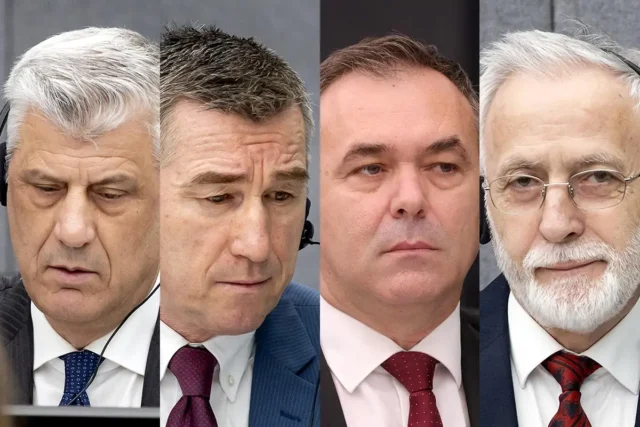
The architecture being tested in Banja Luka has implications for Pristina the analytical record should note. The FARA-registered American lobbying network, the executive-branch sanctions lifting against the prior international consensus, the State Department doctrine that subordinates territorial commitments to commercial agendas, and the civilisational framework that delegitimates the constitutional architecture of a multi-ethnic state, are instruments. They were assembled for the Republika Srpska account. They can be redeployed.
Kosovo’s status is contested by the same Russian-aligned actors who have invested in Dodik’s rehabilitation. Belgrade’s diplomatic capital, its lobbying networks in Washington, and its relationship with the same Moscow security forum Dodik attended on 26 May are the structural raw material for an analogous architecture directed at Pristina. The doctrine that the United States no longer underwrites the constitutional outcomes of the 1990s wars, articulated in the 2026 State Department report and operationalised in the Banja Luka convening, does not protect Pristina any better than it protects Sarajevo. The Banja Luka template is the proof of concept. The Pristina application is the structural question the Kosovo file should now be asking.
The finding
The Banja Luka convening of 27 and 28 May 2026 cannot be read as an isolated event. It is the visible Western component of an architecture whose Eastern component is the Russian International Security Forum in Moscow, attended on the same dates by the convening’s host, who has stated in his own voice that the two events are part of a single coordinated posture and that the principal object of coordination is the High Representative, the institution through which the Dayton Peace Agreement is enforced.
For Albania, the calculation is operational. The State Department report names Albania alongside Montenegro and North Macedonia as having strengthened the alliance through NATO integration. Tirana is consolidating a southern-flank defence-industrial architecture in partnership with Italy and the United States. Albania’s Muslim-majority composition places it inside the same readership in Ankara, Doha, and Riyadh that reads the Banja Luka framework. The credibility of American assurance is the structural condition of the alliance integration Tirana is consolidating. The Banja Luka framework is not directed at Albania. The cost of its delivery is paid in part on Albania’s account, in the diplomatic capital Tirana must now expend to clarify that the framework does not represent the United States it has chosen to integrate with.
The Bosniak community in Bosnia, the Albanian-majority population of Kosovo, the Muslim Albanian and Bosniak diasporas, and the state institutions in Sarajevo, Pristina, and Tirana are not bystanders to this convening. They are the populations whose political standing the framework is designed to delegitimate.
The convening will produce its photographs. The communiqué will speak of partnership, resilience, energy corridors, transatlantic security architecture. The promotional language will perform its function. The host’s Moscow post, published the day before the opening, has performed a different function. It has supplied, in the host’s own voice, the documentation against which the promotional language can be read.
The American general who chairs the convening body is, in the structural terms the host has supplied, on the same strategic plane as the President of the Russian Federation. Whether the American state, in its capacity as the original guarantor of the Dayton Peace Agreement and as the strategic partner of the Muslim-majority states whose investments in Bosnia run into the billions, accepts that placement, or whether it acts on the contradictions the statute and the doctrine have already produced, is the question the Banja Luka convening forces.
The record will note who was in the room. The record will also note what the host of the room said, from Moscow, the day before the doors opened.
Drizan Shala writes on security, institutions, and political violence for Kosovo Dispatch and Tirana Examiner. He is a doctoral candidate at the University of Sarajevo.