By Klea Ukaj | Tirana Examiner, Washington Desk
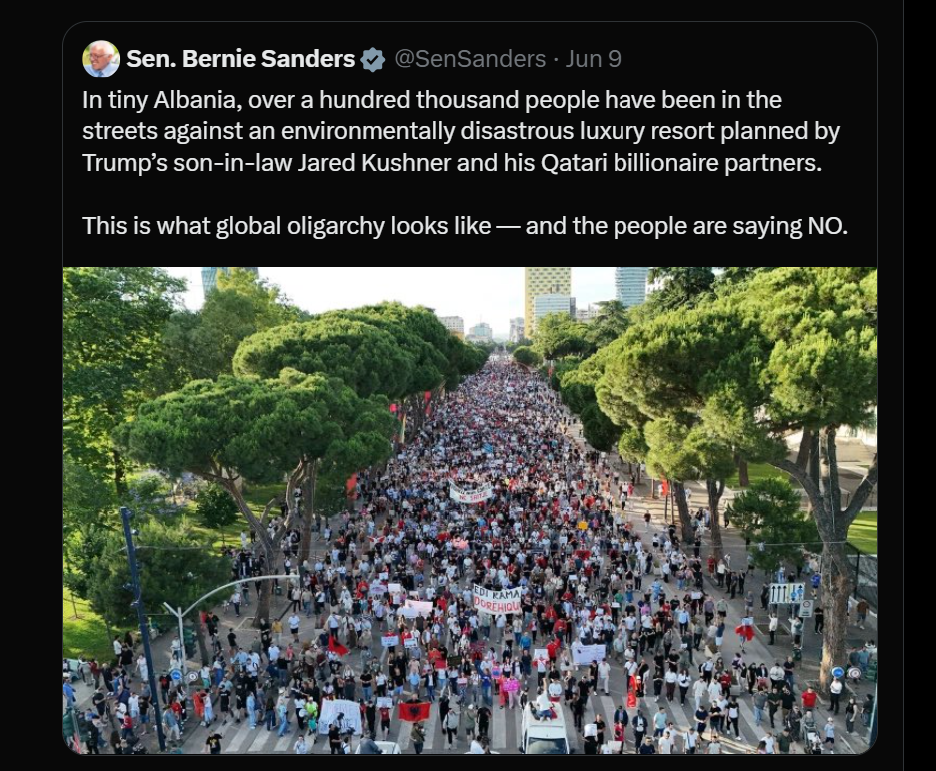
On Monday, Senator Bernie Sanders informed his nine million followers that “over a hundred thousand people” were in the streets of “tiny Albania” protesting an “environmentally disastrous luxury resort” built by Jared Kushner and his Qatari partners. This, he declared, “is what global oligarchy looks like.”
Almost every load-bearing element of that sentence is wrong, and the ways in which it is wrong tell us something about Washington that matters far beyond Albania.
Start with the arithmetic. The largest protests in Tirana have drawn crowds in the thousands, with police and independent estimates converging below ten thousand at their peak. Sanders multiplied the number by an order of magnitude. The resort he described as an environmental disaster does not exist. There is no construction permit, no approved final design, and no completed environmental assessment; what exists is a planning process, a strategic investment framework, fences that should not have gone up when they did, and a fierce domestic argument about all of it. One can hold strong views about that argument. One cannot describe its outcome as a disaster that has already occurred, unless one has decided that the verdict precedes the evidence.
Prime Minister Edi Rama’s reply made this point with more wit than American senators are accustomed to receiving from small allied states, noting that the inflation of ten thousand protesters into a hundred thousand was “perhaps the least harmful amplification of outrage among many,” and that a man who has spent years warning the public about the distortive power of social media platforms had just provided a working demonstration. The jab lands because it is accurate. Sanders has built the final act of his career on the proposition that viral falsehood corrodes democracy. On Monday he sourced a foreign policy pronouncement from a viral falsehood and broadcast it to an audience the size of a European country.
A correction of the record would be reason enough for this column. But the deeper problem with the Senator’s intervention is not the bad number. It is the question his tweet answered without ever asking: who owns the argument about Zvërnec? Albanians do. Their prosecutors, their parliament, their courts, their streets. Washington, in both its tribes, keeps behaving as though hard arguments inside small allied nations are raw material for arguments inside the United States, and that reflex is its most expensive habit in contested regions.
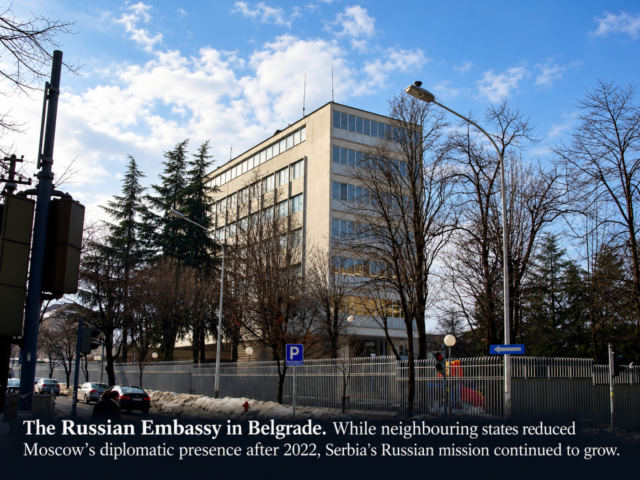
Consider what Albania looks like from the standpoint of American strategic interest rather than American domestic theater. It is a NATO ally that has met its commitments, hosted American forces, and aligned with Washington on virtually every consequential vote and crisis for three decades. Polling routinely identifies Albanians as among the most pro-American publics on earth. For thirty years, Tirana has asked for one thing above all: serious American economic presence to match the security relationship. For thirty years it has mostly received seminars on governance while Chinese state-linked capital bought up Balkan infrastructure, Russian energy leverage entrenched itself next door in Serbia, and Gulf sovereign wealth moved into the vacuum that American private investment declined to fill.
Now a major American-backed investment has finally arrived on the Albanian coast at a scale Albania has sought for decades, and the response of a senior United States senator is to demand, in effect, that it leave, on the strength of a crowd estimate he did not check. Whatever one thinks of this particular project, the signal received in the region is unambiguous: American investment comes attached to American political warfare, and will be held hostage to whichever faction in Washington finds it useful to attack. Beijing and Moscow attach conditions of their own, harder and colder ones. What they do not do is subject every outbound investment to the domestic partisan warfare of the capital that sent it. Neither do the Gulf funds that will develop this coastline with or without American participation. A superpower that treats its own outbound investment as presumptively corrupt is practicing unilateral disarmament in an economic competition it claims, in every National Security Strategy of the past decade, to be waging.
The irony is that the strongest rebuttal to the Senator’s “oligarchy” charge is supplied by the very institutions his framing erases. Oligarchy means captured institutions, prosecutors who do not prosecute, courts that wave the powerful through. What has actually happened in Albania is the opposite. SPAK, the special anticorruption prosecution built over a decade of judicial reform under American and European supervision, opened an investigation into the property titles at Zvërnec and temporarily froze the bank accounts of the landholding company involved, a company owned not by anonymous cronies but by the Qatari investors at the center of the deal. It did so against a project the Prime Minister has personally and loudly championed. Rama, for his part, publicly accepted the freeze on suspect transfers even while objecting to its breadth.
Pause on that. An independent prosecution body moving against the head of government’s signature foreign investment, while that government submits to the process and protesters fill the boulevard outside the Prime Minister’s office, unarrested and uncowed, is not what oligarchy looks like. It is what a rule-of-law state under European Union accession discipline looks like when it processes a genuinely hard controversy. The protests are real, domestically rooted, and in many respects justified; the fencing of public beaches was a self-inflicted wound, and the title questions now before SPAK are serious. None of that is in dispute here. What is in dispute is the question this column opened with, the one the Senator never paused over: who owns that argument. It belongs to Albanians and to the institutions they spent twenty painful years building, several of them at Washington’s insistence.
Which points to the genuinely destructive consequence of the Senator’s tweet, the one his admirers should weigh most heavily. Albania’s environmental movement had spent weeks building a domestic case on domestic grounds: habitat, access, transparency, law. The moment Zvërnec became an episode in the American argument about Trump, that case was repackaged, for half of Albania’s political spectrum and much of its government, as imported outrage. Rama’s letter performed the conversion within hours, and skillfully, because Sanders had handed him the material. A senator who wanted to strengthen Albanian environmental scrutiny accomplished the reverse: he gave its opponents the foreign hand they needed. One careless tweet did more to undermine the credibility of the Vjosa-Narta campaigners than any bulldozer has yet managed.
There is a conservative principle underneath all of this, and it is the one Washington in both its tribes keeps forgetting: small free nations are not props. They are not backdrops for the morality plays of larger powers, not exhibits in someone’s argument about oligarchy or, for that matter, in someone’s argument about American greatness. Albania has laws, prosecutors, a parliament, an opposition, a press, and a public that turns out in the streets when it is angry, which is to say it has the full apparatus of self-government, and the right to use it without supervision from Vermont. The Zvërnec project will be approved, modified, or killed by Albanian institutions applying Albanian and European law. That is the only legitimate way it can be decided, and it is, not incidentally, the way most likely to produce an outcome Albanians will accept.
The Senator closed no factories and froze no accounts on Monday. He merely demonstrated, once again, how cheaply Washington spends the trust of the people who like it most. Rama ended his reply by inviting Sanders to visit, citing the old Albanian code under which the house belongs to God and the guest. He should go. He would find a country considerably more serious than his tweet, institutions considerably more functional than his caricature, and a public quite capable of holding its own government to account.
Klea Ukaj writes on transatlantic affairs from Michigan.