by Besa Ruka (Tirana)
Albania’s opposition leader Sali Berisha on Monday accused Prime Minister Edi Rama of obstructing justice and undermining the country’s path toward European Union membership after the ruling Socialist majority refused to authorize the arrest of former Deputy Prime Minister Belinda Balluku, who is under investigation by Albania’s Special Anti-Corruption Structure (SPAK).
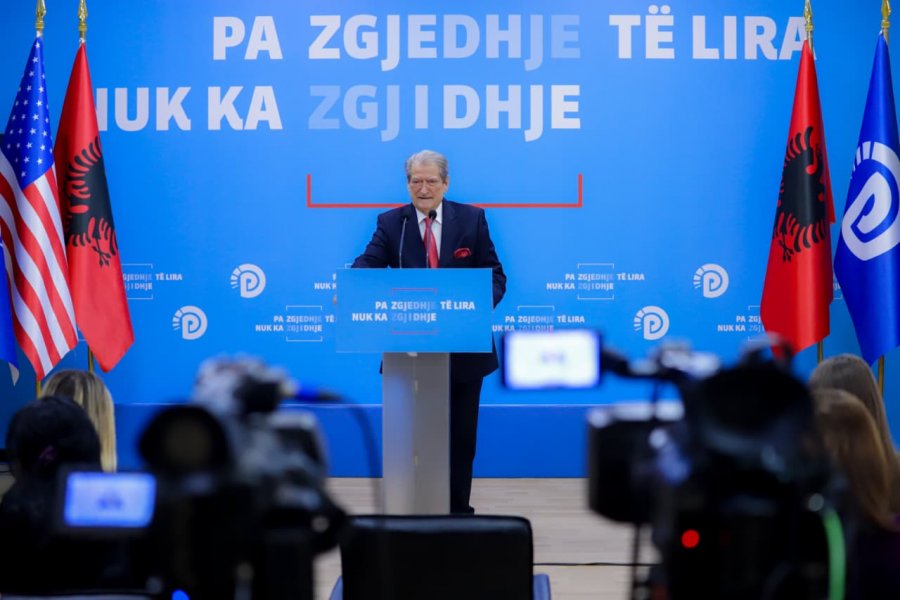
Speaking at a press conference at the Democratic Party headquarters in Tirana, Berisha said the decision by the Socialist parliamentary group to block SPAK’s request represented a direct assault on the rule of law and on Albania’s constitutional order.
“Today Edi Rama removed every mask and publicly came out in total defense of Belinda Balluku, putting the Constitution of the country, the laws of the country, the separation of powers and the process of European integration hostage,” Berisha said.
The controversy centers on a request by SPAK prosecutors to arrest Balluku, now a Socialist lawmaker, as part of an ongoing corruption investigation. Because she holds a parliamentary mandate, Albanian law requires parliament to authorize her arrest by lifting her immunity. The Socialist majority decided not to grant that authorization.
Opposition Claims International Concern
Berisha said the opposition had been in continuous communication with international partners regarding the case and the broader political situation in Albania.
“We have had continuous communication on this issue,” he said. “But fortunately there have also been intensive international visits to Tirana during the past two months, largely focused on this matter.”
He pointed to a fact-finding mission by the European People’s Party (EPP) composed of representatives from around 30 European political parties, which he said had delivered a critical assessment of the situation in Albania.
“The fact-finding mission of the European People’s Parties concluded that the situation they found in Albania was shocking,” Berisha said.
He also referenced visits by European officials in recent weeks, including representatives of the European Parliament, Germany’s foreign minister and minister for Europe, and the European Commissioner responsible for justice issues.
“Free countries stand firmly for the rule of law,” Berisha said. “We have nothing but thanks for the clear and firm positions they have taken.”
“This Is Not About Balluku”
Berisha insisted the issue went beyond the fate of one politician and instead concerned what he described as systemic corruption within the government.
“This is not the issue of Balluku,” he said. “No one should accept that narrative. This is directly the issue of Edi Rama.”
He alleged that Balluku had functioned merely as a facilitator for corrupt practices.
“Belinda Balluku has been nothing more than the notary, the registrar of Rama’s thefts,” Berisha said. “She may have benefited from them, but the main figure is Edi Rama.”
The opposition leader went on to accuse the prime minister of responsibility for a series of alleged corruption scandals, including the long-running controversy surrounding the Tirana waste-to-energy incinerator project, which has been the subject of multiple investigations.
“Edi Rama is the only prime minister in Europe whose signature stands on a public project worth €130 million — the Tirana incinerator — that does not exist,” Berisha said.
He also cited public-private partnership contracts in the health sector and infrastructure projects that he claimed were overpriced.
Protest Call
Berisha said the opposition now believes the dispute has moved beyond institutional channels and must be resolved through public pressure.
“Parliament is totally annexed. It has become an instrument of narcotic dictatorship,” he said. “Justice is being reduced to zero by Edi Rama.”
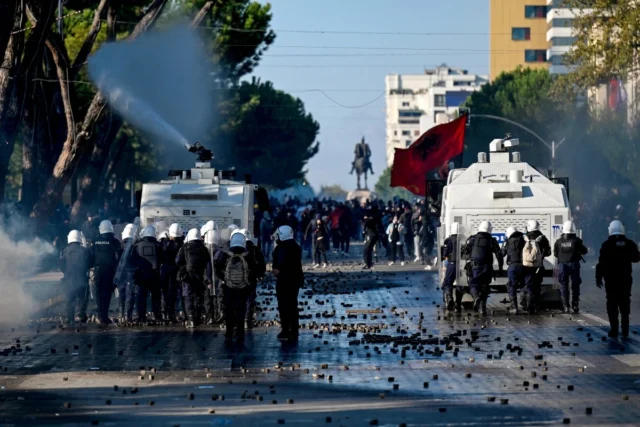
He called on citizens to participate in a large demonstration outside parliament later this week.
“On the 12th, all of Albania will gather in front of parliament in the most powerful peaceful uprising the country has known,” Berisha said.
Justice Versus Politics
When asked whether the judiciary should attempt to pursue legal avenues despite parliament’s refusal to lift Balluku’s immunity, Berisha suggested that institutional constraints limit what prosecutors can do.
“We must be honest,” he said. “If the executive power, with the votes it controls, refuses to accept the decisions of justice, then it is the sovereign — the citizens — who must speak, not the judiciary.”
He added that the justice system ultimately depends on other state institutions that remain under the control of the executive branch.
“Justice is a body of hundreds of people, but the other levers of power are in the hands of the executive,” he said.
EU Integration at Stake
Berisha argued that the parliamentary decision could damage Albania’s prospects for joining the European Union.
“It blocks the integration process. Absolutely, it blocks it,” he said.
He warned that EU member states committed to strict rule-of-law standards would view the decision as a serious setback.
“No country can bypass the group of European states that demand respect for the rule of law and the constitution,” Berisha said.
“Rama Will Not Survive This Year”
In a final remark, Berisha predicted that Rama’s government would not remain in power much longer.
“Rama will not survive this year,” he said. “He is damaging Albania’s EU integration to its core.”
He added that the outcome ultimately depends on public reaction.
“The solution is only in the hands of the citizens,” Berisha said. “Albanians will soon say their word.”
The government has not yet issued a detailed response to Berisha’s latest accusations. The Socialist Party has previously argued that parliamentary immunity must be handled carefully to avoid politicizing criminal investigations and that the decision regarding Balluku was taken according to constitutional procedures.
The dispute over Balluku’s immunity has quickly become one of the most contentious political confrontations in Albania this year, raising broader questions about the balance between parliamentary protections, prosecutorial authority, and the country’s commitments under its EU accession process.