In a lengthy online exchange with citizens on Saturday, the Democratic Party leader ranged across the EU accession file, the Balluku immunity vote, fuel prices, local government reform, and the approaching protest. The session functioned as both a political inventory and a mobilisation exercise, with Berisha framing every grievance as a symptom of a single cause.
Apollon Rexhaj | Tirana
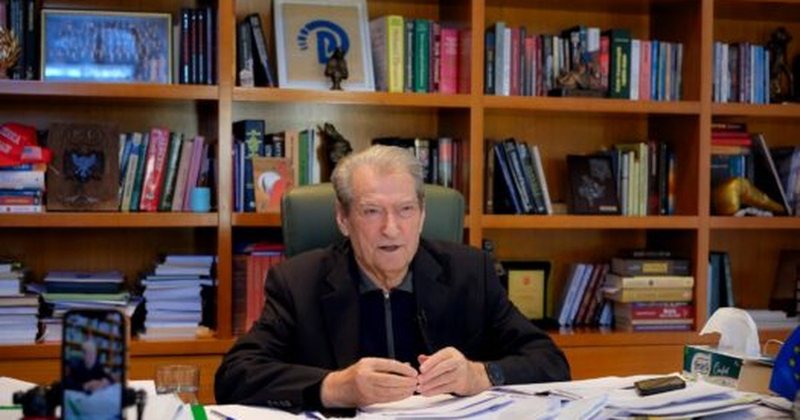
Sali Berisha spent Saturday morning in an extended online question-and-answer session with citizens, fielding queries on subjects from the IBAR report to Kukës regional investment to the Iranian threat warning issued by the US Embassy. The format was informal, the register was combative, and the through-line was consistent: Albania’s EU accession process is in genuine danger, the government is concealing this from the public, and the only available remedy is a mass turnout at the Democratic Party’s national protest scheduled for 17 April.
The IBAR claim
The most consequential assertion Berisha made was on the state of the accession process itself. He said that on 1 April, during a session of COELA, the EU Council’s working group on enlargement, the number of member states objecting to approval of the IBAR report rose from four to nine. The IBAR, or Interim Benchmark Assessment Report, is the mechanism that must be passed before Albania can begin closing negotiating chapters. Without unanimous approval from all 27 member states, the process stalls at its current position.
Berisha said this development was concealed by the government, which he accused of sending out spokespeople to mislead the public while suppressing what he described as a significant diplomatic setback. “Without the unanimous approval of this report, Albania will not close a single chapter,” he said, guaranteeing that if the government’s current posture on the Balluku case and the AKSHI procurement scandal continued, the number of blocking states would reach thirteen at the next review.
The Tirana Examiner was unable to independently confirm the specific figure of nine member states from official or primary sources. The claim is consistent, however, with a pattern of documented diplomatic friction. European diplomats speaking on condition of anonymity to regional media in recent weeks have indicated that multiple member states are unwilling to approve the IBAR in the current circumstances. Germany’s embassy in Tirana stated publicly after the 12 March immunity vote that effective prosecution of corruption in high-ranking cases is a necessary condition for progress. Analysts at European Western Balkans have reported that Germany and the Netherlands may link IBAR approval to further conditions, including the lifting of Balluku’s immunity. The government’s position, articulated by Foreign Minister Ferit Hoxha in a published interview this week, is that no blockage exists, that member state scrutiny is standard procedure, and that Albania remains a frontrunner in the enlargement process.
The gap between those two readings is the central contested fact in Albanian politics at this moment.
The Balluku immunity vote as diplomatic liability
Berisha returned repeatedly to the 12 March parliamentary vote in which the Socialist majority, with 82 votes, rejected SPAK’s request to arrest Deputy Prime Minister Belinda Balluku on corruption charges relating to the Llogora tunnel procurement. He framed the vote not merely as a domestic political failure but as the act that triggered the international deterioration he was describing.
He went further, arguing that the EU’s insistence on rule of law standards is not an external imposition but a direct expression of Albanian citizens’ own interest. “Imagine,” he said, “how we can proceed toward the EU when we do not lift the immunity of thieves. It has never happened before.” He contrasted the current situation with past practice, claiming that during previous governments the parliament had lifted immunity whenever the prosecutor requested it, regardless of whether active negotiations were open.
He also raised the case of Olta Xhaçka, whom he accused of benefiting from the transfer of ten thousand square metres of public land under falsified documents while remaining in parliament, citing two Constitutional Court decisions and a Venice Commission opinion against her continued mandate. The mayor of Himarë, he said, is currently imprisoned for facilitating that transfer. The Tirana Examiner records these as opposition claims; the details were not independently verified within the scope of this report.
Taulant Balla
In response to a citizen question, Berisha made his most serious individual allegation of the session, stating that Taulant Balla is, after Rama, the official with the most serious criminal file, and claiming that official documents prove Balla ordered a murder. He said those documents were subsequently destroyed by a prosecutor and a judge in Elbasan, with only the minutes of the destruction order surviving and having been published. He also alleged that Balla brokered an arrangement with the Suel Çela organised crime network under which rival gangs were arrested in exchange for hundreds of thousands of votes, and that Balla personally intervened to free two individuals who had placed explosives in the saddle of a bicycle belonging to Lulzim Kulla, intended to kill him. These are serious allegations recorded here as Berisha’s claims. They are unverified. Balla has not responded to them in the context of this report.
Fuel prices
Berisha opened the session with a denunciation of fuel prices, stating that petrol had reached 224 lekë per litre, which he described as among the highest in the world. He claimed the Albanian government levies a tax of 1.1 euros per litre, representing 60 percent of the retail price, and that no other country taxes fuel at this rate. He called for an immediate halving of fuel taxes, citing Australia as a model, and dismissed the government’s announced measures as designed not to relieve consumers but to create a new state-controlled enterprise from which Rama and his associates would extract profit, in the pattern he alleged for AKSHI and Air Albania. The Tirana Examiner notes that the 60 percent and 1.1 euro per litre figures are presented as Berisha’s claims and have not been independently verified against current official data within this report.
Territorial reform and the north
Responding to questions from citizens in Kukës and Mirdita, Berisha argued that the 2014 territorial reform carried out under Rama met what he described as the criteria of the Vaso Çubrilović platform for depopulating Albanian lands by removing services and infrastructure from rural areas. The reference is to a 1937 Serbian nationalist memorandum advocating the expulsion of Albanians specifically from Kosovo and Macedonia through deliberate denial of infrastructure and services. Berisha’s deployment of it as an analytical framework for Rama’s domestic reform is a characteristically sharp rhetorical move; taken literally it is also an extraordinary charge, and the report records it as his political position.
He said the Democratic Party’s platform commits to restoring all municipalities and communes with a meaningful population base, including restoring Mirdita as a single unit of local government. On Kukës specifically, he said Rama’s Mountains Package allocates investment to villages thirty to sixty metres above sea level near Maminas while ignoring the highland plateaus of Kukës, which he described as having exceptional tourist potential.
Kosovo
In response to a question about reports of Tirana-linked investment in Kosovo’s construction sector and potential money laundering, Berisha called on Kosovo’s authorities to take every measure to sever what he described as Tirana’s mafioso tentacles from its territory. He described Albania under Rama as a narco-state that is the principal exporter of cannabis in Europe and the principal transporter of cocaine from Latin America to Europe, and said Kosovo’s exposure to this network constituted a threat to its EU integration trajectory and a potential propaganda gift to Serbia. These are Berisha’s characterisations, recorded with attribution.
The Iranian threat warning
Asked about the US Embassy’s 1 April advisory warning of possible attacks by Iran-linked groups on American-affiliated targets and public spaces in Albania, Berisha said the warning was credible and based on real intelligence. He said he did not foresee an aerial attack, noting that NATO air defences had already intercepted two Iranian rockets fired toward Turkey, and that Albanian airspace falls under the same protective coverage. He did not exclude the possibility of sleeper cell activation, noting that Iranian officials had publicly claimed cells were distributed globally, and urged heightened vigilance in crowded public spaces.
April 17 and the protest strategy
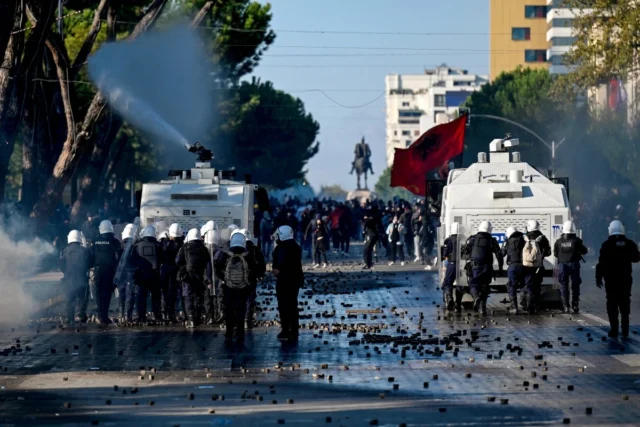
Berisha closed the session with a direct appeal for mass turnout at the 17 April protest, which he described as the most powerful peaceful uprising. He declined to detail the tactical plan, saying only that the opposition intended to catch the government by surprise. He addressed citizen frustration about the protests’ failure to produce concrete political results directly, arguing that the demonstrations had achieved two things: they had demonstrated to the world that Albanians reject corruption as a cultural norm, countering what he described as narratives promoted by Rama’s paid lobbyists that corruption is part of Albanian culture; and they had placed the government under international scrutiny it would otherwise have escaped.
He acknowledged that the protests had not achieved their maximum objective, which he defined as Rama’s removal, but said the path there required sustained peaceful mobilisation and patience. He rejected any suggestion that the Democratic Party would seek power through means other than the vote, describing this as a founding principle of the party. He said the candidates for the 2027 local elections would be announced significantly earlier than in previous cycles, and that the party would field its strongest possible candidate for Tirana, declining to comment on Erion Braçe’s self-declared candidacy beyond describing the Socialist Party as a party founded in crime.
What the session reveals
Berisha’s Saturday session served several functions simultaneously. It was in part an answer to a specific internal problem: a party figure told him at the outset that the structures show apathy and have taken things too lightly. His response was to frame the stakes as existentially high, connecting every domestic failure directly to the EU accession timeline in a way designed to make disengagement feel like complicity in national failure.
The session also revealed the opposition’s current strategic logic with unusual clarity. Where Rama on Saturday morning framed EU accession as proof that only the Socialists can deliver it, Berisha on the same morning framed it as proof that only the Socialists are blocking it. Both arguments point to the same mechanism: the IBAR and the chapter-closing process as the decisive test of Albanian governance in this period. The disagreement is not about whether EU membership matters but about who is endangering it.
Whether the IBAR dispute resolves in ways that validate Berisha’s warnings or Rama’s assurances will be one of the defining questions of the pre-election period. The answer will not come from Tirana.