The Newsroom
The eighth in the series of street protests called by Democratic Party leader Sali Berisha, held on Thursday evening on Boulevard Dëshmorët e Kombit in central Tirana, drew the smallest crowd of the cycle, produced no political speeches, and ended with three militants detained after a failed attempt to break a police cordon blocking the route from the boulevard toward the Ministry of Internal Affairs.
The protest opened forty minutes behind schedule. Berisha left Democratic Party headquarters flanked by a thin handful of militants and party functionaries and walked to the boulevard where police had authorized the gathering. Conspicuously absent for the first time in the cycle was what local reporters have come to call the “fire group,” the contingent that in earlier protests assembled behind banners and launched Molotov cocktails at the Prime Ministry on Berisha’s signal. That tactic appeared disrupted after April 18, when Police Director Skënder Hita ordered arrests in flagrante of the militants throwing the petrol bombs.
In front of the Prime Ministry, where in past editions the protest’s climax took place, the demonstration stood for roughly an hour without addressing the building. No leader took the microphone. The only political messaging came from a single activist with a megaphone, repeating two lines. “Parliament has been turned into Rama’s notary, defending Balluku and Karçanaj,” ran the first. The second: “Edi Rama does not want integration. He blocked it with Balluku, and gave eighty-three slaps to justice.” Berisha stood among his security detail and was photographed scrolling through his phone for much of the hour. Rain fell intermittently and intensified as the evening went on.
At one point the protest paused for a minute of silence in memory of the two minors, aged twelve and ten, killed in Durrës on May 3 when a vehicle driven by 57-year-old Nikoll Radaçi struck them.
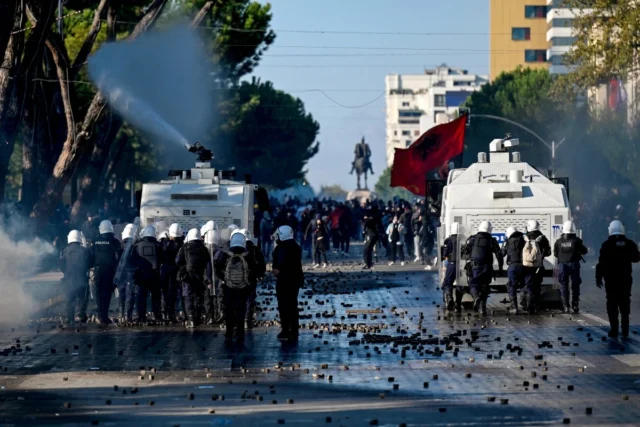
After the hour at the Prime Ministry produced no incident, the column moved. Berisha led his militants in the direction of the bloc of ministries, but the march never cleared the boulevard. Police, having anticipated the manoeuvre, had formed a long cordon at the exit toward the Ministry of Internal Affairs. Hita had made the legal position public earlier in the day: the permit covered only Boulevard Dëshmorët e Kombit, and any deviation from that route would be met with a police response. Police therefore treated the attempted march toward the ministries not as an extension of the rally but as an unauthorized deviation from the approved route.
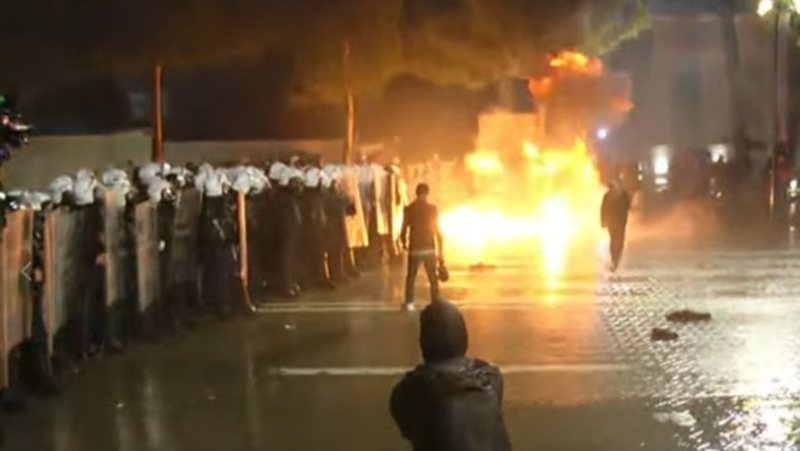
That was where the violence began. As militants pressed against the cordon and could not break it, they threw Molotov cocktails and fireworks toward the line of officers. One petrol bomb detonated close to officers’ feet after an officer kicked it back toward an empty stretch of pavement. Another militant, masked and holding a Molotov, was filmed by Report Tv attempting repeatedly to light the wick. The device failed to ignite. Officers responded with water cannon and pepper spray, dispersing groups of militants in the opening phase before resorting to tear gas as the projectiles continued.
The standoff drew Democratic Party deputies into direct physical confrontation with the police line. MPs Bledion Nallbati and Flamur Noka, alongside militants, pushed against the cordon in repeated attempts to force it open. Deputy Gazment Bardhi addressed officers directly: “Peaceful protest march. In what country in the world is protest banned? From whom are you taking orders? Why are you provoking? You are executing illegal orders. Go arrest Belinda Balluku and Edi Rama.” Behind him, militants continued throwing Molotovs in close proximity to the same officers Bardhi was addressing.
Berisha himself appeared at the Ministry of Internal Affairs wearing an anti-gas mask, surrounded by bodyguards and senior party figures. A separate militant approached the cordon with a vuvuzela and blew it directly at officers, who did not react.
By the close of the protest, three militants had been taken into custody. Berisha called the police strategy an ugly crime. “We were on a peaceful march, the road was blocked, these people will get the answer they deserve,” he said. “These have committed an ugly crime. We were doing our march, a peaceful march. But Balluku and Rama have no place on this earth without going before the law. We were marching and they blocked the boulevard. We will prepare for all forms, and I guarantee they have already lost the battle.”
The thinness of the crowd was matched by the thinness of the audience online. Berisha’s Facebook livestream of the protest drew approximately 360 concurrent viewers, an unusually modest figure for a sitting party leader and former prime minister whose stated objective is to bring the government down.
Hita, who had inspected the police deployment in person before the protest opened and instructed his officers to maintain calm and professional conduct, oversaw a containment operation that produced no serious injuries on either side and held all confrontation inside a defined perimeter. The police approach that emerged on April 18, after which the contingent of throwers behind banners did not regroup in the same form, held again on May 8. What did not hold was Berisha’s mobilization. The eighth protest in the cycle drew the thinnest crowd, no political speeches, and a clear demonstration that the kilometri i fundit framing on which the protest cycle was built is finding fewer takers in the street and online alike.