The Newsroom
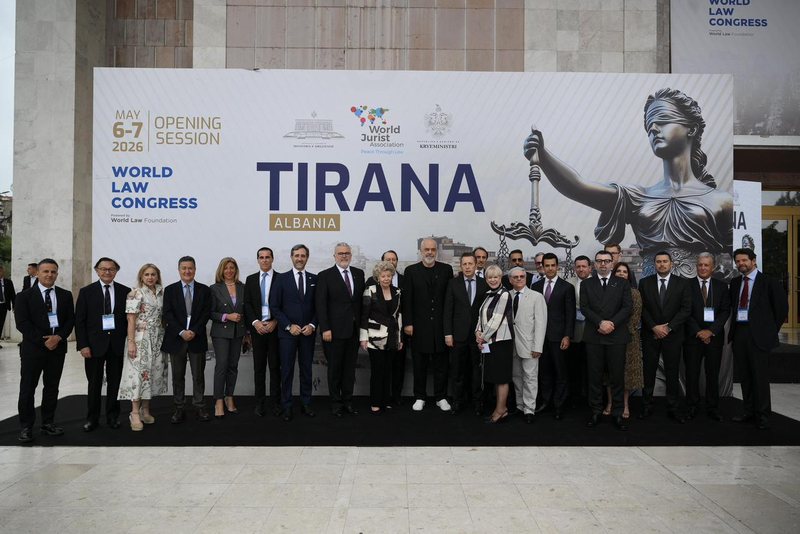
Tirana hosted the opening session of the World Law Congress on Thursday, the first formal step in a programme of preparatory events that will culminate in the 30th edition of the Congress in 2027, when the Albanian capital becomes the seat of what its organisers describe as the Davos of Law. The session, organised by the World Jurist Association (WJA) in cooperation with the Ministry of Justice, gathered close to 600 jurists from Albania and abroad over three days in Tirana and Berat, with the agenda woven into Albania’s national Justice Week.
The roster confirmed the institutional weight of the event. Javier Cremades, the Spanish lawyer who has led the WJA since 2019, opened the proceedings together with Viviane Reding, the former European Commissioner for Justice and current Vice-President of the World Law Foundation. Angela Montoya, the Foundation’s CEO, was present alongside French Justice Minister Gérald Darmanin, whose trip to Tirana, the first ever by a French Justice Minister, was treated by the Albanian government as a diplomatic gain layered onto the legal one.
That layering matters. The Congress preparation arrives at a moment when Albania’s case to Brussels rests on whether judicial reform has produced an institution that can outlast its political authors. The opening session was engineered to make that argument visible to an audience that includes precisely the constituencies Tirana needs to convince: heads of supreme and constitutional courts, ministerial peers, and the international jurists’ associations that supply Brussels with much of its evaluative vocabulary on rule of law. The 2027 Congress is expected to draw roughly 5,000 participants, including heads of state and serving judges, and to issue what the WJA’s communications routinely position as the closest thing global jurisprudence has to a Nobel: the World Peace and Liberty Award, previously conferred on figures including Ruth Bader Ginsburg, Sonia Sotomayor, and Ursula von der Leyen.
Prime Minister Edi Rama’s address was the morning’s centrepiece, and it operated on two registers at once. Publicly, he framed Albania’s selection as the host of the 2027 Congress as a verdict, not a courtesy. The choice of Tirana, he argued, owed nothing to geography, climate, or hospitality, and everything to what the country had attempted in the last decade against a problem older than the Albanian state itself: the construction of a system in which power is constrained by law rather than the reverse. He returned to a public survey his government commissioned during the design phase of the vetting process, which produced two findings he treats as definitional. More than ninety percent of respondents supported the vetting of judges and prosecutors. More than eighty percent did not believe they would live to see equality before the law. Rama presented the gap between those two numbers as the political problem the reform was designed to close.
The address then moved into a narrower and more revealing argument about institutions. Citing Daron Acemoglu’s Why Nations Fail, Rama deployed the example of two halves of a single town divided by the border between the United States and Mexico, identical populations producing radically different outcomes because one side is governed by institutions and the other by force. He paired it with a domestic anecdote about seat belt compliance, the same Albanians driving in Germany behaving as Germans, the same Germans driving in Albania behaving as Albanians, the variable being neither nationality nor culture but the system within which the behaviour occurs. The point, deliberately understated, was that the durability of judicial reform cannot rest on the personal preferences of its current political custodians. It has to be carried by institutions designed to outlast them.
Rama was unusually direct about the role of the European Union in that architecture. Without Brussels, he said, Albania would not have built an independent system; with Brussels, the country has access to what he described as the world’s most effective transfer mechanism for institutional knowledge. The framing was strategic. It positioned EU accession not as a reward for reform but as the condition of its survival, and it positioned the governing majority as the political guarantor of a process that is neither complete nor reversible.
Justice Minister Toni Gogu, who opens the working sessions on May 7 and 8, struck a deliberately cooler tone. Where Rama’s address was historical and political, Gogu’s was institutional and diagnostic. Rule of law, he argued, is not built once and then preserved; the harder challenge is sustaining trust in institutions over time. He placed Albania inside a global trend in which rule-of-law indicators have stagnated or worsened in more than half of measured countries, and in which mature democracies face escalating stress tests. Against that backdrop, he framed Albania as a deliberate counter-case: a country that chose to reform itself even at significant institutional and political cost.
The 2016 reform, in Gogu’s reading, was not a technical adjustment but a structural decision to alter the relationship between political power and law, transferring authority into self-governing institutions. He treated the public debate around that decision as a feature, not a defect, of the transformation. Justice, he argued, is not built in private; it is built in public view and through public trust. His closing was characteristically measured: rule of law as a continuing process requiring institutions that correct themselves, societies that do not abandon their demand for justice, and political will sustained even when the cost is high.
The two registers were complementary rather than competing. Rama supplied the historical and political argument that justified Albania’s selection as host. Gogu supplied the institutional argument that the reform’s preservation depends on conditions Albania has not yet fully secured. Read together, they sketched the case the government intends to make to the international legal community across the next eighteen months: that Albania has done something difficult, that the difficulty is not over, and that the international jurists’ community has a stake in ensuring the work is not undone.
The institutional history of the Congress reinforces the framing. The WJA was founded in Athens in 1963 by the American lawyer Charles Rhyne and co-founded by former US Chief Justice Earl Warren, in a moment of acute geopolitical anxiety, on the proposition that stable peace can only be achieved through law. The Congress has since become a biennial fixture under the patronage of King Felipe VI of Spain, with prior editions in Madrid, New York, Cartagena de Indias, and most recently Santo Domingo in 2025. The agreement to bring the 2027 edition to Tirana was signed in Madrid in October 2025, with Holta Zaçaj, President of Albania’s Constitutional Court, present alongside the Spanish king. Thursday’s opening session was designed to redeem that signature.
Two structural realities sit behind the symbolism. The first is that Tirana’s hosting of the 2027 Congress will coincide with the NATO summit scheduled in Albania the same year, an unusual concentration of high-visibility multilateral programming for a country still negotiating its accession to the European Union. The second is that the vetting process, the most internationally visible component of Albania’s judicial reform, is expected to reach its concluding phase in June 2026, weeks after the opening session. The convergence is not accidental. The Congress preparation, the Justice Week programme, and the diplomatic programming around Darmanin’s visit are calibrated to mark the closing of one phase of judicial reform and the opening of a longer institutional consolidation.
Whether that consolidation holds is, as Gogu admitted, a separate question from whether the reform was correctly designed. Rama, more directly, treated the answer as a function of political will: the governing majority, he said, would not allow what was built to be undermined or what was projected to be unwound. The qualifier sat unspoken behind the assurance. Political will is itself a perishable resource, and the institutions Albania has built will eventually have to defend themselves without it.
That, finally, is the test the 2027 Congress will measure. Tirana will not be evaluated only on the quality of its hosting. It will be evaluated on whether the system it has built has begun to govern its own custodians.