The German Embassy asked for an unequivocal break with violence. What it received was a conditional doctrine.
By Ardit Rada (Tirana)
The German Embassy in Tirana was unambiguous on Monday morning. “The German Embassy condemns the unacceptable violence in the context of yesterday’s demonstrations,” the statement read. “Political protests and the right to demonstrate are fundamental rights in every democratic society. But they can never justify violence against persons or property.” It then addressed the Democratic Party directly: “We call on representatives of responsible political parties to distance themselves unequivocally from violence.”
Unequivocally. The word leaves no room to maneuver. No conditions, no reinterpretation, no attempt to shift responsibility elsewhere. In European political practice, this is the minimum threshold. When violence occurs around your mobilization, you reject it clearly and without qualification.
By 13:00, Sali Berisha was at a podium.
Four hours
The timing matters. The Democratic Party had just spent the week in Berlin meeting CDU figures and engaging the Bundestag’s European and foreign affairs networks. The purpose was clear: to present itself as a credible European actor on rule of law and democratic standards. The Embassy’s statement, issued less than eighteen hours after the protest, landed as a direct test of that claim.
Berisha did not wait. Four hours is not enough to construct a new position. It is enough to reveal the one already in place.
What Berisha said
The statement needs to be read closely because its logic is deliberate.
“We are committed to peaceful uprising. If in these protests there are demonstrators injured by police violence, not a single police officer has been injured to date. We remain committed to peaceful uprising. We want to continue with the peaceful motto. In the conditions of a coup all means are legitimate, but we stand by peaceful uprising. We believe violence does not serve us. On the peaceful path we achieve our goals faster and better.”
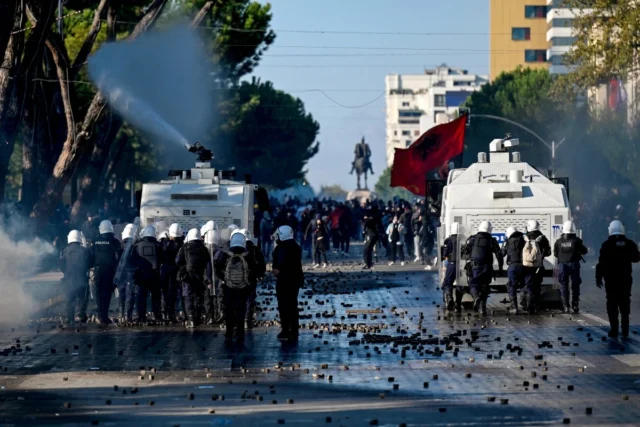
Begin with the factual claim: “not a single police officer has been injured.” Reporting by Timoni and Shqiptarja documented six injured officers on March 22 alone. Berisha’s claim does not dispute that figure. It ignores it entirely, removing the state’s wounded from a picture in which they inconveniently exist.
Then the architecture beneath the concession: “in the conditions of a coup all means are legitimate.” This is the sentence the Embassy’s demand was written to close. Berisha reopens it. The framework that permits escalation remains in place, available whenever the speaker decides the conditions warrant it. The peaceful commitment sits on top of that framework, not in place of it.
Which is why the final reasoning — “violence does not serve us” — is the most revealing line in the statement. Not: violence is wrong. Not: we reject it. We have assessed it and found it currently inefficient. A moral rejection does not expire when circumstances change. A tactical one does.
The answer Berlin received
The Embassy asked for a clear and unconditional distancing from violence. The Democratic Party’s leader responded by erasing the injuries of six officers, preserving a doctrine under which all means remain legitimate in coup conditions, and offering nonviolence as the more productive path for now. European partners have seen this construction before. It is the position of a party that wants credit for restraint without accepting its obligations.
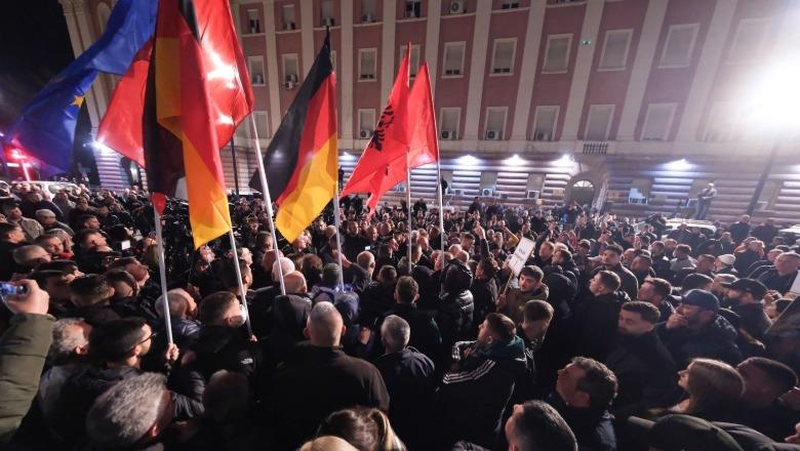
The sequence of the week makes the gap visible. The PD spent its Berlin meetings arguing that it embodies European democratic standards. Its supporters spent Sunday night attacking state institutions in Tirana under a German flag. The Embassy responded the next morning with a demand for clarity. What came back, four hours later, was a statement that reads as compliance and functions as its opposite.
European capitals do not expect opposition movements to be without fault. They do expect, on the question of political violence, a line that is held rather than managed. What Berisha offered was management. The rejection of violence as an unacceptable act, full stop, was not in the statement. It was precisely what the Embassy had asked for, and precisely what did not come.
The Embassy used one word. Unequivocally.
Berisha used many. None of them meant the same thing.
Ardit Rada is a Tirana-based journalist covering Albanian politics, governance, and institutional developments.