Aurel Cara (Tirana)
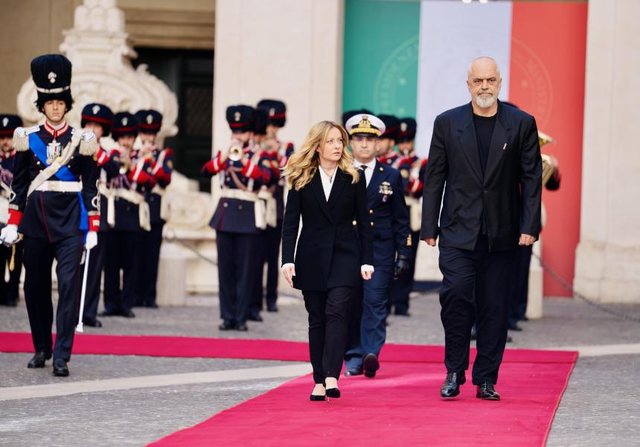
Prime Minister Edi Rama arrived at Palazzo Chigi on Thursday afternoon for what the Italian government, in a carefully worded readout, described as a chance to “take stock of the strengthening of the partnership between the two countries in sectors of common interest, with particular focus on interconnection, the defence industry, and cooperation on migration.” A bilateral with Defence Minister Guido Crosetto followed. From Rome, Rama travels to Barcelona for the fourth “In Defence of Democracy” summit hosted by Spanish Prime Minister Pedro Sánchez, where he is scheduled to meet Sánchez and European Council President António Costa on the margins.
The choreography is by now familiar. What deserves a closer look is the substance, and the claim Rama attached to it. Writing on social media hours after leaving Palazzo Chigi, the prime minister offered a formulation that was less a thank-you note than a political statement: “All governments of Italy in the last 35 years have been particularly well-disposed toward Albania, but no Italian government has set in motion a programme of strategic cooperation with Albania as dense as the government of Giorgia Meloni’s. Further approximation with Italy through large and concrete projects brings more development and security for Albania.” It is worth examining on its own terms.
Rama had telegraphed the register earlier in the day. Arriving in Rome before the meeting, he posted a photograph with a gently ironic caption: “Rome, revising the lessons before the meeting, because the sister of Italy does not forgive you with the knowledge she has of every project.” The line, half-joke and half-warning, telegraphed the operating style he has built with Meloni: a working relationship in which granular project detail is the currency, and political warmth is the collateral.
What the November summit actually contained
The November 2025 intergovernmental summit produced sixteen signed agreements spanning defence and security, health, infrastructure, and education. The defence package is the one that matters most for any serious assessment of the bilateral relationship. It commits Italy to supplying equipment, transferring technology, and developing maritime infrastructure in Albania. Read alongside Albania’s ongoing negotiations on naval basing, airspace surveillance, and joint industrial participation, the defence track is no longer ceremonial. It is, in practice, the first attempt by a NATO member to fold Albania into its own defence-industrial base at scale, rather than treating Tirana as a recipient of training and surplus.
Against that benchmark, Rama’s claim is defensible. The D’Alema, Prodi, and Berlusconi governments invested in Albania; the Gentiloni and Conte governments maintained commercial and migration channels; the Draghi government coordinated closely on Ukraine. None of them constructed an integrated defence, energy, and migration architecture with Tirana. The Meloni government has.
The energy file as the hard test
The interconnector discussed on Thursday is not an abstraction. It is a defined project with defined numbers. On 15 January 2025, Albania, Italy, and the United Arab Emirates signed a trilateral framework for a 1,000-megawatt high-voltage direct current subsea cable running from Vlora to Puglia, paired with 3 gigawatts of new renewable generation in Albania. The investment is estimated at one billion euros. Italy’s transmission system operator Terna and Abu Dhabi’s Taqa are the designated grid partners; the Italian energy company Eni signed an agreement on 24 February 2025 to act as preferred off-taker for the Albanian renewable output transmitted to Italy. Commissioning is targeted for 2028.
The numbers matter because they clarify the strategic proposition. Italian electricity demand, which totalled 312.3 terawatt-hours in 2024, is projected to rise toward 356 terawatt-hours by 2030, driven by data centres, electric vehicles, and industrial re-shoring. Albanian electricity generation is already nearly entirely renewable, dominated by hydropower that produces between 4,000 and 5,000 gigawatt-hours annually. The cable makes Albania a supplier of choice into an Italian market whose shortage is structural, not cyclical. If EU co-financing is secured under the Connecting Europe Facility, as the Italy-Tunisia ELMED precedent suggests is plausible, the project will also fold Albania into the EU’s TEN-E regulatory architecture before accession, an outcome of significant institutional value that would survive any change of government in either capital.
The migration track and its costs
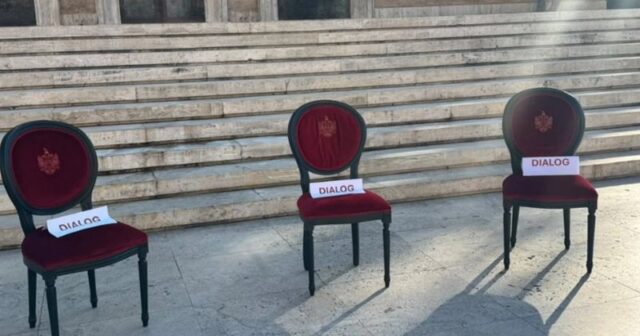
The migration file is where the claim becomes more complicated. According to Italian news agency Nova, whose readout was picked up by Il Giornale on Thursday afternoon, Rama told Meloni inside the room that “all Italian governments of the last 35 years have forged particularly friendly relations with Albania, but none has ever implemented a programme of strategic collaboration as effective and rich as the one willed by President Meloni.” The phrasing mirrored his public post, but the context was sharper: the remark was delivered while, outside Palazzo Chigi, the +Europa party, a small pro-European opposition formation, was staging a flashmob demanding the closure of the Italian migration centres in Shëngjin and Gjadër. “The centres in Albania have not worked and will not work,” the party’s secretary Riccardo Magi told reporters. “Today President Meloni together with Albanian President Edi Rama should find a way out of this epochal failure.”
The protocol governing those centres, signed in November 2023 and ratified the following year, is the most visible element of Italy-Albania cooperation for European audiences and the most contested. Italian magistrates have repeatedly blocked transfers; the Court of Justice of the European Union is expected to rule on the legal architecture; and the Italian government continues to frame the experiment, in the words of Thursday’s ministerial circles cited by Il Giornale, as “a beacon for other countries” on returns policy. Albanian public opinion remains divided on whether hosting the facility is an act of European solidarity or a rental of sovereignty. Thursday’s communiqué confirmed the migration track as a pillar of the relationship. It did not resolve the structural question of what happens if the pillar is declared illegitimate by Luxembourg.
The defence industry track and its stakes
The Crosetto bilateral, held after the meeting with Meloni, is where the most consequential file sits. Albania’s armed forces have been rebuilt under NATO membership but remain undersized and undercapitalised. An industrial partnership with Italy, whose defence industry hosts Leonardo, Fincantieri, and a dense tier of subcontractors and ranks among Europe’s largest, would give Albania a path into the European defence-industrial ecosystem that it cannot build alone. For Italy, Albanian participation in Adriatic maritime infrastructure, in airspace surveillance, and eventually in component manufacturing reduces costs and deepens a logistics footprint on the southern flank that Rome is quietly rebuilding. The political framing of the file as “cooperation” understates its strategic character. It is a regional defence-industrial integration project, conducted bilaterally because the EU framework cannot yet deliver one.
Barcelona as the counterpoint
The second leg of the trip, the Sánchez summit in Barcelona, is not an accidental pairing. “In Defence of Democracy” is a Spanish-led platform whose stated themes include “institutions and multilateralism” and “disinformation and digital technology,” with particular attention to “the regulation of the digital environment in order to combat disinformation, the strengthening of democratic institutions and multilateralism, as well as the fight against inequalities as the foundation of a strong democracy.” Rama appears to be its only Western Balkans participant. His scheduled bilaterals with Sánchez and with Costa fold neatly into the enlargement conversation: Spain chairs a portion of the Council’s work on democratic resilience; Costa sets the Council’s enlargement agenda. Rama will arrive in Barcelona able to say, credibly, that the most structured bilateral relationship Albania has with an EU member state is the one with Rome, and that it covers the domains, defence, energy, migration, that the Union itself struggles to coordinate.
The structural question
Rama’s Italy axis is real, it is dense, and it is, for now, largely personal. Meloni and Rama have built a working relationship that survives each of their domestic storms. What the Palazzo Chigi readout does not answer is what this architecture looks like when one of the two leaders leaves office. The defence-industrial track will outlast any government; contracts and capital commitments have their own gravity. The Vlora-Puglia cable will too, if the 2028 commissioning target holds and if Eni’s off-take agreement converts into signed contracts. The migration protocol may not. The question Albania’s foreign-policy establishment will eventually have to answer is whether the Meloni-Rama years have built an institutional partnership or a bespoke one, and whether the ballast exists to carry the relationship through the first government in either capital that does not treat it as a priority.
That is the question Thursday’s stocktake did not pose, and the one the Barcelona summit, with its emphasis on institutions over personalities, indirectly raises.