In four days of coordinated statements, the governing majority has distinguished the movement’s legitimate grievances from its violent and utopian fringe, received an unexpected endorsement of that distinction from the protest’s own legal conscience, and opened the way to a dialogue that will test both sides
By Ardit Rada, Tirana Examiner
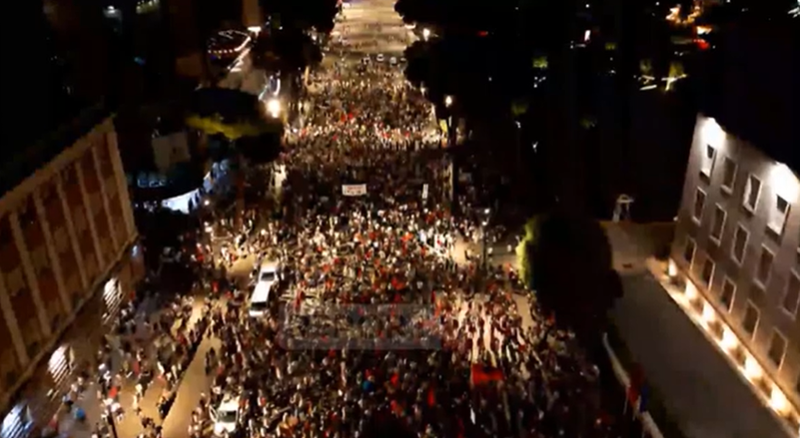
Governments under sustained street pressure usually face a binary choice: repress or concede. In its fifth week of confrontation with the largest protest movement in over a decade, Edi Rama’s government is attempting a third course. It is drawing a public distinction inside the movement itself, between the grievances that brought citizens to the boulevard and the actors who have attached other agendas to them, and it is inviting the former to a table from which the latter are excluded.
The operation has unfolded in a tight sequence since June 30, and its architecture is now visible. Speaking this morning at the third edition of Public Administration Week, the Prime Minister supplied the metaphor that names it. The government, he said, is gathering episodes to read the boulevard protest in the part of it that carries fundamental importance, “the voice and the real concerns, what I call the clean and flowing water of the protest beneath that black crust of what is, unfortunately, its visible and noisy part, where all of Albania’s failures and embittered have gathered.”
Clean water beneath a black crust. The image does three things at once. It concedes that the protest’s social base is real and its grievances legitimate, a concession few governments make in week five of a crisis, and one this government has now made repeatedly and in specific terms. It separates that base from the movement’s most visible and vocal layer, the layer that in recent days has thrown stones at police and advanced platforms touching the constitutional order. And it claims for the government the role of reading the protest, of distinguishing message from noise. Each of these moves can be assessed on the evidence, and the evidence of the past week has, in significant part, run in the government’s favor.
The sequence
The morning speech was the fourth move in a series, not the first. On June 30, responding to the protest’s escalation, Rama predicted that “the governing majority will emerge from all this vortex with renewed will to be much closer to the people,” that “the protesters will win together with Albania, while the black effigy that misused them will fail and shatter to pieces.” The vocabulary of use and misuse was already in place: a mass of citizens acting in good faith, and forces exploiting their presence.
On July 1, from an innovation summit in Germany, the register was that of a government treating the movement as information rather than threat. “As Prime Minister I consider this protest an important message for me and for my government,” Rama said. “I am listening and trying to understand this message with great care, trying to understand the concerns, the anxieties, the hopes that brought people there.”
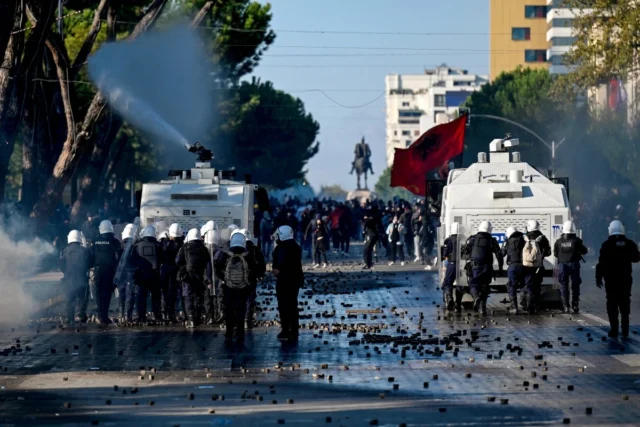
On July 2, events outside parliament gave the distinction concrete form. A section of protesters threw stones at police and pelted Socialist deputies’ vehicles with eggs and flour, attempting to block the exits from the building until police dispersed them. Nineteen people were arrested and twelve more placed under investigation, and a journalist was struck while on duty, an assault the Association of Journalists condemned as unacceptable. Deputy Interior Minister Besfort Lamallari rejected accusations of police brutality, stating that officers were struck first and that those who attacked them were vandals. From inside the chamber, Socialist parliamentary group leader Taulant Balla announced the government’s next step. “The Socialist Party of Albania, its government, in a few days will reach the moment when it sits down with the real protesters,” he said. “The real protesters today are divided: the citizens who filled the boulevard, and a criminal group, with persons with dangerous criminal records.” Critics will note that the government benefits from this framing. The night’s video record, the arrest list, and the assault on a working journalist mean the framing did not need to be manufactured.
Then came the development no government communication strategy could have produced, and the one that matters most.
The Matlija rupture
Dorjan Matlija is not a government voice. The executive director of ResPublika, one of the country’s most credible legal and human rights organizations, has stood with the protest since its first days, when the cause was flamingos, Vjosa Narta, and the planned resort at Zvërnec. On the night of July 2 he broke with a part of it, and he did so in writing.
“I distance myself from those who are trying to take the protest hostage and are damaging it,” Matlija wrote. “I distance myself from the institutional fantasies of constitutional illiterates dressed in a patriotic flag, from imaginary assemblies, from invented technical governments. I refuse to draft articles, provisions and legal technicalities for the unclear ideas of those who proclaim themselves ideologues.”
The statement’s significance is structural. Every protest movement that outgrows its founding cause needs jurists to translate anger into demands that institutions can process. Matlija was that translator, and his refusal to give juridical form to the imaginary assemblies and technical governments that have colonized the movement’s stage is testimony from inside that those demands cannot be served by anyone who takes the constitution seriously. This is not a government talking point. It is the independent judgment of a human rights lawyer whose credibility was built in opposition to state power, and it corroborates, from the least suspect possible source, the core of the government’s reading: that the protest contains both a legitimate grievance and a platform incompatible with constitutional order, and that these are separable.
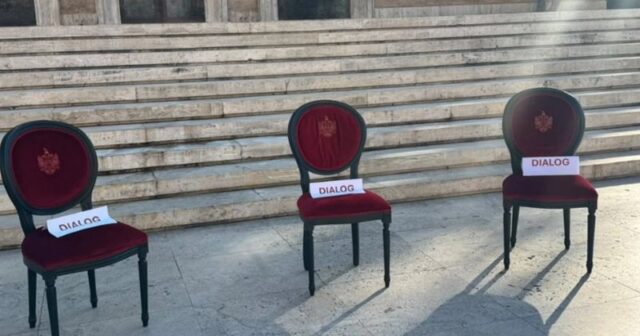
Rama responded within hours. “A constructive step in the right direction,” he wrote, and then listed the agenda he is prepared to discuss: “The themes of nature, Vjosa Narta, the flamingos, transparency, anticorruption or the arrogance of power have only one way to be treated seriously: democratic dialogue with the Albanian Government.”
The list is worth reading carefully. It covers the movement’s founding cause and its animating grievances in full: environment, Zvërnec, transparency, anticorruption, official arrogance. What it excludes is what Matlija himself excluded the night before, the demands aimed at the constitutional order. On that boundary, the government and the protest’s most credible legal ally are now, remarkably, in the same place.
The government’s case, and the questions it must still answer
This morning Rama worked to demonstrate that the “clean water” half of his metaphor is sincerely meant. He told the story of a friend’s mother, a woman of a certain age, who joined the protest after years of queueing from five in the morning at a polyclinic where the doctor arrives late and leaves early. “This woman goes out to protest because she is offended,” he said. “The feeling of humiliation from your own state, from the people who are paid to serve you, is a feeling that makes you understand this is the limit.” He drew the causal line back to the movement’s ignition point himself: “There is no need for everyone who has something to say to be dragged. It is enough for one person to be dragged, as happened in that scandalous moment, and it resonates in the others. That mother is not dragged physically, but the doctor drags her.” The Zvërnec dragging as spark, administrative humiliation as fuel: the government has adopted the protest’s own account of its origins, which is both an act of listening and the precondition for addressing it.
He attached to it an argument about method. Changing the administration, he said, “is much more complex than it seems. Like the fight against corruption, it is not only a matter of prison. The system must protect you.” What is happening in Albania today, “and what gets lost in the fog and smoke of things, is that for the first time the system is fighting corruption,” systemically rather than through voluntarism, reaching “where it has never reached before.” State building, he argued, “is the totality of steps taken with patience and without noise,” and the demand for a guillotine is not an argument against the balance of powers. This is a serious institutionalist position, and it has evidence behind it: SPAK’s record of prosecutions reaching into the political class, including the government’s own ranks, is precisely the kind of systemic anticorruption enforcement that noisy episodes do not build. The announcement that 140 senior civil servants have entered an artificial intelligence training program, the first cohort of a wider rollout aimed at decision speed and interinstitutional quality, belongs to the same argument: reform as accumulation, not spectacle.
The questions that remain open are real, and the government will be judged on how it answers them. The grievances it now validates accumulated during its own thirteen years in office, and a dialogue will need to produce commitments specific enough to be verified: on Zvërnec, on health service standards, on the administrative conduct that put a pensioner on the boulevard. The moderate protesters being invited to the table have no elected representatives, so the mechanics of who sits down, and how they are chosen, will determine whether the process reads as negotiation or consultation. These are questions of execution, not accusations of bad faith, and the government has given itself the means to answer them well: it has named the agenda, acknowledged the causes, and committed publicly, through Balla, to a timeline of days.
The protest’s authority crisis
The harder problem now belongs to the movement. For five weeks its strength was its formlessness: no leaders to arrest, no party to discredit, no program to pick apart. That formlessness has become a liability at exactly the moment dialogue was offered. Who accepts the invitation? Who refuses it? Who is entitled to do either in the movement’s name? The radical wing will call any negotiator a collaborator. The moderate base, the polyclinic mothers of Rama’s anecdote, has no mechanism to disown the stone throwers and the drafters of imaginary constitutions except by staying home, which is demobilization by another name. Matlija’s statement shows the sorting has already begun from within, and voices adjacent to the protest are reinforcing it: commentary in the Tirana press this morning insisted the movement must reject any concept of vigilante justice if it wants to keep its moral standing.
The coming days will test both sides against their own words. The movement must show it can produce interlocutors who speak for the boulevard rather than for the stage, and that it can hold its constitutional demands to what a lawyer of Matlija’s standing is willing to draft. The government must show that the table Balla promised is a working one, and that the clean water it has so carefully identified flows into decisions. Both tests are passable. A government that has correctly diagnosed the protest’s causes, publicly committed to dialogue on the protesters’ founding agenda, and received independent confirmation of where the legitimate demands end has positioned itself to resolve this crisis rather than merely outlast it. Whether the movement can organize itself into a partner capable of collecting on that offer is now the more uncertain half of the equation.