Thirty days into the protest movement, the crowd outside the Kuvend crossed from ritual insult into violence. A reconstruction of July 2, hour by hour, and what it cost the movement that committed it.
The Newsroom
At two minutes past ten on Thursday morning, a stone thrown from the crowd outside the Kuvend struck a police officer in the head. He went down inside the cordon and was taken for treatment. The men and women around the thrower did not cheer. Some of them shouted at him. Dritan Goxhaj pushed to the front of the crowd and turned to face it. Our quarrel is with the parliament, he told them, not with stones against the State Police. A woman near him took up the call: not the boys, not the police. The crowd absorbed the appeal, and then, over the next four hours, ignored it.
By mid afternoon the count stood at 23 people detained, nine police officers and four protesters under medical care at QSUT and the Trauma Hospital, a police vehicle with its windows beaten in, sections of the security perimeter torn away at two government buildings, and a city bus full of passengers pelted with eggs for the offence of trying to drive down a blocked street. None of the injuries is life threatening. The damage to the movement is harder to assess, and may be worse.
The dough of democracy
The violence did not announce itself as violence. The previous evening, at the rally outside the Prime Minister’s office, the call had gone out for every protester to arrive at parliament supplied with eggs and flour, to cook what organisers called the dough of democracy. It was theatre, and effective theatre: food thrown at power is an old Balkan grammar of contempt, humiliating without wounding. There was also, that same evening, a warning addressed to the police, who were advised to be careful. In retrospect the two messages belonged to different scripts.
The morning began on the first script. Socialist deputies arriving for the plenary session, which the opposition had decided at the last moment to boycott, ran a gauntlet of eggs. The Speaker’s car took flour and eggs to chants of thief. A protester tried twice to hit Fier deputy Ramion Kurti, missing once and catching him on the leg the second time, to shouts of you do not represent us. Eight protesters found a gap in the perimeter through a café on the pedonale near the Academy of Sciences and ambushed deputies Ulsi Manja and Admir Kadeli at close range before police pulled them out of the premises. Among the first detained was the activist Gent Progni.
All of this remained within the register the movement had set for itself: illegal, aggressive, but symbolic. Eggs are an argument about dignity, not an attempt to injure. The treatment of the opposition confirmed the point. When opposition deputies Tomorr Alizoti, Enno Bozdo and Zia Ismaili walked through the same crowd, no one threw anything. They received only the chant that has become the movement’s second anthem: sold out opposition. The crowd was making a distinction, and making it with discipline. Socialists were the enemy and got the eggs. The opposition was merely despised and got words.
The second script
The discipline broke at the barriers. Just before ten, protesters began rocking the metal fencing around the parliament, then tore sections of it away. Police responded with pepper spray, which caught among others Luçiana Kokaj, a member of the organising group. Then came the stone to the officer’s head, Goxhaj’s appeal, and the crowd’s answer to it.
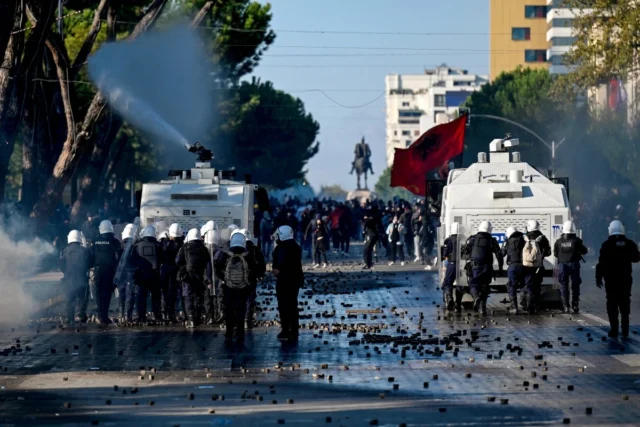
From that point the day escalated in a recognisable sequence, each step abandoning a constraint the previous one had kept. At the Interior Ministry, protesters struck police with hard objects and pulled away more fencing, over the objections of others in the crowd who shouted not with hard objects. When the plenary session ended, deputies found their cars ambushed at the parliament exit, driven back into the courtyard under volleys of eggs and water bottles, and it took water cannon and tear gas to open the road.
Some deputies did not wait for the road to open. They left on foot and took refuge in the shopping centre on Murat Toptani street, making for the stairs down to the parking level, and the crowd followed them in. Video records the protester Arvina Lleshi closing on the group among the shoppers, calling them deputies of crime who hide from the people. One deputy shoves her. Another apparently insults her, because she is heard returning the word clown with interest. No one is injured in the exchange, and injury is not what makes it matter. Members of parliament pursued through a shopping centre, past the escalators and the storefronts, is the image of a political space that has stopped having walls. The crowd did not storm the chamber, so it hunted the legislators through the civilian city instead, and a movement should ask itself which of those two pictures it finds more reassuring.
Then came the episode that severed the day from any defensible account of itself. A group of protesters, some masked, smashed the windows of a police vehicle, first with stones, then by lifting the metal barriers and bringing them down on the car repeatedly. Masks are a confession in advance. The man who throws an egg wants to be seen. The man who covers his face before picking up a crowd barrier has already conceded that what he is about to do cannot survive daylight.
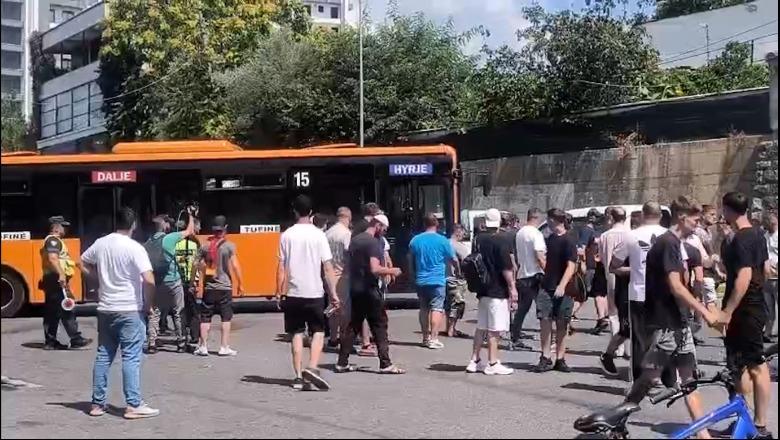
And finally the bus. At 14:37, at Commissariat 4, where part of the crowd had relocated after the morning detentions and had planted itself across both lanes of the road, protesters pelted a municipal bus with eggs. The bus was not carrying deputies. It was not carrying anyone connected to power. It was running its ordinary daily route with ordinary passengers aboard, and its driver’s offence was attempting to pass a blockade that no law had authorised and no authority had declared. Whatever theory of legitimate targets had governed the morning, when the crowd distinguished so carefully between Socialists and the opposition, it did not survive to the afternoon, and it certainly did not cover commuters. By 14:37 the movement was attacking the public it claims to embody, and the passengers behind that glass are the citizens in whose name every chant of the past thirty days has been raised.
A movement that answers to no one
The day’s second story ran underneath the first. This crowd rejected every politician who approached it. Adriatik Lapaj was told to stand as a protester or leave. Erald Kapri arrived at Commissariat 1 with news that four detainees would walk free within the hour and was told to surrender his mandate. Klevis Balliu and Redi Muçi were turned away with the same chant used against the Socialists’ cars. Even Dritan Goxhaj, hours after his appeal against stoning the police, was accused of negotiating the moment he stood near Balliu, and told to go.
This is the movement’s strength and its exposure in a single fact. Its refusal to be captured is genuine, which is why Sali Berisha’s afternoon statement, blaming what he called the narcopolice for bloodying the protest and demanding the immediate release of the detained, reads as an attempt to annex an event whose participants chased his deputies away in the morning. The government’s counterclaim arrived within hours through Blendi Gonxhja, the Minister of Tourism, Culture and Sports, who identified a woman speaking for the protesters as a sitting member of the Democratic Party leadership. Both parties are contesting ownership of a crowd that owns itself, which is precisely the problem. A movement that answers to no one cannot restrain anyone. Goxhaj’s appeal at 10:05 was the closest thing to a command structure the day produced, and it held for less than three hours.
The activist Andi Tepelena, speaking after the worst of the clashes, distanced the movement from what he called every kind of violence and insisted the people had come out for justice, not to attack institutions paid for by their own taxes. The distancing is welcome and it is also insufficient, because it was delivered after the stone, after the smashed vehicle, after the bus. A movement that can only disown violence retrospectively has no mechanism for preventing it prospectively.
The state’s answer
The government answered in three registers. The sober one belonged to Justice Minister Toni Gogu, who called the stones against police unacceptable and unjustifiable, affirmed protest as a fundamental right exercised within the law, and left it there. Interior Minister Besfort Lamallari and State Police Director General Skënder Hita, visiting the injured officers, called the day an attack on the state and promised the perpetrators the force of the law.
The second register belonged to Taulant Balla, and it was not sober. From the rostrum of the chamber the crowd was besieging, the Socialist group leader condemned the violence as the work of criminal individuals who had penetrated and taken the protest hostage, and then went further on every axis. He named a wanted man, one Anton Frroku of Lezha, as present among the protesters and sought by police for violence inside his own family, and demanded officers produce him for the flamingos to see. He described the stone throwers as social and political refuse. He reached for the Reichstag fire, telling the chamber that Nazism was born by attacking a parliament. And he asserted a foreign hand behind the destabilisation, naming Iran, unnamed neighbouring states jealous of Albanian tourism, and the Kremlin, a claim to which he attached no evidence. The Prime Minister worked the same seam in his own key, pronouncing the flamingos peaceful and blaming crows and ravens for the pressure on deputies, and separately claiming mercenaries from Prishtina and Tetova were posing as diaspora, another assertion delivered without anything attached to it.
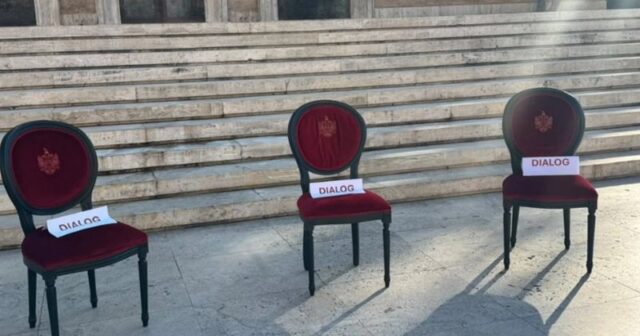
Two things in Balla’s speech deserve to survive the noise around them. The first is the arithmetic: the chamber sat, the three laws passed, and the group leader anchored his defiance in the 856,177 votes behind his majority and a mandate running to May 2029. The blockade failed at the only thing a blockade is for. The second is the offer. Balla told protesters with what he called legitimate reasons, from the environment to anger at those who abused power under his own party’s colours, that the time for dialogue was days away and the majority was prepared to listen and reflect. A government that spent the morning being egged ended the day proposing talks, which is either confidence or theatre, and the movement’s response will reveal which it was ready to believe.
What the footage will decide
The legal consequences will follow the images. Assault on officers and destruction of state property sit in a different category of the Criminal Code from disturbing public order, and the 23 detentions will sort accordingly. That is what the footage will do to individuals. What it does to the larger argument is settle the question of proportion.
On the day’s evidence, the police response was graduated, and measured against what it answered, proportionate. A crowd may assemble outside a parliament and insult everyone who enters it. It may not imprison the people inside. Holding deputies within the building and its courtyard to prevent a constitutional organ from functioning is not assembly but obstruction, unlawful on its face, and the sequence of the police reply tracked the sequence of the offence. Officers absorbed hours of egging of deputies and vehicles without moving on the crowd. Pepper spray appeared when the barriers came down and the confrontation turned physical. Water cannon and gas appeared only after the session closed, when the deputies were held at the exit and no lesser means would open the road. Each escalation on the police side followed, and none preceded, an escalation from the crowd. Berisha’s afternoon claim that the narcopolice bloodied the protest asks the public to run that tape backwards, and the tape does not run backwards.
It must also be recorded, because symmetry demands it, that the response was not gentle. Pepper spray reached organisers and bystanders, Luçiana Kokaj among them. Four protesters ended the day in hospital, and one of them, his face covered in blood outside the parliament, was treated at the scene by the same officers his comrades had been stoning. That image, an officer disinfecting the wound of a protester, is the day’s most eloquent frame, and the movement should study it. The police left the square with a photograph of restraint. The protest left with a photograph of a man in a mask beating a police car with a crowd barrier.
Thirty days in, the question one Tirana newsroom put to its readers this week was whether the movement’s spirit is improving or degrading. On Thursday the movement answered it in stones.