Jasmin Mujanović mapped a region’s contradictions. Read backwards, they form something more dangerous: a method the world has seen before.
By Ngadhnjim Brovina (Prishtina)
On Friday the political scientist Jasmin Mujanović compressed the diplomacy of three theatres into a single post on X. We reproduce it in full, because its method is accumulation and a summary would dissolve it:
“To review: Ukraine wants to reset relations with Serbia, Russia’s closest ally after Belarus, and China’s closest partner in Europe; Russia is at war with Ukraine, and China is providing Russia with massive material aid in the same effort; Serbia is significantly deepening its relations with Israel, including opening an Israeli combat drone factory on its soil; Serbia also enjoys warm ties with Iran, which is at war with Israel, and which also provides Russia with combat drones; Israel refuses to provide Ukraine with lethal aid because it does not want to undermine its relations with Russia, although it knows Russia likewise provides critical military intelligence to Iran; Ukraine does not want to recognize Kosovo because it does not want to undermine the principle of state sovereignty and territorial integrity, owing to Russia’s occupation of Ukrainian territory; Ukraine has not commented on Serbia’s efforts to break-up Bosnia and Herzegovina, and seize its territory, which are backed by Russia, and have been ongoing since the 1990s, because it is attempting to reset ties with Serbia. Got it?”
The post reads at first sight as a catalogue of hypocrisies, and most of the commentary it has drawn treats it that way: everyone is inconsistent and everyone transacts; the region, on this reading, is a hall of mirrors. That reading flatters every government named in it, because a hall of mirrors implicates no one in particular.
Read the post backwards.
The last clause is the finding, and everything above it is the supporting file. His sentence says that Serbia has been working at the breakup of Bosnia and Herzegovina, with Russian backing, since the 1990s, and that Ukraine has said nothing about it because it is courting Belgrade. The August record alone carries the present tense of that claim. The middle clauses, the drone factories and the intelligence channels, describe the ordinary traffic of interest. The outer clauses describe what the traffic runs over: two states, Bosnia and Kosovo, whose standing is the material the stronger parties trade in. His closing question is impatient for a reason.
And the method he is pointing at has run once already, in public, to completion. In July 2021 Russia’s president published an essay declaring Russians and Ukrainians one people. This month, at a monastery in western Bosnia and then from a stage in Mrkonjić Grad, Vučić declared the adjectives abolished: no Bosnian Serbs, no Croatian Serbs, only Serbs. Through the decade before the invasion Moscow kept a grievance inventory over the Donbas and called every warning about its intentions hysteria. On 4 August, closing a three-day tour of Bosnia, Serbia’s president apologized to the Serbs of Krajina for Serbia’s weakness in 1995 and pledged that Serbia “will protect its people and will not wait or look for an excuse.” On 24 February 2022 the first run of the method reached its final sentence, and the sentence claimed there had been no other way to protect our people.
Through that same decade, the partners reset. Pipelines were laid to carry the aggressor’s gas around its target. Dialogue formats multiplied. The target’s warnings were filed as an obsession, and each reset was announced in the vocabulary of stability. The European Union, which spent those years explaining that trade would moderate Moscow, now explains that enlargement will moderate Belgrade, while its own annual reports record Belgrade’s foreign-policy alignment as low, year after year, and attach no consequence to the finding.
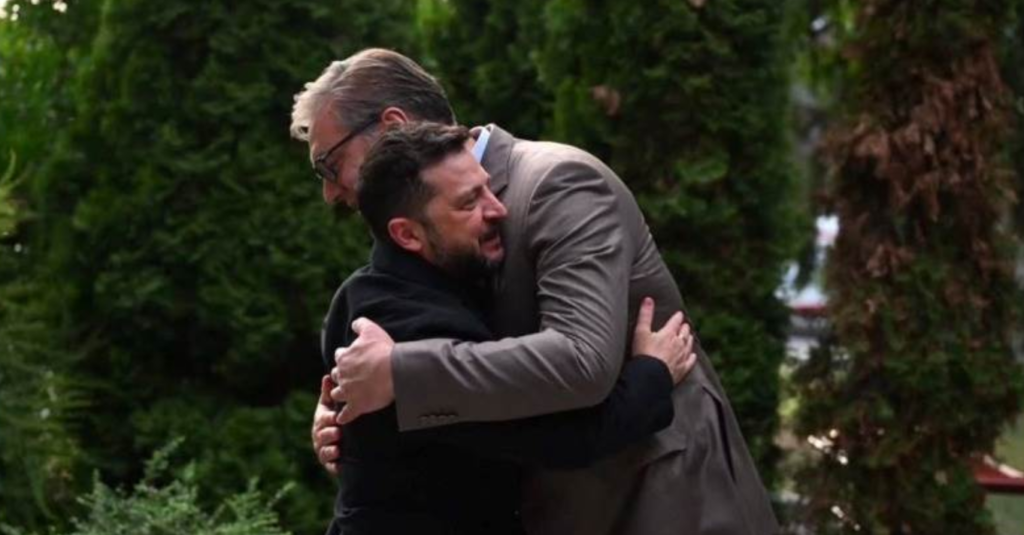
No state alive knows this method better from the receiving end than Ukraine. Its president stood in Munich days before the invasion and told the assembled partners that appeasement had produced no security and that the concessions being asked of Ukraine would not produce it either [GAP: 19 Feb 2022 transcript check]. Four years later Ukraine sits on the other side of the same table. It courts the state running the method’s second iteration and recites that state’s position on Kosovo in that state’s capital. About Bosnia, in Belgrade, it said nothing. Sarajevo watches the reset the way Kyiv once watched the pipelines.
The difference is real, and we state it without irony. Germany’s silence came at no risk. Ukraine’s comes under fire, in the fourth year of an existential war, from a government that needs shells more than it needs consistency. We do not fault the shells. But the method keeps no file on motives. A silence grants nothing by itself. What it proves is that nothing follows, and the method requires no more than that.
So does Mujanović indeed have a point? He does, and it is grimmer than his format suggests. A catalogue of hypocrisies would describe governments making mistakes. His map describes a method running in public for the second time, with Russian backing on both runs, while the partners perform the same resets around it. The first run ended on 24 February 2022. Ukraine is the one state on the map that has seen what the method becomes when no one interrupts it.
Ngadhnjim Brovina is a political scientist at the University for Business and Technology in Pristina, where his research addresses party systems, democratic consolidation, and transnational party organisation in postcommunist Europe.