Serbia is free to sit close to Moscow. The question this week is why Brussels and Washington keep holding the other chair out for it, on the same terms, after everything they have watched.
by Ngadhnjim Brovina (Regional Affairs Desk)
On Saturday 26 September Aleksandar Vučić telephoned Vladimir Putin about the Gazprom supply annex Serbia wants extended past its 30 September expiry. On Sunday he resigned the presidency to lead his list into the election. On Monday, when Brussels and Washington were asked what they made of the call, Brussels issued a reminder and Washington pointed to a sentence it had already said. On Monday evening, live on social media and now as leader of the Serbian Progressive Party list, he told Serbs that “the state knows what the foreigners have devised” and that “we will not for one moment allow them to steal the will of the voters”. The Kremlin’s readout of Saturday’s call had put “external interference in electoral processes” on the record. By Monday night the former president was saying it in his own voice, with the West’s reaction already in hand.
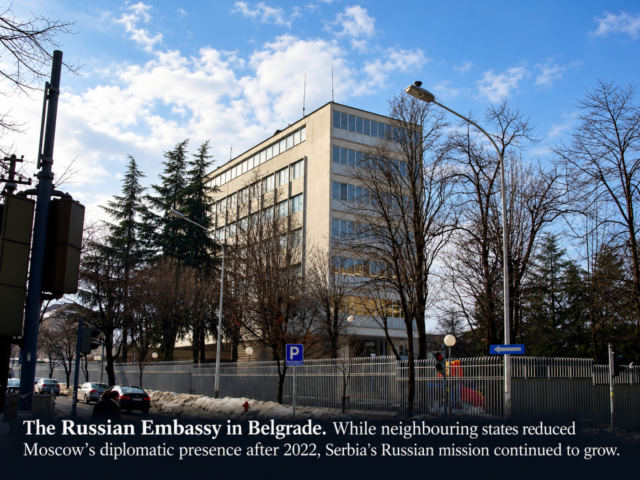
Start with what Serbia is entitled to. It is a sovereign state and the relationship it has chosen with Russia is a political one, not an energy contract. It remains the Western Balkan candidate that has not joined the EU sanctions imposed on Russia over the full-scale invasion. RT Balkan and Sputnik broadcast into the region from Belgrade newsrooms, the first recorded by Serbia’s own regulator as wholly Russian-owned. The Russian-Serbian centre at Niš is open. An investigation by Agentstvo counted 29 of 78 accredited Russian diplomats and trade officials in Belgrade with documented or indicative links to the security services. NIS, the national oil company, is 56 percent owned by Gazprom entities and has spent a year inside the American sanctions regime on a waiver that expires on 30 September. Belgrade chose all of this in the open, and its voters have had every chance to object. Kosovo Dispatch takes the choice at face value.
The problem is the second chair.
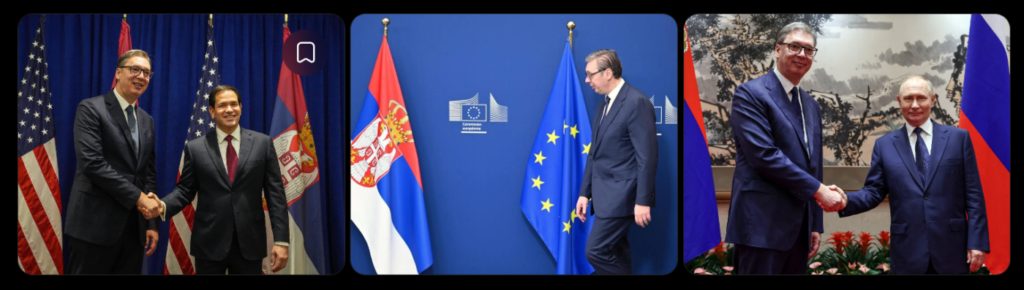
Serbia holds the largest national envelope in the Western Balkans Growth Plan: 28.3 percent, €1.59 billion, first tranche approved on 12 January. The Commission describes the facility as performance-based and reserves the right to reduce or redistribute an allocation when conditions are not met. On 17 July, in Washington, Serbia signed a memorandum on energy infrastructure and regional energy security under a United States strategic dialogue that Marco Rubio opened in person. On 23 September Rubio said Serbia “is tied up in some issues that are potentially problematic and explosive”, and in the same breath called it “a strategic partnership that we’d like to deepen and intend to do so”.
That is the money and the engagement. Now the reaction. Commission spokesman Guillaume Mercier, asked by RFE/RL about the call, said Serbia’s alignment with the common foreign and security policy “remains considerably lower than that of the other Western Balkan candidates” and that Belgrade should raise it “as a priority, including on sanctions against Russia”. No tranche was mentioned. The State Department offered no new assessment of the call; its spokesperson referred RFE/RL back to Rubio’s remarks of 23 September, the ones that end in “deepen”. No review was announced. Nothing was paused. The reminder and the referral were the whole of the Western response to the Putin call. By Monday evening, with that response already in hand, the former president was borrowing the Kremlin’s election vocabulary.
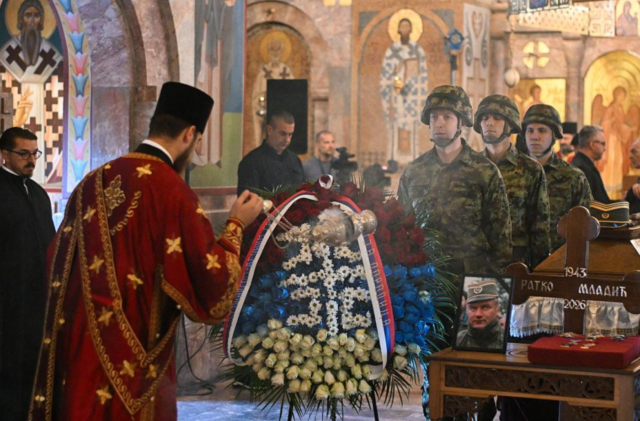
Vučić has had years to learn what separates Western condemnation from Western cost. Serbia’s refusal to join the Russia sanctions has survived four years of demands for alignment, the latest from the European Parliament this spring, while EU funding continued and Washington opened its strategic dialogue in July. The Mladić funeral on 7 September produced real condemnation and one real consequence, Marta Kos cancelling her Belgrade visit; two nights later Emmanuel Macron received Vučić at the Élysée, and no Growth Plan measure followed. This episode supplied the latest data point. In each case the consequences stopped well short of the material relationship. A warning that never reaches the money is not deterrence. It is information. Repeated often enough, it tells a government exactly where the real line runs.
Vučić has not outwitted the West. He has read it.
That is why the Saturday call could be made without visible anxiety about Monday. Belgrade did not need Brussels to approve of the Gazprom extension; it needed Brussels to complain and keep the tranche schedule. From Washington it needed only what it got: the word “problematic”, followed by the partnership carrying on. The Western vocabulary of red lines and the Western practice of accommodation have run in parallel for so long that the gap between them is now the most reliable fact in Serbian foreign policy.
The signal travels. Milorad Dodik, Vučić’s closest ally in the region, was in the Kremlin on Tuesday with the Republika Srpska government, having said the night before that “Republika Srpska supports the Russian Federation in its efforts to secure stability and freedom”. He is not another exhibit on the Russia ledger. He is proof that the price list is public. Legitimacy from Moscow, money from Brussels, and every government in Sarajevo, Podgorica and Skopje can see what the combination has cost Belgrade here: neither the Growth Plan envelope nor the strategic dialogue.
Albania and Kosovo have aligned fully with EU foreign policy from the first day. Albania imposed the sanctions and expelled Russian diplomats; its last published strategic dialogue with Washington was in 2022, while North Macedonia held its second round in April and Serbia launched its own in July. Kosovo aligns at the same rate and from June 2023 was placed under EU measures over the north that put remaining IPA III programming and WBIF approvals on hold until the measures began to lift in 2025. Partial alignment has cost Serbia none of the benefits this piece is about: it keeps the Growth Plan envelope and gained the strategic dialogue while declining the sanctions.
The remedy needs no lecture on Serbia’s friendships. The Growth Plan is conditional by design; the Commission wrote the clause, used it against Bosnia last year, and has not used it against Serbia. A strategic dialogue can be paused, or offered to the ally that has earned one. Serbia would then be exactly what it says it is, a sovereign state pursuing its own balance, and paying for it with its own money.
Vučić did not build the second chair. The West keeps pulling it out for him.