The Hague sentenced four commanders for what was done to prisoners. It refused to find that the KLA made war on a people.
by Ngadhnjim Brovina (Regional Affairs Desk)
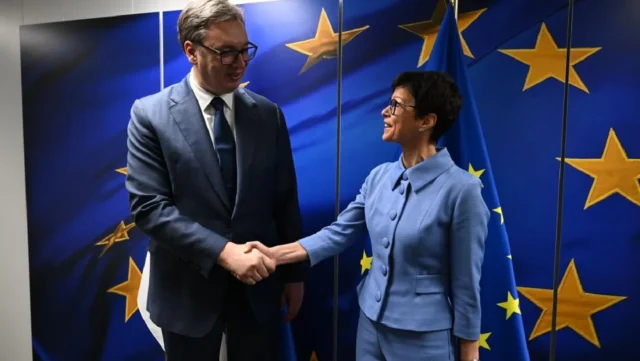
Aleksandar Vučić waited until 18:30 to say it, and then he said it plainly. The chamber in The Hague did not find, beyond reasonable doubt, an attack directed against a civilian population. It did not declare the Kosovo Liberation Army a criminal organisation. It did not question the legitimacy of its aim. He listed the six counts of crimes against humanity by name, persecution, imprisonment, other inhumane acts, torture, murder, enforced disappearance, and said that on none of them was guilt established. He added that wrong information was circulating in Serbia.
The wrong information had come from his own interior minister a few hours earlier. Ivica Dačić called the verdict confirmation of what Serbia had been saying for a quarter of a century, that the so-called KLA was a criminal and terrorist organisation. Milorad Dodik said the same from Banja Luka. The president of Serbia, reading the judgment, said the opposite. He was right.
The court convicted Hashim Thaçi, Kadri Veseli, Rexhep Selimi and Jakup Krasniqi of war crimes: the arbitrary detention of at least 385 people, cruel treatment of 49, torture of 303, the murder of 96. Sentences of 25, 25, 18 and 13 years. The victims were people the KLA treated as opponents, Albanians linked to rival parties, people suspected of working with Belgrade, Serbs and Roma among them. The chamber found that the four contributed significantly to a common purpose aimed at those opponents. Ninety-six people were killed in KLA custody, and four men are now answerable for it, subject to appeal.
No army was in the dock. Four men were, and the charge sheet carried a claim about the army all the same. War crimes are offences against the laws of armed conflict, whoever the victim: prisoners, the wounded, civilians in the wrong village, anyone the law of war protects. Crimes against humanity require something else. The prosecution must prove an attack directed against a civilian population, widespread or systematic, with the individual crimes forming part of it. That element turns an army’s misconduct into an army’s purpose. The chamber accepted that the violence was widespread and systematic. Proof that it was aimed at a civilian population is what the prosecution could not supply.
The comparison Belgrade will not draw is with its own case. In 2009 the ICTY convicted Nikola Šainović, Nebojša Pavković, Sreten Lukić, Vladimir Lazarević and Dragoljub Ojdanić for the deportation and forcible transfer of Kosovo Albanians in 1999, the first three as members of the enterprise, the last two for aiding and abetting it. The judges found a widespread and systematic campaign, a joint criminal enterprise at the top of the state, and a population as the target. That is what a finding against an army looks like. The Specialist Prosecutor asked for the same finding against the KLA and did not get it.
Two verdicts now stand in the same city. One says the Serbian state organised the expulsion of a people. The other says four KLA commanders committed crimes against prisoners, and that the KLA did not wage war on a population. Vučić’s list from the Presidency, the cases after 20 June 1999, the Yellow House, the names read out with photographs, is a catalogue of what no court has tried. He built it because the court answered the question it was asked, and the answer went against him.
That is why the anger in Pristina, real as it is, is aimed at the sentences. An appeal can move those, and the defence intends to try. The acquittal on crimes against humanity can only be revisited if the prosecution appeals it, and the burden it failed to carry at trial does not get lighter on appeal. Belgrade needed the court to say that the KLA was to Kosovo’s Serbs what the Serbian forces were to Kosovo’s Albanians. The court would not say it, and the president of Serbia has now told his own country, on camera, that anyone claiming otherwise is misinformed.