The Newsroom (Tirana)
Democratic Party militants hurled Molotov cocktails at seven locations across central Tirana on Sunday evening, injured five police officers, and came within metres of the Italian Embassy and the national public broadcaster in a two-hour march that substituted organised violence for political argument. It was the third major PD protest in a month, and the most destructive.
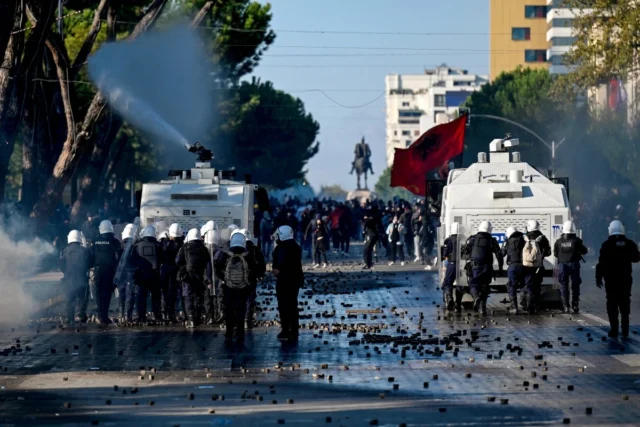
The violence began before the march had properly formed. At 18:45, as Sali Berisha led his column from PD headquarters toward the Prime Ministry, the so-called “fire group” — masked, hooded, faces covered to avoid identification, concealed behind banners — opened with Molotovs while the megaphone was still running slogans demanding a technical government and Rama’s resignation. Police, caught partially off-guard, responded with tear gas and water cannons. No speeches had been planned. The format was the message.
The march was the third in a sequence that has grown progressively more violent. On 20 February, Molotov cocktails struck the Namazgja Mosque during Ramadan prayers and targeted Villa 31, where artists inside were endangered. On 12 March, Parliament’s perimeter became the focal point. On Sunday, the target list expanded to seven sites across the capital’s institutional core.
A calculated route
Police had anticipated enough to pre-position. Metal barriers had been placed at the Namazgja Mosque — barricaded at every protest since February 20 — and at Parliament’s lateral entrance. Eagle Forces created a corridor along the march route, blocking side streets leading to Villa 31 and channeling the column toward Dëshmorët e Kombit boulevard instead. The march passed the Police Directorate without stopping, an unexplained gap in an otherwise methodical circuit of state targets.
The first stop after the Prime Ministry was the Ministry of Infrastructure and Energy — struck with Molotovs for the first time. The symbolism was not subtle: Belinda Balluku, whose parliamentary immunity the government refused to waive for SPAK, had until recently run that ministry. The crowd treated the attack as a celebration of her dismissal.
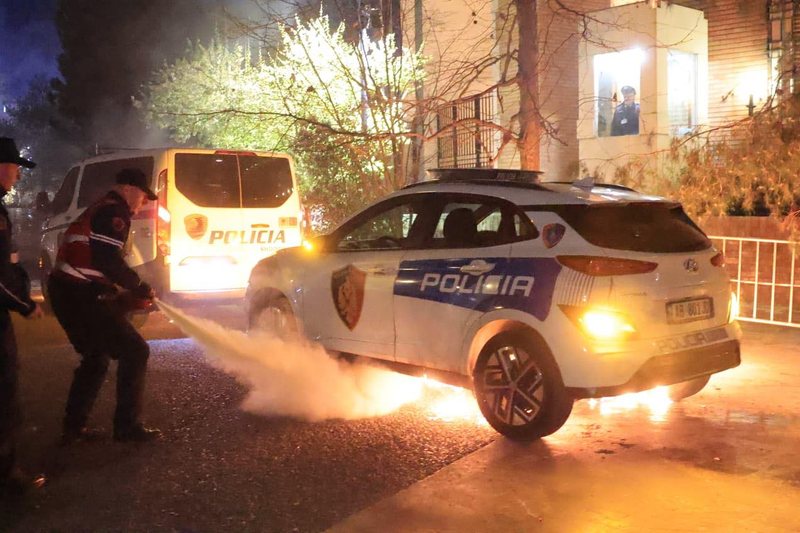
From there the column moved to the Socialist Party headquarters. A police cordon held; Molotovs fell instead between the Bank of Albania and the party’s pink building, and a police vehicle was attacked in front of the Bank. The march then moved through the former Bllok — past the Police Directorate without incident — before reaching AKSHI, the national information society agency, where several devices landed near the perimeter wall of the Italian Embassy. The building of Radio Television Albania stood in the same zone. Police cordons at both locations absorbed the assault.
The evening’s sharpest confrontation came at the Namazgja Mosque, where a police line blocked the march’s approach to Parliament. When protesters attempted to push through, officers deployed tear gas and water. The response was a direct Molotov attack on police officers. Three State Police officers were hospitalised at the Trauma Hospital; a fourth, from the Road Police, was treated at QSUT. A fifth officer was also reported injured. In between, Berisha himself was caught in a tear gas dispersal near his residence, continued the march wearing a protective mask, and later dismissed the incident as a “shameful act.”
Deputies on the front line
PD lawmakers did not observe from a distance. Deputies Luçiano Boçi, Gent Strazimiri, Xhelal Mziu, and Flamur Noka were filmed in direct physical confrontations with officers during the AKSHI attack. Noka told police they had received orders to target the opposition leader and warned them they would “pay dearly.” Boçi called officers “soldiers” and “mercenaries.” These were not statements made in the heat of the moment by unnamed militants — they were made on camera by elected members of Parliament.
Shrinking crowd, expanding violence
Drone footage broadcast during the march showed a column composed primarily of core militants rather than any broader public mobilisation. The footage was framed by Albanian media as evidence of a continuing decline in organic participation — a trend now visible across all three protests in the series. The inverse relationship between crowd size and violence was not addressed by PD leadership.
Sunday was also Sulltan Norvuz, the Bektashi community’s major religious feast. The Democratic Party chose instead to invoke 22 March 1992 — the party’s victory in Albania’s first pluralist elections after communism’s fall — as the protest’s symbolic anchor. Thirty-four years on, the American flags that had featured at previous protests were replaced with German and EU ones, a gesture pointing at Berlin’s reported reservations about approving Albania’s EU progress report, which the opposition ties directly to the parliamentary vote on Balluku’s immunity.
Government Secretary General Taulant Balla reacted with open sarcasm, saying Berisha had been abandoned even by his own people and that the European flags amounted to a provocation of the very institutions PD claims to champion.
Berisha’s closing address
After nearly two hours, the column returned to PD headquarters. Berisha held a brief internal meeting with deputies before addressing militants outside. He declared the protest a victory, said Rama had been “terrified,” and issued what amounted to an ultimatum: resign, or be removed “in a way you won’t expect.” He promised a further protest would be announced shortly and described the ongoing campaign as a “peaceful uprising” — a formulation he repeated while standing in front of a party whose parliamentary deputies had spent the evening threatening police officers by name.
The next date has not yet been set.