Rama sets the agenda from Durrës: referendums, reformed prefects, and a dare to his critics.
by the Newsroom (Tirana)
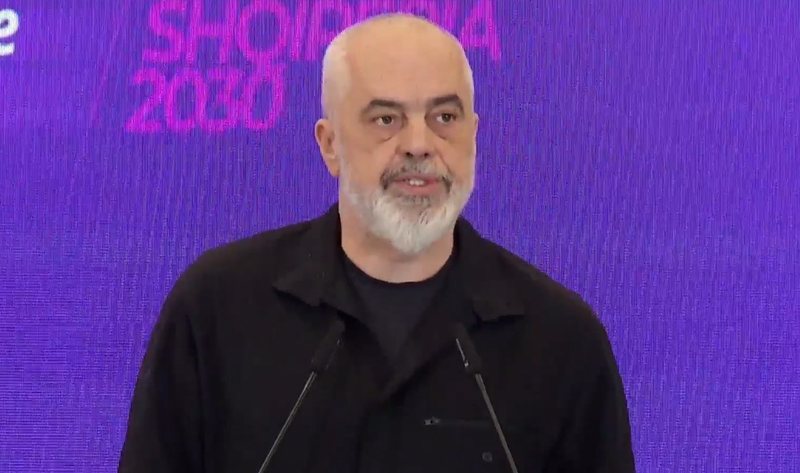
Prime Minister Edi Rama addressed the Socialist Party assembly in Durrës on Saturday in what amounted to one of the more programmatically dense internal party speeches he has delivered in recent memory. The setting was the PS assembly — a gathering of party structures, not parliament — and Rama used it as a platform to launch several simultaneous lines of political action: electoral preparation, institutional reform, a defense of his EU integration record, and a reorganization of the state’s territorial architecture. The speech was long, discursive, and at times combative. It covered at least eight distinct policy and political domains.
The Referendum Law and the Reduction of Deputies
The most structurally significant announcement of the session was Rama’s firm commitment to passing a referendum law within the current parliamentary session. Albania’s referendum legislation is, by his own description, a missing instrument — currently contained in only a few pages of the Electoral Code. The last referendum held in the country was in 1998, when citizens voted in favor of the new post-communist constitution. In the nearly three decades since, no significant initiative has gone through a popular vote.
Rama has been floating the idea of reducing the number of parliamentary deputies for several months. The proposal is specific: bring the number down from 140 to 100. The obstacle is equally specific: amending the constitution to change the structure of parliament requires 94 votes in the Assembly, a supermajority that the Socialists do not hold and are unlikely to obtain through negotiation with the opposition. The referendum path is therefore not a preference — it is the only available mechanism.
Rama framed this not as a workaround but as an overdue democratic exercise. “We will bring down the number of deputies,” he said. “I believe we are late on this, but we have all the necessary time to call Albanians to a referendum.” He was explicit that the referendum law itself must be passed within this parliamentary session — not merely discussed or tabled, but enacted. And he signaled that reducing parliamentary seats would not be the only item put to a popular vote: “There are other topics that we must put before Albanians and let them say who is with whom.”
The framing of the referendum as a mechanism for resolving politically blocked questions — rather than as a constitutional safety valve — marks a meaningful shift in how Rama is approaching legislative strategy in his third mandate.
EU Integration: Defiance and Reassurance
The Balluku immunity vote — the parliamentary majority’s decision not to allow SPAK to arrest former Defence Minister Belinda Balluku — has generated the most significant international diplomatic blowback of Rama’s current term. Germany led a chorus of EU member state criticism. The opposition has argued that the vote effectively closed Albania’s EU door.
Rama dismissed this framing with unusual force. “Negotiations have not stopped for a single second,” he said. He cited the European Commission’s progress report as “excellent for Albania” and declared flatly that the negotiations will be concluded within his current mandate. He then turned directly on the critics: “There are no cuckoo expats in Berlin that will stop us in this process. There are no cuckoo expats in Brussels that will stop us in this process.”
The “cuckoo expats” line — mërgatë qyqesh in Albanian — was not a general insult aimed at the diaspora. It was a targeted jab at PD-aligned political figures who travel to European capitals to lobby against his government. The contempt in the phrase was deliberate and the audience understood the reference.
Rama also addressed the EC monitoring mission that recently visited Albanian dairy and meat processing facilities. The results, he acknowledged, are “far from” the standard required to close the food safety chapter of accession negotiations. This was one of the few moments in the speech where Rama conceded a genuine deficit rather than deflecting criticism.
Depoliticization of the Electoral Administration
Rama described the politicization of Albania’s electoral commissions as “one of the most shameful points for an Albania that is getting ready to join the EU.” He went further, suggesting that Albania may be the last country in Europe still operating with a politically constituted electoral administration. OSCE-ODIHR has flagged this in multiple election observation reports over the years, and Rama acknowledged the recommendations directly, stating that they must be addressed.
The commitment here is to full depoliticization — not incremental reform, but a structural change to how Albania’s electoral administration is composed and operated. He said this must be done regardless of whether the opposition agrees. The framing was characteristically confrontational: this reform will proceed on the majority’s terms if the opposition refuses to engage.
He linked depoliticization to the broader EU accession timeline, presenting it not as a domestic good-governance measure but as a European integration deliverable.
The 2027 Local Elections: Conditions and Strategy
Rama signaled that the PS is now formally entering the preparatory phase for the 2027 local elections, with an internal campaign process running from now through the end of April and consolidating by the end of June. He was direct about what incumbents will need to demonstrate to earn re-nomination.
The conditions he set are non-negotiable and specific. No sitting mayor will be allowed to run again without having signed at least 10 contracts under the Mountain Package — the government’s flagship rural investment program — and without having established at least 3 approved joint enterprises. These are not aspirational targets. They are baseline requirements for candidacy consideration.
Rama also made a point of addressing the diaspora dimension of local elections. Unlike parliamentary elections, the diaspora does not vote in local contests. He argued that local elections are nonetheless the moment to demonstrate concrete results to Albanians abroad — not through festivals and meetings, but through documented investment in the territories where diaspora families retain land and connections.
The Mountain Package featured heavily here. Rama explicitly rebutted what he characterized as “nonsense from the pots” — slang for online misinformation — claiming the program is designed to hand land to oligarchs. His response was sharp: “There are no oligarchs in Albania. They use those who were brainwashed with the word kulak yesterday — to appear fashionable they now call oligarch what was once called kulak.” The program, he insisted, is for Albanians who hold land by law or custom but lack the financial instruments to develop it.
Voter Participation: Rama’s Alternative Arithmetic
In a segment that will likely generate controversy, Rama contested the official turnout figures published by the Central Election Commission. The CEC records approximately 44% turnout in recent Albanian elections. Rama argued that this figure is meaningless because the voter rolls include large numbers of Albanians who have emigrated and no longer live in the country.
His counter-argument: if you measure participation as a share of Albanians actually residing in Albania — rather than all registered citizens — the real turnout figure is approximately 80%. “In Albania there is no decline of interest in voting,” he said. “In Albania 80% of voters participate, because voters are those who are here and not those who are on the list and are somewhere else.”
This is a politically convenient reframing, but it also touches on a genuine structural problem: Albania’s electoral rolls have not been adequately purged of emigrant citizens, producing a denominator that inflates apparent abstention. Rama is using this to deflect the narrative of democratic disengagement, but the underlying data problem is real.
The Justice System: Independence Without Professionalism
Rama offered his most extended and nuanced assessment of the reformed justice system, and notably, he did not declare victory. He said that the new justice is fully independent — “and this is little.” Independence, he argued, is a necessary but insufficient condition. What the system still lacks is impartiality and professionalism, and on those counts “there is much road still to travel.”
The framing was careful. Rama deflected opposition attacks by noting that no one can produce evidence of judicial interference by the government: “We have handed the sword of the judicial system to the judicial system.” The governance of justice, he said, now rests with the judicial and prosecution councils and the inspector — not with the executive.
But he was also honest about expectations: “We never had the illusion that everything would function correctly in such a short time.” He compared judicial institutions to children who need time to grow — “except that democratic institutions take much longer than 18 years.” This is a long-term framing designed to pre-empt criticism of specific SPAK outcomes without directly addressing them.
The Territorial Reform and the Prefects
Rama announced a significant expansion of the role and powers of Albania’s 12 prefects. Under the current system, prefects function largely as administrative supervisors — signing off on municipal council decisions, with limited independent authority. Under the planned reorganization, they will become what Rama called “deputy interior ministers in the territory” — active agents of central government policy at the regional level with substantially expanded mandates.
He also announced that Albania has begun producing fire engines domestically, as part of a broader push to manufacture emergency civil protection equipment locally rather than import it. He described this as part of a systematic effort to strengthen civil emergency capacity across municipalities, backed by a dedicated fund.
On the territorial reform more broadly, Rama acknowledged that significant public confusion and deliberate disinformation are already circulating in advance of implementation. He called on PS members to go into the territory and counter this directly, arguing that the reform serves genuine public needs that citizens deserve to understand clearly.
Women in the Party
Rama was blunt to the point of embarrassment about the PS’s own gender composition. Only 34% of Socialist Party members are women. The party’s secretary general had apparently described this as a success — an increase from 26%. Rama was having none of it. “Unforgivable,” he said. The target is 50%, and he laid out a mechanism for achieving it: impose gender parity requirements on party organizations, and where a male-dominated organization refuses to admit it can find women, create a parallel women’s organization of equal standing and put them face to face.
He connected this to the PS’s electoral success, attributing the party’s dominance in part to women voters — including a pointed reference to Dibër, where he had told voters that a man who doesn’t listen to his wife when voting “is a quarter-wit,” and the electorate apparently agreed with him.
Small and Medium Enterprise Initiative
Rama briefly announced a new state initiative called “Double Your Enterprise” — a financing program targeting small and medium enterprises in the territory that have reached a ceiling of organic growth and need capital to expand. The state will provide financial backing for these businesses as they scale. He framed this partly as a diaspora-facing measure: Albanians abroad who retain land or business interests at home will have access to government financing instruments to develop them.
Tirana and the Internal Party Rankings
In the closing stretch of his remarks, Rama turned to internal party performance metrics. He singled out Tirana for underperformance relative to other districts, naming Shkodra and Lezha as regions that have made “extraordinary leaps” while Tirana has lagged. The tone was not gentle. “We are PS and we must raise Tirana above the middle of that ranking at all costs.” He acknowledged an unnamed “objective reason” for the gap but declined to elaborate, signaling that the underperformance is nonetheless unacceptable regardless of its causes.
Closing Observation
Taken as a whole, the Durrës assembly speech reveals a Rama in an interesting posture: simultaneously defensive on the international front — the Balluku fallout, the EU criticism — and expansive on the domestic reform agenda. The referendum law, the electoral depoliticization, the prefect restructuring, the 2027 local election conditions, the justice system assessment — none of these are holding-pattern announcements. They represent a dense forward-looking program delivered in the context of a party that has just absorbed significant reputational damage and is attempting to pivot toward institutional legacy-building.
Whether the pace of delivery matches the ambition of the announcements is a separate question. But the direction Rama has set from Durrës is clear: move fast, consolidate power where you have it, and dare the opposition and the diaspora critics to catch up.