The Flamingo protests earned a reputation. What sat at Rama’s back gate on Tuesday is spending it.
by Drizan Shala (Security Desk)
For most of the summer the world’s coverage of Tirana said the same thing. A protest that was peaceful, persistent, young, and not for sale. Channel 4 came for it. In July the Commissioner for Enlargement asked Tirana to repeal the law the boulevard had been marching against. Ninety-four consecutive evenings is a civic achievement in any European capital, and the Albanians who built it were entitled to the credit.
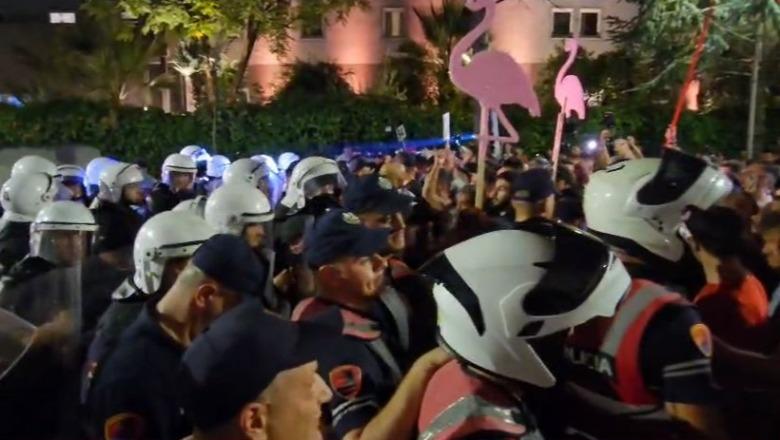
On Tuesday evening a few hundred people took that credit down Rruga “Ismail Qemali” and spent it. They did not stand in front of the Prime Minister’s Office. They went around the back, on the information that Edi Rama was in the building, sat across the entrance his escort uses, and were told from the megaphone to hold both gates. Stones went over the cordon. At least one officer was hurt; the police had issued no figure by the time this was written. More than ten people were taken to two police stations, the organizer Dritan Goxhaj among them, shouting as he went that the police were working for Rama. The crowd then marched to the police station to stand outside it. The prime minister left his office under escort.
None of this was improvised. The organizers said on Monday that September would open with civil disobedience, and they had been saying it through August. The crowd on Tuesday, in JavaNews’s own words, was low again. The objective the megaphone carries is not an election. It is the prime minister’s resignation, the removal of what the organizers call the political class, and a transitional government with a twelve-month mandate, appointed by no one who was voted for. A stated objective, a stated method, a stated calendar, and a shrinking crowd. Tuesday was the evening the protest stopped being a demonstration of numbers and became an operation to produce pressure without them. That is a design, and Tuesday was its first execution.
What the design produces
A movement with numbers does not need the back gate. It fills the boulevard and lets the arithmetic work on the government. A movement without numbers has to produce, by other means, the thing numbers used to produce: the image of a state under pressure. The gate, the cordon, the stone, the handcuffs, the march on the station, the prime minister leaving under escort. Ervin Karamuço, watching it live on Euronews Albania, called the injured officer “a warning, or a test, of what is expected in September,” and forecast the rest: blockades, resistance to police, the surrounding of the main institutions of the capital. He was reading the design off the street. It is not hard to read.
The design has one more component, and the organizers did not have to build it. The state built it for them. Against a few hundred people the government put the FNSH, its rapid intervention force, the “Shqiponja” units and the State Police’s special forces on the ground and parked a water cannon within sight of the gate. Whether the water was fired is disputed between the outlets that covered the night. It does not matter. Four formations and a water cannon for a crowd that could not fill a square is precisely the picture this method produces, and Tirana produced it. Overreaction is the cheapest asset on any destabilization board, because the target supplies it free.
Where it lands
What was designed for September lands on the state’s stability at the exact moment the state is being measured on it. Albania aims to close accession negotiations in 2027. It was awarded a NATO summit at The Hague last year, and that summit is confirmed in name and fixed in nothing else. Reuters reported on 30 June that the draft Ankara declaration had dropped Albania as the next host, citing the Trump administration’s reluctance and allies’ dissatisfaction with Tirana’s defence spending; after the summit Mark Rutte confirmed Albania would host the next meeting, and the declaration named neither the city nor the year. The defence minister said in July the date is for heads of state to fix and could slip to 2028. Albanian analysts were asking before Ankara whether the domestic crisis would be the next reason. A transitional government installed by a street cannot be reached through Tuesday’s method. What can be reached is the sentence in a foreign ministry cable that reads “domestic instability in Albania continues,” and that sentence is written from footage, and Tuesday was footage.
Here is the part the organizers should hear, because it is not the government’s argument and it is not flattering to the government. A protest that has to manufacture its own images has become raw material. It does not need a foreign owner to be useful abroad. Anyone who wants Albania described as unsteady in the month its treaty and its summit are being weighed does not have to send a euro or make a call. He needs the back gate, the water cannon and a police station with a crowd outside it, delivered by Albanians, and then he needs it to travel. Every protest travels; that is not the question. The question is whether Tuesday traveled fast, in a standardized narrative, through ecosystems already carrying hostile messaging about Albania, about enlargement or about the alliance, and whether the same accounts were ready for it before it happened. That is the difference between noise and exploitation, and Albania’s services can answer it from what they already collect. I have no evidence that it happened, and I am not going to invent any. I am saying the material was made to order, and the order was placed in Tirana.
The reputation
This is what the design costs. The Flamingo movement’s standing in the capitals that matter rested on one word, peaceful, and on the fact that ninety evenings of it had produced not one water cannon. The people who inherited that movement in its ninety-fourth week have traded the word for an image, and the image belongs to whoever uses it next.
A prime minister in Albania is removed with ballots, and the ballots are scheduled. What was announced for September and executed on Tuesday is a method for obtaining through pressure what the movement presently lacks the numbers on the street to compel. That is not persistence. It is the moment persistence turned into something the country will be asked to explain abroad, and the explanation, this time, will not be that Tirana is peaceful.
Drizan Shala is a security researcher and doctoral candidate at the University of Sarajevo. He writes on defense, private security, and the security architecture of the Western Balkans.