By Ylli Manjani, former Minister of Justice of Albania
Translated from the Albanian original, published 14 August 2026.
I cannot find a single genuinely successful political narrative from the opposition parties in all the time Edi Rama has governed. I say this not without pain, because for a long time I have wanted to find myself, given the public investment I have made, within a serious political alternative. I have not sought and do not seek a career in politics, but to stand on a front with people who think seriously about a political alternative is a good feeling.
That feeling, unfortunately, I never had.
The question that arises is simple: why has no political narrative built by the opposition since 2017 taken hold?
In a simple, even merely empirical analysis, the answer seems relatively clear. The narratives have been shallow, without substance, built on the quips of the day. Quips that can produce applause for an evening, but not political conviction for a decade.
Taken together, these quip-narratives have not held, because reality has dealt them hard slaps, very hard ones indeed.
The hardest slap of all, without doubt, has been and remains the acceleration of Albania’s accession to the European Union.
This has struck hard, very hard, not only at the quip-narratives of the “narco-state,” “Ramaduro,” “Ramaform” and others of that kind, but has struck at the foundations of a considerable part of the opposition’s narrative as such. So much so that the opposition today faces an existential dilemma: “To be or not to be.”
The problem is that the opposition’s narratives have been chiefly reactive and denunciatory, not inspiring for the future.
What has emerged from the opposition, above all, is the model of the political and public complainant. The complainant who denounces, reports, accuses and waits for the adversary to be brought down through a criminal process.
But here arises the greatest irony.
The political complainants have exercised their mission before the very justice system which, in the same opposition’s other narrative, stands accused of being controlled by the political enemy, Edi Rama.
So within the same day, the same justice system can be both an instrument captured by Rama and the fair arbiter that must punish his adversaries.
This does not produce credibility. It produces fatigue. And, ironically, the horoscope inspires more.
Because the horoscope at least tells you what to expect tomorrow. The opposition tells you only what not to like today.
Last, but not least in importance, the opposition’s critical narrative has been and remains focused on Edi Rama the person, not Edi Rama the politician.
This is perhaps one of its greatest mistakes.
To attack Rama, the opposition has often reached for models of political conduct that it practiced itself when it governed.
“Rama the bandit.” But when his political account holds no one killed and no one disappeared without a trace, the label becomes unbelievable.
“Rama the abuser of the media.” But when you are not facing a reality in which newspaper offices are burned by the SHIK [the state intelligence service of the 1990s] or by the police, this narrative too loses its force.
The problem is not only that these accusations are exaggerated. The problem is that they do not explain Rama.
And here lies the opposition’s greatest defect: the permanent refusal to know Rama as a political adversary.
It is easier to call him “bandit,” “criminal,” “narco-state” or “Ramaduro” than to sit down and understand where his political strength lies, where he yields, what makes him successful and, above all, how he can be defeated politically.
Because an adversary you do not know is an adversary you cannot defeat.
You can only curse him. And a narrative that exists only to dirty the adversary ends up dirtying only itself.
None of this is simple, of course.
Rama is perhaps the most utilitarian politician in the Albanian political space. He has few or none of the barriers of traditional morality usually set before a politician. Precisely this has been one of the sources of his success.
He has not needed to do battle with everything traditional politics considers unacceptable.
He has had no problem cooperating with people he considered adversaries a day earlier. He has had no problem walking out of a political situation even “naked,” if that serves the next objective.
In Rama’s politics, the means do not necessarily have a color. Neither does money, nor the people who hold it.
Whoever has resources and is prepared to use them for a project can be useful. But this does not mean that Rama automatically extends a moral guarantee for the legitimacy of the resource or of its bearer.
This is political utilitarianism. And it does not, in itself, make a “narco-state.”
It makes an unscrupulous political utilitarian, one who has no need to kill or disappear people in order to exercise strong political power.
This is precisely the distinction the opposition has failed to draw.
Rama is not a proceduralist. For that reason he is defective in much of the business of the state, above all where bureaucracy, procedure and administration demand patience and institutional discipline.
But precisely this lack of proceduralism has made him more direct, more comprehensible and, for many people, more popular.
This does not necessarily make him a statesman.
It makes him an effective politician. And that is where the opposition’s analysis should begin.
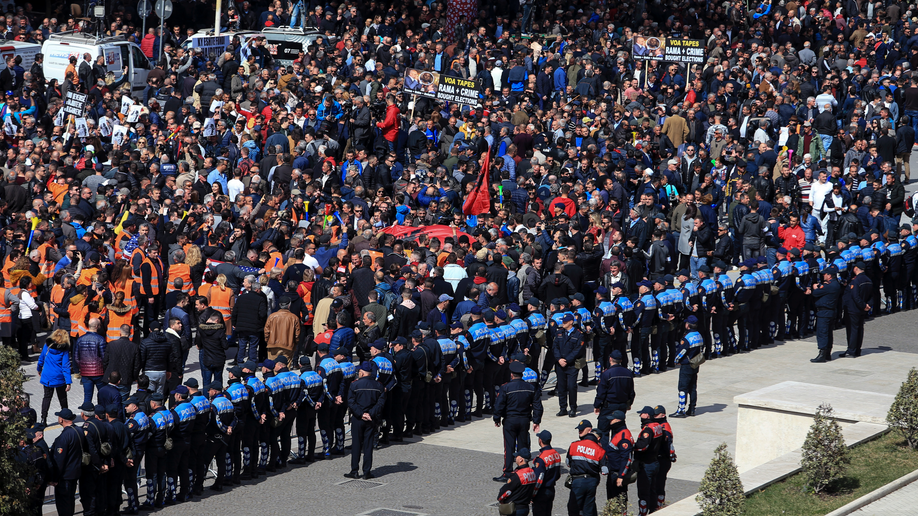
Rama is not a man who fears protest. In a way, he is even entertained by it.
Indeed violent protest, when unaccompanied by a credible political alternative, serves him.
Because faced with a protester repeating the same political quip, the police can afford to stand down, while faced with an adversary who has an idea, a project and a possible social majority, the game would change completely.
That is why the opposition’s protest so often looks more like a television performance than a political process. Even the comedy shows have produced longer-lived quips than the political opposition.
The opposition does not lose because Rama is invincible. It loses because it has still not managed to explain why Rama won.
It is not enough to say he is corrupt; you must explain why part of society keeps voting for him. It is not enough to say he is authoritarian; you must explain why so many people do not perceive him that way. It is not enough to say “narco-state”; you must build an alternative state that the citizen can imagine and desire.
It is not enough to denounce. You must inspire.
It is not enough to tell the citizen what is bad. You must show him what will be good.
And above all, you must build an Albania that exists in the citizen’s imagination before you ask for his vote.
That is what is missing.
An opposition that knows its adversary but does not copy him. An opposition that criticizes the government but does not build its own identity solely on hatred of the government.
An opposition that has no need to call Rama a “bandit” every day, because it holds a far stronger argument: “I can make this country better than he can.”
Until then, unfortunately, even the horoscope will remain more inspiring than the opposition’s political narratives.