Belgrade named the Albanians, then objected when Albania answered. The record requires correcting.
By Ardit Rada (Tirana)
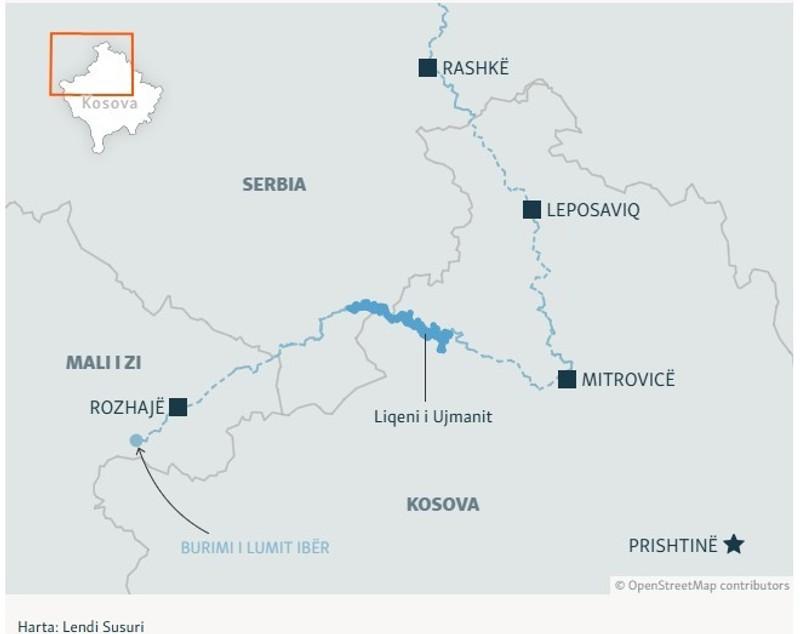
On Monday, Serbia’s foreign minister Marko Đurić published a lengthy statement in English, hashtags included, addressed to his Albanian counterpart, concerning a river that rises in Montenegro and sustains Kosovo. Albania’s stated concern over the announced diversion of the Ibër (Ibar), he wrote, “revives legitimate concerns about familiar regional concepts,” and then supplied the concept himself: Greater Albania. He warned against “ethnic expansionism and the redrawing of borders.” He closed with counsel about “loudspeaker diplomacy” and the wisdom of lowering one’s voice.
Since the record is being written in public, we will set it straight.
The Tirana Examiner has spoken off the record with Albanian institutional leaders. They confirmed to us that the statement issued by Minister Hoxha on Serbian threats stands exactly as written, and that Albania’s close interest in Belgrade’s manipulation of the Zelensky visit stands with it. Nothing has been walked back. We are told that nothing will be.
As for standing, the question answers itself. Serbia’s president announced the diversion with an addressee: let us see, he said, what the Albanians will do. The announced audience replied. Đurić now asks what business the reply was of Albania’s. He should direct the question to the man who named us. It is also worth recording what his statement does not contain. Minister Hoxha cited the water convention Serbia joined in 2010, together with the dispute mechanisms Serbia accepted. Đurić answered with the Serbian constitution and did not write the word convention once.
And since Đurić finds it useful to share advice, we will return some. These are no longer the 1990s. No one in Tirana or in Prishtina is intimidated by the rhetoric of Greater Albania, a phantom summoned whenever Belgrade needs to assign its own regional ambitions to its neighbours. Albania has been a member of NATO for seventeen years. Kosovo is building the forces required to defend its territory. Both countries are committed, deeply and by civic conviction rather than convenience, to the Euro-Atlantic political order. We require no lectures on expansionism from a capital that projects the Serbian version of the Russian World across four borders as an instrument for intimidating and destabilizing its neighbours, and whose president spent the first Sunday of this month rehearsing exactly that doctrine at a monastery in another state.
One thing in Belgrade’s ledger is true, and we will concede it plainly. Serbia has accumulated a significant arsenal, financed in part by the hundreds of millions it has earned selling ammunition to Ukraine, ammunition purchased for the purpose of killing Russian soldiers. Serbia’s president boasts of the planes openly; he counted three of them on television. A state that arms the enemies of its declared brother while performing brotherhood in Moscow’s direction has learned to hold two books at once. But self-confidence drawn from that kind of accounting can deceive. Arsenals measure what a state can buy. They do not measure what its neighbours will tolerate.
Belgrade will need, sooner rather than later, to reconcile itself with a fact that no statement, no hashtag and no working group will move: Kosovo is the first priority of Albania’s foreign policy. This is not a slogan of the moment. It is the settled position of the Albanian state, and Prime Minister Rama has stated it more than once, in terms that require no translation. Who harms Kosovo has harmed Albania.
Ardit Rada is a Tirana-based journalist covering politics, governance, and institutional developments. Focused on the intersection of domestic political dynamics and Albania’s European trajectory.