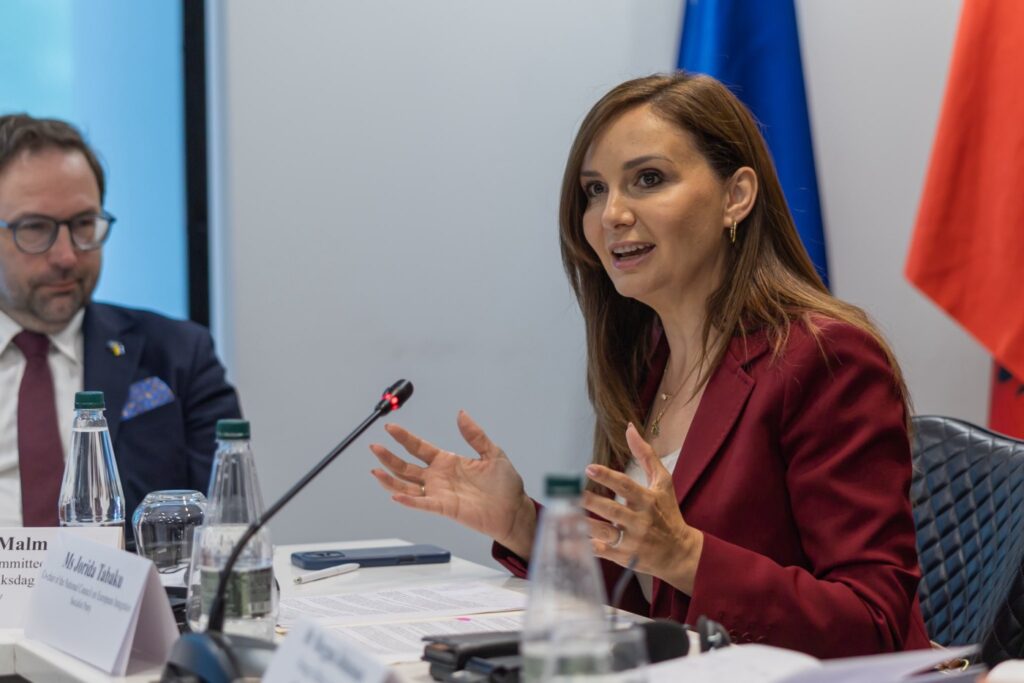
The Democratic Party’s most fluent transatlantic voice has spent four years presenting herself, in Strasbourg, Brussels, Berlin, and Tirana, as the institutional partner of Albania’s justice reform and the principal opposition critic of government obstruction of SPAK. On May 14, 2026, in a four-paragraph post in Albanian on her X account, she repudiated the position she had publicly maintained, in both languages and across every audience, for the four preceding years. The record is now in one document.
by Ardit Rada (Tirana)
On May 14, 2026, Jorida Tabaku, Democratic Party MP and the opposition’s principal interlocutor with the German Bundestag and the European People’s Party apparatus in Brussels, posted the following text on her X account in Albanian:
“Every reform the socialists undertake produces the same result: more power for a minority and less state for citizens. This is what happened with the territorial reform, which moved services away from citizens and weakened local representation. This is also what happened with the justice reform, which was promised as justice for citizens, but today is often perceived as a closed system, far from accountability and democratic control. Instead of reforms bringing the state closer to people, they have created a model where decision-making is increasingly concentrated in the hands of a minority. While citizens feel further from institutions, further from services, and less heard. Reforms have no value when they are built to strengthen power. They have value only when they strengthen the citizen, democracy, and trust in the state.”
Four paragraphs. Two reforms collapsed into a single causal frame. One assertion that the justice reform produced an institutional architecture “perceived as a closed system, far from accountability and democratic control.”
This piece is the documentary case that the proposition is irreconcilable with what Tabaku has said, in Albanian, in her own voice, on her own platforms, to her own electorate, continuously for the four years preceding the May 14 post. The record, examined in chronological order, establishes that Tabaku built her political identity, in both languages and across every audience available to her, on the proposition that SPAK is the legitimate institutional remedy, that the Rama government is the obstruction to it, and that the Democratic Party is the partner of the reform. That position was not occasional. It was constant. The May 14 post is not a clarification or a refinement of an evolving view. It is a rupture from her own four-year published record.
The 2016 Constitutional Vote
The constitutional amendments that created the architecture of Albania’s justice reform, the entire institutional package of SPAK, GJKKO, the Special Prosecution Office, the prosecutorial and judicial councils, and the vetting institutions, passed the Assembly on 21 July 2016. The vote was unanimous among deputies present, with the constitutional two-thirds majority that required Democratic Party consent. The package was negotiated under American and European mediation and was understood, at the time and for the decade that followed, as a shared national achievement under external supervision.
The institutions the reform produced have, in operational terms, fallen heaviest on the Socialist Party. Former interior minister Saimir Tahiri, prosecuted. Former deputy prime minister Arben Ahmetaj, prosecuted, in flight. Former health minister Ilir Beqaj, prosecuted. Tirana mayor Erion Veliaj, in pretrial detention since February 2025. The Belinda Balluku file has now produced the immunity vote that defines the present crisis. The Socialist Party has lost more ministers, deputies, and senior figures to SPAK than any other party in the country, by an order of magnitude.
Through all of it, the Socialist Party’s institutional line has been procedural rather than structural. Individual prosecutions are challenged on their merits; specific files are litigated in court; the legitimacy of the institution itself, the constitutional design that placed the prosecution beyond political control over individual cases, has not been challenged by the party that built it and absorbed its heaviest blows. Edi Rama, who has watched SPAK strip his cabinet of ministers, has not once said publicly that SPAK is a closed system lacking democratic control.
That formulation, until 14 May 2026, had no advocate inside the Democratic Party at the level of articulation Tabaku has just produced. She did not arrive at it from a record of consistent criticism. She arrived at it from a record of consistent defense.
The Four-Year Record: Tabaku and SPAK in Her Own Words
March 2022: SPAK as the legal vehicle against Rama
On 18 March 2022, Tabaku, then Vice President of the Democratic Party, held a media conference announcing the Democratic Party’s formal submission to SPAK of a criminal complaint against fifty named individuals, including Prime Minister Edi Rama, on the charge that they had operated as a “structured criminal group” in the incinerator concessions. The submission included 112 pieces of evidence. Tabaku, in her party’s name, used SPAK as the legal mechanism to attempt to prosecute the sitting Prime Minister of Albania. The premise of the submission was that SPAK was the legitimate, capable, and independent institution to which such a complaint could meaningfully be addressed.
The act of submission would face difficulty reconciling with an institutional assessment of SPAK as a closed system without democratic control. The 18 March 2022 record establishes, at minimum, that Tabaku’s operative view of SPAK at the time was that it was the legitimate venue for the gravest possible accusation against a sitting head of government.
October 2022: Strasbourg and Brussels
On 11 October 2022, Tabaku addressed the Parliamentary Assembly of the Council of Europe on the Western Balkans report. Her own LinkedIn post documenting the address read: “Balkan countries should accept responsibilities and move fwd! Moving fwd means EU integration and fully embrace EU values… WB has not been sheltered from democratic backsliding: corruption, breach of human rights, media freedom and inability to hold free and fair elections! So lets use the accession process as a drive for change!” The accession process is framed as the corrective architecture; the implicit institutional remedy is the rule of law architecture the reform produced.
A week later, as President of the National Council of European Integration, Tabaku raised concerns about corruption, the golden passport scheme, and fiscal amnesty with the EU Ambassador to Albania. The opposition position was articulated as aligned with EU standards; the government was the source of the violations.
2023: “Support for SPAK”
In a public statement during the Tirana tower controversy in 2023, Tabaku wrote, in Albanian, on her own platforms: “SPAK is doing an extraordinary job in stopping corruption and disbanding the political and economic oligarchy. Where the economy, politics, media and every sector has sunk today can really change only with an uncompromising fight against corruption and support for SPAK.”
The phrase to mark is her own: “support for SPAK.” Not support for justice in general, not support for the rule of law in the abstract, but support for the specific institution she now describes as a closed system. The statement was made to her own electorate, in her own language, with no foreign audience present.
January 2024: The European Parliament SAPC
On 24 January 2024, the 17th meeting of the EU-Albania Stabilization and Association Parliamentary Committee convened in Brussels. The committee issued a formal call urging the Albanian parliamentary majority to restore opposition oversight rights. Tabaku, as Chairwoman of the Albanian Parliamentary Committee on European Affairs, addressed the committee. Her statement, as transmitted by Tirana Times: “the importance of electoral reform and the independence of the judiciary, which, according to her, are at risk from the majority’s efforts to control justice institutions.”
This is the analytical center of the contradiction. Read it twice. In January 2024, in Brussels, in an EU institutional setting, Tabaku said that the threat to the independence of the judiciary was the parliamentary majority’s effort to control the justice institutions. The justice institutions, in her January 2024 frame, are the entity to be protected; the majority is the threat. In May 2026, on X, the justice institutions are themselves the entity to be condemned, as a closed system lacking democratic control. The same SPAK, the same KLP, the same architecture. Described in directly opposing terms. Twenty-eight months apart.
In the same January 2024 Brussels address: “Albania’s battle against corruption at high levels is crucial for integration. Parliament must approve Investigative Commissions as requested by the opposition… The fight against corruption begins with a parliament in the service of citizens.” The architecture is unambiguous: corruption is the disease, parliamentary oversight and SPAK are the cure, the Socialist majority is the obstacle.
October 2024: The “captured state” address
On 30 October 2024, at the 18th meeting of the EU-Albania Stabilization and Association Parliamentary Committee, Tabaku delivered what international press characterized as a “forceful address” describing Albania as a “captured state” overwhelmed by systemic corruption. She cited 80 percent of Albanians experiencing corruption firsthand and 2.16 percent of GDP as “dirty money,” naming Vlora airport, Durrës port, and the National Theater as Stabilization and Association Agreement violations.
The frame is critical. The “captured state” terminology is applied to the government, not to the prosecution. SPAK is the implicit institutional remedy. The international community is asked to recognize the capture and to support the institutional architecture that resists it. The word “captured” in the 2024 frame attaches to the executive. In the 2026 frame, it attaches to the prosecution. Same vocabulary, opposite referent, same author.
February 2025: Veliaj’s arrest and “maximum congratulations”
On 14 February 2025, SPAK arrested Erion Veliaj, sitting Socialist Party mayor of Tirana. Tabaku appeared on News24 the same day. Her statements:
“It is news that citizens have been waiting for a long time, knowing the criminal scheme that has operated in the Municipality of Tirana, which has been reflected in the incinerators, in the 5D case. Veliaj’s arrest is the dismantling of the corrupt system… It was a beautiful day when Veliaj went to SPAK. It was a good day when Veliaj was imprisoned.”
And, directly on SPAK as an institution: “There are prosecutors with integrity in SPAK, but there are also people in SPAK who do not have enough integrity. For the Veliaj case, SPAK has the maximum congratulations.”
“Maximum congratulations.” To the institution she now describes as a closed system lacking democratic control. Fifteen months between the two statements.
February 2025: The government’s attack on SPAK as “a coup”
On 19 February 2025, in an A2 CNN interview, Tabaku addressed the government’s response to a separate SPAK measure. The crucial passage is her institutional framing: “We have raised concerns regarding the political pressure exerted on justice… What happened with the government’s protest against an institution has never happened before in Albania. I have called it a coup. This is inconceivable.”
A coup. In February 2025, the government’s attack on SPAK is a coup against an institution. In May 2026, SPAK itself is a closed system lacking democratic control. The institution that was a victim of an attempted coup in February 2025 becomes, in May 2026, an unaccountable entity in need of democratic correction. Both statements made by the same author. Both in Albanian. Both to Albanian audiences.
This is the second analytical anchor of the contradiction, and it is sharper than the first. The same vocabulary of constitutional crisis is deployed in February 2025 to defend SPAK and in May 2026 to attack it. The institutional referent does not change. The threat actor reverses.
July to October 2025: Brussels and the EP report
On 9 July 2025, before the European Parliament vote on the Albania report, Tabaku issued a public video statement: “As the European Parliament report emphasizes, Albania poses an extraordinary challenge to democracy, to institutions, to free elections and to the rule of law.” The framing places Europe and the government in opposition; the EP report is treated as vindication of the opposition’s reform critique; the government is the obstruction to the integration process.
On 28 October 2025, the 20th SAPC convened in Tirana. Tabaku, as deputy chair of the Albanian delegation, emphasized the importance of integration but argued the process needs improvement, citing “lack of transparency and the inclusion of the opposition.” The institutional grievance is articulated against the executive; the EU framework is the venue at which it is registered.
November to December 2025: The Balluku indictment and the immunity vote
On 6 November 2025, on the Balluku indictment, Tabaku in Albanian: “The Llogara tunnel scandal, face of corrupt governance… Parliament must rise to the height it deserves, for transparency and justice.”
On 20 November 2025, after GJKKO suspended Balluku from duty: “A unique case in the world when the court suspends a deputy prime minister!” The framing accepts the court’s action as correct and proportionate; the scandal is the government’s defense of Balluku, not the court’s action against her.
On 16 December 2025, in advance of the parliamentary vote on Balluku’s immunity, Tabaku spoke in Albanian: “The Prime Minister is preparing to give political cover to his deputy, who is a defendant. Support for justice is measured by actions, not statements. Today, the socialist majority seems determined to vote against SPAK’s request.” And the headline formulation: “The Assembly is not a law firm! Every vote against justice is in favor of theft!”
Read that last sentence against the May 14 X post. In December 2025, every vote against SPAK’s institutional request is a vote in favor of theft. In May 2026, the institution making the request is itself a closed system far from accountability and democratic control. If the institution lacks democratic legitimacy, the vote against its request cannot be a vote in favor of theft. The two propositions cannot both be the speaker’s actual institutional assessment.
Balkan Insight on the same day transmitted the same framing in English. The Albanian-language and English-language framings were identical and pro-SPAK. This is not a foreign-versus-domestic split. It is a temporally consistent record of one position, maintained across both audiences, which Tabaku then ruptured on May 14.
February 2026: SPAK as authority in parliamentary committee
On 16 February 2026, during the parliamentary debate on the draft law on Electronic Governance in the Laws Committee, Tabaku told the commission: “Those 500 million euro tenders that AKSHI was awarding, which until yesterday, as SPAK says, were awarded by a structured criminal group.”
She is citing SPAK’s institutional findings, by name, in the chamber, as authoritative basis for an argument against a government draft law. The institution whose finding she invokes as authority in February 2026 is the institution she describes as a closed system in May 2026. Thirteen weeks separate the two statements.
March 2026: The Berlin delegation
On 18-19 March 2026, a Democratic Party delegation traveled to Berlin. Tabaku, with Gazment Bardhi and Klevis Balliu, met over two days with senior Bundestag figures including the Foreign Affairs Committee chair, the Western Balkans rapporteur, the CDU deputy group chair for European affairs, and the Bundestag’s principal Albania specialist.
The substantive frame, consistent across the meetings as recorded in the published Democratic Party readouts, was that the Albanian justice reform is real, valuable, and ongoing; SPAK is the institution that gives the anti-corruption fight its credibility; the Rama government is obstructing it; and the Democratic Party is the partner of the reform. The operative formulation, from the Knut Abraham meeting, in the published readout in English: “The government and the SP in Albania are obstructing justice and are giving political protection to corruption with votes. This is damaging the country’s credibility and is holding the integration process hostage.”
The Berlin delegation was the culmination, not the beginning, of a four-year transatlantic campaign in which Tabaku presented herself as the institutional partner of SPAK and the principal opposition critic of the government’s obstruction of the reform.
April and May 2026: The McAllister channel
On 30 April 2026, Tabaku submitted a formal account to David McAllister, Chair of the European Parliament’s Committee on Foreign Affairs, alleging that the Albanian government is excluding the opposition from EU accession information flows and failing its constitutional obligation to inform Parliament on accession-related reforms; on 7 May, McAllister transmitted the account to Marta Kos, Commissioner for Enlargement.
The substance of the McAllister letter is the inversion of what Tabaku would publish one week later. In the McAllister channel, the government is the obstruction and the EU is asked to intervene institutionally. In the May 14 X post, the reform architecture for which Tabaku has sought EU institutional protection is itself reframed as a vehicle of minority capture.
May 14, 2026: The post
Seven days after the McAllister-Kos letter. Eight weeks after the Berlin delegation. Twelve weeks after citing SPAK’s findings as authority in parliamentary committee. Fifteen months after awarding SPAK “maximum congratulations” for the Veliaj arrest. Fifteen months after describing the government’s protest against SPAK as a “coup.” Twenty-eight months after telling the European Parliament that the threat to judicial independence was the SP majority’s effort to control the justice institutions. Forty-six months after submitting a 112-piece evidentiary file to SPAK in a criminal complaint against fifty individuals including the Prime Minister.
The X post: “the justice reform… today is often perceived as a closed system, far from accountability and democratic control.”
The same SPAK. The same KLP. The same constitutional architecture. The position reversed.
What the Record Establishes
The May 14 post is not Tabaku’s first formulation of a critique of the justice reform. It is the first formulation in her four-year published record that attacks the legitimacy of the institutional architecture itself rather than the government’s interference with it. The distinction is total. Every prior statement, in every venue, in both languages, frames the architecture as legitimate and the government as the obstruction. The May 14 statement frames the architecture as the obstruction and obscures the government’s role entirely.
This is not a position drift across years. The transition is compressed into weeks. On 30 April 2026 Tabaku transmitted to the AFET Chair a complaint built on the premise that the government is obstructing parliamentary oversight and that the EU rule of law architecture is the standard against which the government should be measured. On 14 May 2026, two weeks later, the same author writes that the justice reform architecture is itself a minority-capture project. The author has not announced a change of view. The author has not addressed the contradiction. The author has placed both positions on the public record within fifteen days, on the assumption that the audiences are not in communication.
What ruptured on 14 May 2026 is not a foreign-versus-domestic split. It is the speaker’s four-year record. The post is the first instance, in her own four-year archive, of a categorical attack on the constitutional design of SPAK rather than on the government’s interference with it. The author offers no explanation, no transition, no acknowledgment. She writes the new position as though it had always been her position. The archive establishes that it has not.
The Five Propositions the Post Commits Her To
First, that the justice reform is a project of the Socialist Party rather than a cross-party constitutional achievement. The historical record contradicts this directly. The unanimous Assembly vote contradicts this directly. Tabaku’s own four-year messaging contradicts this directly. Adopting the position requires erasing the Democratic Party’s constitutionally necessary vote and conceding to Edi Rama the singular authorship of the most consequential institutional reform in Albania’s post-communist history.
Second, that SPAK is a captured instrument of a political minority rather than an independent prosecutorial body. This proposition is contradicted by the operational record, which Tabaku herself has celebrated repeatedly. The list of Socialist Party figures prosecuted by SPAK is long, recent, and ongoing. No prosecutorial institution captured by the Socialist Party would produce that record. The proposition is also contradicted by the institutional record: the Socialist Party majority has just refused to strip Balluku’s immunity at SPAK’s request, an act incompatible with the claim that the prosecution serves the majority.
Third, that the prosecution and the anti-corruption courts lack “democratic control.” This is the most serious of the propositions and the one that crosses from partisan critique into constitutional attack. The reform was designed, deliberately, to insulate the prosecution from political control over individual cases. That was the purpose. The KLP provides institutional governance; the appellate structure provides legal review; the Constitutional Court provides constitutional oversight. To call the resulting architecture a lack of “democratic control” is to attack the constitutional design itself, not its implementation. It is the line Tabaku herself, in February 2025, identified as a coup against an institution when used by the government.
Fourth, that the case Tabaku has made in Brussels, Strasbourg, Berlin, Tirana, and her own published Albanian-language statements for the four years preceding the May 14 post cannot all be the speaker’s actual institutional assessment. At minimum, one register is receiving a representation she does not consistently maintain elsewhere. Given that the four-year record is uniformly pro-SPAK and that the May 14 post is the single rupture, the analytical weight of the contradiction falls on the post, not on the record.
Fifth, that the speaker is repudiating her own political identity. Tabaku has built her career as the technocratic, EU-fluent, transatlantically credible opposition voice on rule of law and institutional reform. That identity rested on a single substantive proposition: that the architecture is legitimate, the government is the obstruction, and the opposition is the partner. The May 14 post abandons that proposition. The question this raises, which the piece registers without attempting to answer, is whether the abandonment is electoral positioning, generational repositioning of the Tabaku profile to a different audience, or a coordinated party realignment in advance of the next political cycle. Whichever it is, the record of what came before is now part of the public file.
The Closing of the Documentary Gap
The consolidated Albanian-language record of the position Tabaku has now repudiated has not previously appeared in English in a single document. The briefing materials on which her transatlantic relationships have been built do not contain it. Until this piece, the Albanian-language archive of her domestic pro-SPAK statements existed only in scattered form across four years of Balkanweb, Euronews Albania, A2 CNN, and her own platforms. This piece is the first time that archive has appeared in English in a single document.
The point is not to call for sanction or to demand a response from Berlin or Brussels. The point is the record. It exists in published Democratic Party readouts and Bundestag meeting confirmations from Berlin; in SAPC transcripts, EPP Group panel appearances, and the McAllister-Kos letter from Brussels; in PACE addresses and EP Stabilization and Association Committee filings from Strasbourg; and in her own published Albanian-language statements over four years from Tirana, in which she submitted to SPAK a criminal complaint against the Prime Minister, awarded SPAK “maximum congratulations,” called government attacks on SPAK a “coup,” and described every vote against SPAK’s institutional requests as a vote in favor of theft. The X post of May 14, 2026 exists, in the form of four paragraphs on her own account, in her own language, on her own initiative, against the institution she has spent four years defending.
The contradiction between the May 14 post and the four-year archive is now testable against a single document rather than reconstructed from scattered sources in two languages across four years. The next time Tabaku enters a Bundestag committee room, sits with a CDU foreign-policy adviser, addresses an EPP gathering in Brussels, lectures at a Western Balkans law faculty, transmits a complaint to the AFET Chair, or publishes a video before a European Parliament vote on Albania, the documentary record will be available, in English, for any interlocutor who wishes to consult it.
That is the consequence. Everything else follows from it.