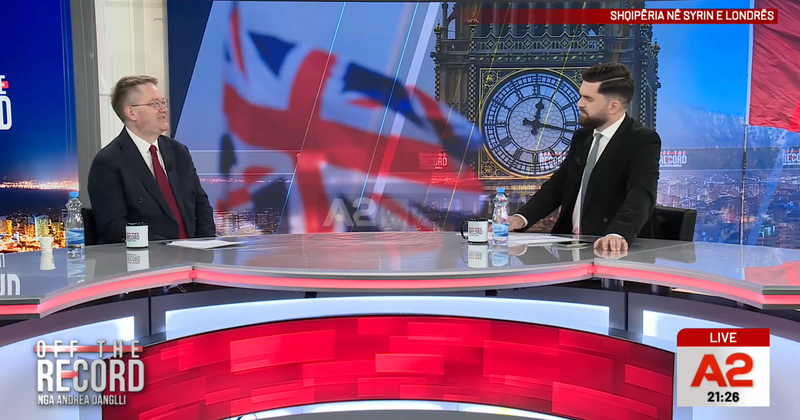
Ambassador Nicholas Abbott told A2 CNN on Wednesday evening that Albania’s opposition believes its role is only to block. The record supports him.
Editorial Board
Speaking to Andrea Dangllin on A2 CNN’s Off The Record on Wednesday evening, British Ambassador Nicholas Abbott delivered the most direct foreign-government appraisal of Albania’s opposition aired on domestic television in recent memory. The phrasing was careful. The meaning was unmistakable.
“The opposition in Parliament and opposition parties have a key role to play,” Abbott told Dangllin, “and in our system we speak precisely about a loyal opposition, because it is an opposition that has to be there to challenge the government, to challenge its policies, to challenge the government’s proposals, often by offering other options.”
Then the line that has dominated reaction since the broadcast: “The challenge here, often, is that the opposition believes its role is only to block. And this does not help. It is not constructive.”
He went further. “Albania needs an opposition that is willing to engage on the issues, that is willing to ensure that it can offer alternatives. Because this, ultimately, is what political competition is.”
The diplomatic register is recognisable to anyone who reads Foreign Office cables: framed in the abstract language of “the system,” courteous, declining the temptation to name parties or persons. But Abbott was not speaking in the abstract. He was speaking in May 2026, after a particular sequence of opposition behaviour, to an audience that knew exactly which party he meant.
Abbott also knows what he is not saying. He has served in Tirana long enough to have read every European Commission progress report, every OSCE/ODIHR election assessment, every SPAK indictment file that has crossed his desk. He is aware of what the government does. He has made statements about that, on the record, on other occasions. On Wednesday evening, however, he was answering a different question, and answering it deliberately. The question is whether Albania has an opposition capable of doing the work an opposition does. His answer was that it does not. The case for that answer is the subject of what follows.
The Democratic Party has, since October 2023, operated parliament as a stage for disruption rather than as an arena for legislative contest. The choreography is by now familiar: flares lit in the well, including black flares during the 18 December 2025 ombudsperson session; water and bottles thrown at the Speaker; ministerial benches occupied; small fires set during the November 2023 budget vote; chairs piled against the rostrum; microphones grabbed from socialist deputies mid-speech; physical scuffles with parliamentary police. Reuters, AP, BIRN, the BBC and Fox News have all carried footage. The European Commission’s 2025 progress report, published 4 November, recorded the pattern: “Political polarisation, lack of genuine political dialogue and clashes between the ruling majority and parts of the opposition continued to affect Parliament’s activity.” The European Parliament’s Schieder report on the 2023 and 2024 Commission reports, adopted in plenary on 9 July 2025 by 502 votes to 120 with 64 abstentions, was sharper. It “deplores the continued confrontations and inflammatory rhetoric by politicians from all parties” and called on parliamentarians “to demonstrate full respect for the role of parliamentarism, by putting an end to political attacks.” Abbott was not improvising. He was reading from a shared Brussels and London text.
The pattern of refusal extends beyond disruption to outright absence. The Democratic Party boycotted the 17 March 2026 plenary that adopted the resolution declaring Iran a state sponsor of terrorism. Parliamentary group chair Gazment Bardhi framed the boycott in procedural terms, citing rules of procedure. The procedural objection had its merits and could have been made from the floor through dissenting votes and recorded speeches. The party chose absence instead. The precedent runs deeper: the 2017 mass boycott, the 2019 mandate resignations, the 2019 local election boycott. Boycotts have become the standard reflex when the party cannot prevail in the chamber, and the reflex has become the substitute for an argument.
Beyond parliament, the party’s stated programme is not a policy platform but the demand to dismantle the elected government. At the closing 2025 Democratic Party conference, again at the 24 January 2026 rally outside the Prime Minister’s Office, and again at the 10 February protest, Sali Berisha articulated his goal in identical terms: “the overthrow of this regime, the technical government, new elections.” That is not the vocabulary of alternation. It is the vocabulary of a faction that has lost faith in its own capacity to win an election and has substituted street pressure for electoral persuasion. The January and February rallies produced their own evidence: Molotov cocktails and stones thrown at the prime minister’s office and parliament, fireworks fired at government buildings, at least twenty-six police officers injured across the two demonstrations, dozens arrested. When the parliamentary arena is treated as ungovernable and the street as the alternative, the question of what kind of opposition Albania has, has already been answered.
There is also the leadership question, which Abbott was too courteous to raise but which structures everything else. The Democratic Party’s chairman was sanctioned by the United States State Department under Section 7031(c) on 19 May 2021, sanctioned by the United Kingdom in 2022, placed under house arrest in December 2023 on a SPAK indictment over a 2008 privatisation scheme that allegedly benefited his son-in-law, and remains under judicial supervision today by the Special Appeal Court for Corruption and Organised Crime. Franziska Tschinderle, writing in European Western Balkans on 1 April 2026, put it plainly: in the wider public, Berisha “is not perceived as a particularly credible leader of an anti-corruption movement.” In the same piece, Albanian political scientist Afrim Krasniqi was sharper. The opposition’s “failure to reform, renew its leadership, become electorally attractive, and position itself as a credible partner to the United States and the European Union reflects strategic miscalculations by its leaders and effectively constitutes a ‘free gift’ to Prime Minister Rama’s government.”
The market verdict is consistent with the diplomatic one. The Warsaw-based Centre for Eastern Studies, in its 30 April 2026 analysis, cited polling showing the Socialist Party has shed six points since the May 2025 vote. None of that loss has accrued to the Democratic Party. Twenty-six percent of Albanians say they would prefer to vote for an entirely new political movement, unconnected to the existing elites. There is visible public appetite for an alternative. The existing opposition is not the alternative that appetite is reaching for. The political market is open, and the party that has spent ten years declaring itself the only alternative has not been able to occupy it.
Abbott’s diagnosis on Wednesday evening was not editorial. It was a statement of what is observable from the diplomatic gallery, from the European Commission’s drafting room, from the European Parliament chamber, and from Albanian voters who have steadily withdrawn their consent from the existing opposition without transferring it anywhere yet. Albania does not, at present, have a loyal opposition in the sense Abbott described. It has a faction that mistakes the appearance of resistance for the substance of it, and that has confused making the government’s life difficult with the harder, slower, more useful work of giving Albanians a reason to choose differently.
The country needs the second thing. It is not getting it.