An open letter to the Embassy of Ukraine in Tirana
By Albatros Rexhaj (Tirana)
On 9 August the Ministry for Europe and Foreign Affairs published its statement on President Zelenskyy’s visit to Serbia. We write to make certain that nothing in it is read as routine. The Ministry called the visit important and dialogue welcome. It then wrote a sentence we ask you to transmit to Kyiv exactly as printed: any attempt to draw a parallel or establish an equation between Kosovo and any other international situation is “wrong, opportunistic and profoundly misleading.”
The statement answers Saturday. A journalist of Serbian state television asked your president whether Serbia could continue to count on Ukraine over Kosovo. He said: “We respect the territorial integrity of our partners, we respect international law. Therefore, our position on what you said, the unilateral declaration of independence of Kosovo, remains unchanged.”
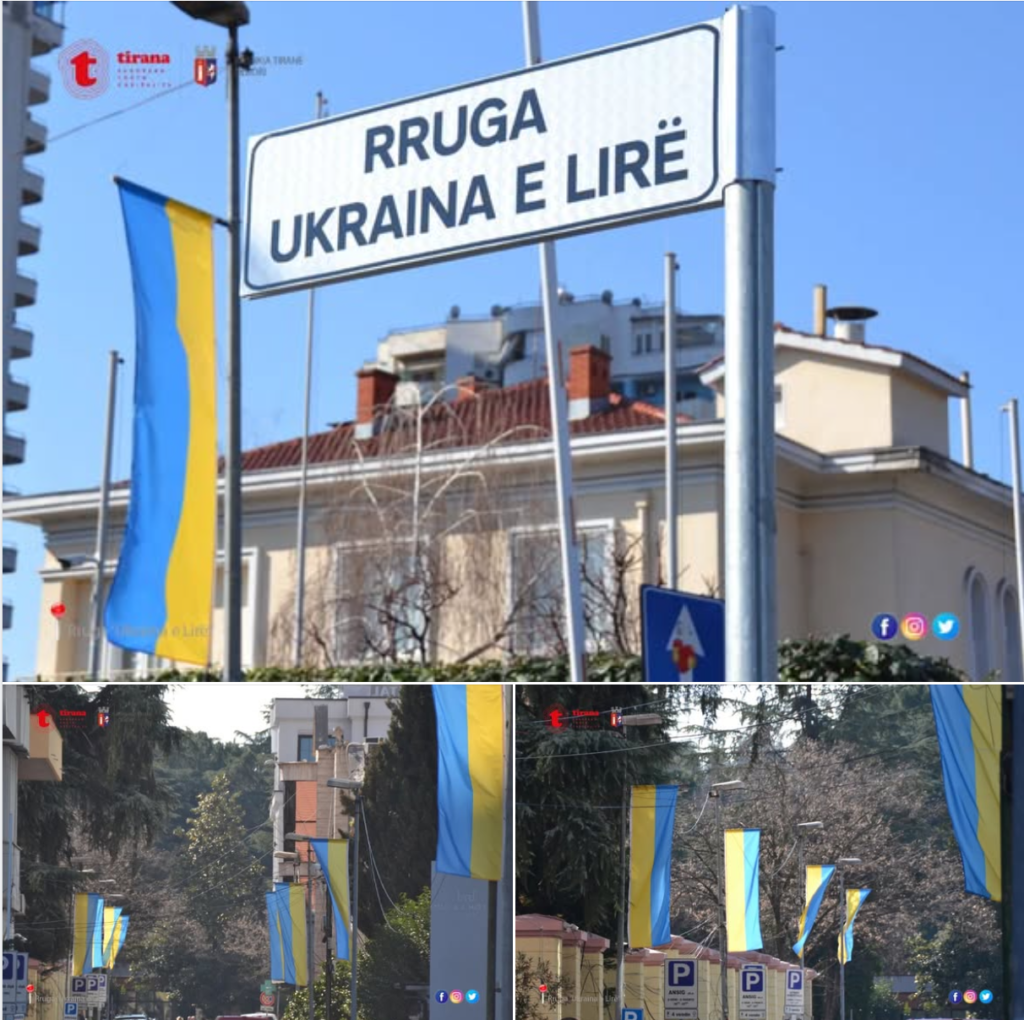
This letter arrives at an embassy that this week has no ambassador. By Decree No. 710/2026 your government ended Volodymyr Shkurov’s mandate after six years, within a wider rotation of your embassies. We read nothing into the timing, and we address whoever in your chancery opens the mail. It arrives at Free Ukraine Street 5. On 7 March 2022, eleven days into the invasion, Tirana’s municipal council voted unanimously to rename the street that carries your chancery, until that Monday named for Donika Kastrioti, the wife of Skanderbeg. The same street houses the embassies of Serbia and of Kosovo. This city chose its side in the invasion’s second week, in letters visible from your windows.
Weigh the question before the answer. What state television asked was whether Serbia can count on Ukraine: the vocabulary of allegiance, with the sides already drawn and Kosovo cast as an asset one capital holds for another. The frame had an exit. A president may answer that recognition belongs to law and to a state’s own institutions, and is no neighbour’s asset to count on. Your president answered inside the frame. Recognition is Ukraine’s decision; reassurance to Belgrade was his choice. On the record of Serbian state television, Kosovo is now something Serbia counts on Ukraine for.
We are deeply disappointed by what your president said. By answering a question about Kosovo with respect for Serbia’s territorial integrity, Ukraine has chosen, in this case, to stand where Russia stands. That is why this declaration is particularly painful, and why we disagree profoundly.
Permit us one question about vocabulary. Your president spoke of partners. Partners in what? We know the word has a short history: he praised Serbia’s support in Odesa last June. Here is the record behind it. Serbia has voted for General Assembly resolutions on your behalf, and in four and a half years of your war it has joined no sanctions against your aggressor. Its ammunition reached your defenders as commerce, through intermediaries whose destinations Belgrade professed not to control. When Moscow’s foreign intelligence service complained aloud in May of last year, calling the trade a stab in the back, all exports were halted within a month, and any future shipment now requires the consent of Serbia’s National Security Council. That is the partnership: deniable while it ran, suspended on the aggressor’s complaint, and priced, on Saturday, in the territory of the partners who never asked to be paid.
On the law, the Ministry’s words need no improvement: “At the request of the UN General Assembly, the International Court of Justice was unequivocal: Kosovo’s declaration of independence did not violate international law. Russia’s aggression against Ukraine is an entirely different matter.”
Nor is the record in dispute. Serbian and Yugoslav forces under Milošević carried out large-scale ethnic cleansing and crimes against humanity in Kosovo, atrocities extensively documented and established before international courts.
The Ministry calls your president’s visit “understandable and legitimate,” and we agree. We will not pretend to instruct a government at war on the price of its diplomacy. States fighting for survival take help where help is found. It is precisely because we understand it that Saturday’s words landed as they did.
Albania, Kosovo and Albanians everywhere have stood with Ukraine since day one of Russia’s aggression. When Albania sat on the Security Council, it spent the seat on you: co-author, with the United States, of the resolutions Russia vetoed. On 20 September 2023, your president came to the Council in person for the first time, and Russia’s ambassador objected to him taking the floor at all. The session’s president was Edi Rama, and the record preserves his answer: “You stop the war, and President Zelenskyy will not take the floor.” Your president took the floor. We have supported Ukraine’s sovereignty, territorial integrity and right to determine its own future without hesitation. We will not change our position, because we believe in Ukraine’s just cause and in the principles of sovereignty, freedom and the right of peoples to live in peace and determine their own future.
This February, at the commemoration of the invasion’s fourth anniversary here in Tirana, Ambassador Shkurov told this city that Ukrainians had defended not only their land and their homes but “sovereignty, freedom and the right to determine their own future.” We learned nothing new that evening. We were listening to our own vocabulary.
But we expect these principles to be respected consistently, not selectively.
And your government should hear plainly what Saturday has cost. In January your foreign minister, receiving his Albanian counterpart in Kyiv, thanked Albania by name: for the Coalition of the Willing, for the coalition returning Ukraine’s children, for the Air Force Coalition, for the sanctions, for the visa regime imposed on citizens of your aggressor. The inventory was accurate, and every line of it is discretionary. None of it is owed; all of it has been given, by governments answering to a public that backed you with no ifs and no buts when it was hardest. Something has been seriously damaged here, and it is larger than government-to-government relations. The question already circulating in Tirana is: for what? For a partnership that suspends itself on Moscow’s complaint? Business as usual will be very hard to maintain, and the difficulty will not come from governments first. It will come from the people who renamed your street.
Two words now stand on the record of a single weekend: unchanged, spoken in Belgrade, and irreversibility, written in Tirana. Those who have themselves suffered war and atrocities at the hands of a larger neighbour are expected to understand each other’s wounds, not to reopen them.