When a security regulation bars a defendant’s chosen lawyer from the courtroom, the court has stopped being one.
By Ylli Manjani
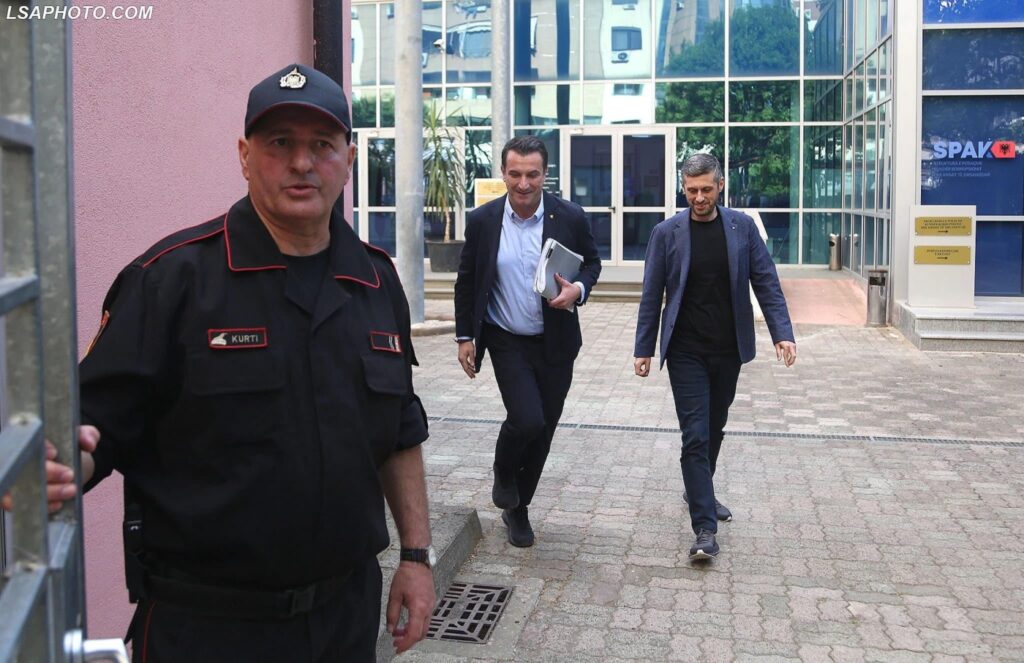
Editor’s note: The author is a former Minister of Justice. The piece answers an incident of 4 September, when defence lawyer Dorian Matlija was kept out of a courtroom at Albania’s Special Court against Corruption and Organised Crime (GJKKO) after refusing to surrender his phone under the court’s new internal regulation on security, order and solemnity, adopted by the court chair in July and in force since 1 September. By his account the trial judge found his objection reasonable, the prosecutor insisted, and the court then fined him 50,000 lekë (about 500 euros) at the prosecution’s request. He has appealed. Press associations had already objected in August to the same regulation’s accreditation and filming rules. Bracketed glosses in the text are ours; the piece is otherwise published as written.
The Republican Guard’s barring of lawyer Dorian Matlija from the courtroom is flagrant proof of how a court chair, and an acting one at that, can violate due process at the GJKKO. He has issued a security regulation that owes more to the logic of a police state than to the standards of a court in a constitutional democracy.
[The Republican Guard is the state body that protects the President, Prime Minister, Speaker and designated buildings under its own statute. It has held the outer perimeter of the special court and prosecution since October 2025, after a judge was shot dead in a Tirana courtroom.]
Whenever power begins to justify its own abuses, it reaches for the argument of security. Whenever that word is used, the democratic alarm should sound.
The real question is what the GJKKO means to hide beyond what it hides already. Because this regulation looks a lot like a cough meant to cover a fart. It has nothing to do with security.
History has shown that, in the name of security, democracy has always been hit harder than whatever danger was supposedly being averted. And when courts themselves decide to sacrifice due process for the “security” of their building, what is struck is the very reason they exist.
This time, in the name of the security of one part of the GJKKO building, one of the foundations of a fair trial has been struck: the citizen’s right to be defended by the lawyer of his own choosing. Down with it go the adversarial principle, equality of arms and the guarantee of a fair and impartial hearing.
And all of this because of a pig-headed regulation which apparently treats the lawyer and his or her mobile phone as a potential threat to the security of the court.
Hey, Enver Hoxha, where are you?
Your day has come again.
[Enver Hoxha ruled communist Albania from 1944 to 1985; his name in Albanian polemic stands for the police state and its show trials.]
And not in some prison, but in the middle of a court the democratic West presents as the model of justice reform.
Well done, all of you!
Security, they say!
[The special court and prosecution were created by the 2016 justice reform, designed with the European Union and the United States and held up by both as the flagship of Albania’s EU accession process.]
So who threatened your security?
When this court was guarded by the Prison Police there was not a single security incident. No one recalls a lawyer having caused a disturbance, breached order or endangered the court with a phone in his pocket.
So practice counts for nothing. The wish to display administrative power is enough.
But the laws of this country were not written by the GJKKO administration. The law gives the judge absolute authority to conduct the hearing and to set the rules of conduct in the courtroom. It has not delegated that power to the Republican Guard, nor to an internal regulation.
Which raises another question: what is the Republican Guard doing inside a court? The Guard is an institution for the protection of persons and sites designated by law, not a body that decides who does and does not enter a judicial proceeding.
Only one government knows the answer to that. Or perhaps the Xhafaj committee knows it better.
[The ad hoc parliamentary committee on judicial reform, chaired by Socialist MP Fatmir Xhafaj, which is reviewing the 2016 architecture.]
We live in the age of technology, not in the age of medieval lockdowns. When you enter a court you enter a public hearing room, not a detention regime where they make you take out your shoelaces. A court is not a cell. A lawyer is not a detainee.
Hey!
Whoa!
Are you in this reality or not?
This is unacceptable.
At least for as long as this state claims to recognise the legal profession, a free press and public trials.
If all of that can be set aside by an administrative regulation, then what is the point of a constitutional order of norms? What do we need the Constitution, the laws and the courts for, if an administrative act can put them out of operation?
Then let us admit it openly: declare the GJKKO a functional extension of 313 and let us all rest easy. At least we would stop pretending to hold open trials in a democratic state.
[“313” is the street number of Tirana’s pretrial detention prison, and in Albanian speech the word for jail itself. The special court sits across the city from it; most of its defendants arrive from there.]
Because these falsities cannot go on.
I will be part of any strike the Bar Association has to call.
[The National Chamber of Advocates, the compulsory professional body for Albania’s lawyers, which has struck before over court access and fees.]