The European Democrats posted an accusation in a picture and a question in the caption. Edi Rama was right to answer the picture.
By Albatros Rexhaj (Tirana)
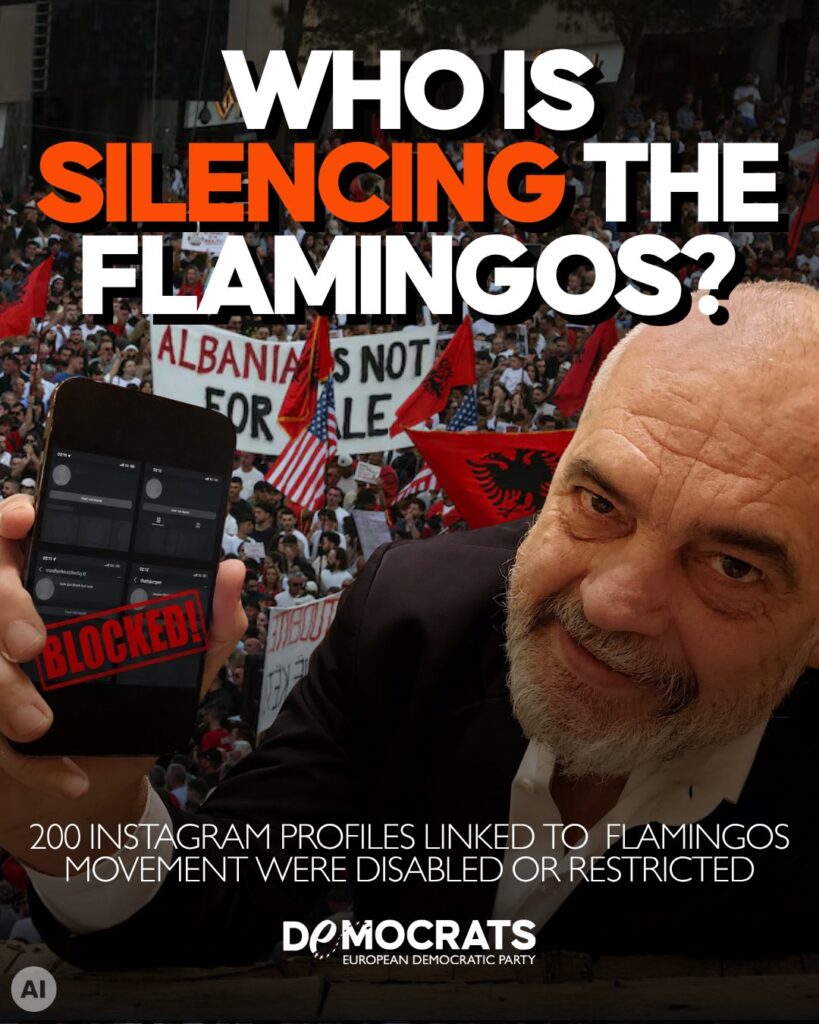
At three minutes past one on Thursday afternoon, an account called @democrats_eu posted a picture. Edi Rama’s face, a phone in his hand stamped BLOCKED, a crowd behind him carrying “Albania is not for sale” banners, and across the top, in capitals: WHO IS SILENCING THE FLAMINGOS? An AI label sat in the corner.
The words underneath were more careful. Around 200 Instagram profiles linked to protesters, the European Democratic Party said, had been disabled or restricted. The allegations demanded immediate answers from Edi Rama’s government. A country advancing towards European Union membership had to protect every peaceful critical voice.
The gap between the picture and the paragraph matters, because two hours after Rama answered, it became the party’s defence: they had never accused him of anything. That holds only if one reads political communication as though pictures contain no propositions.
The account belongs to the European Democratic Party. Most readers in Tirana had never heard of it, and there was no reason they should have. It holds ten of the 720 seats in the European Parliament and is one of the smaller constituent forces inside Renew Europe. Its president is François Bayrou. Its secretary general, Sandro Gozi, is an Italian former state secretary for European affairs who sits as a French MEP.
Ten seats. The number will matter later, though not for the reason Rama’s critics think.
At eleven minutes past seven, the Prime Minister of Albania replied. “How can these agitators call themselves democrats while publishing such a shameless visual insinuation?” He had lived with blame-and-shame games his whole political life, he wrote, but this “low form of propaganda” from “people parading as European democrats” was “truly pitiful.” He placed the post inside the argument he has made all summer: that political instability is not always spontaneous, that democratic societies across Europe are being worked on by actors with an interest in weakening institutions, and that the so-called Flamingo Revolution had attracted some of the same energies. Then he answered the accusation. His government had nothing to do with the disabling or restriction of any social-media account and possessed no technical capacity to carry out such an operation. He ended with “Shame on this whole bunch of failures” and a clown.
Two hours later Gozi replied for the party. Insults do not answer questions. Read what we wrote. We never claimed your government was responsible. We welcome your denial. We asked Meta for transparency and the Commission to look into it. Dozens of accounts going dark at once is a legitimate matter of concern.
Gozi was right about the last sentence and wrong about the first defence.
The accusation was in the picture
The words asked a question and the image supplied the answer, and that arrangement, far from being an accident of design, was the whole mechanism. If the European Democrats did not mean to associate Rama with the disabling of protest accounts, there was no reason to put him in the graphic holding a telephone marked BLOCKED, no reason to place his face between the accusation and the protesters, no reason for the visual grammar of the poster to name him as the actor while the written grammar merely requested explanations. The text keeps the deniability. The image does the work.
Political communication has used this device for longer than Instagram has existed. Put the allegation where the eye lands first, put the deniability in the paragraph underneath, and if challenged, defend the paragraph. Rama saw what was being done and objected to it. It is possible to find his language excessive and to dislike the clown; neither changes the substance of what he answered. A party cannot place an image of the Albanian prime minister holding a BLOCKED phone above claims that critical Albanian voices are being silenced and then insist that no accusation against the Albanian government was ever made. They made it visually. He answered it in words.
What actually happened
Underneath the poster there is a real story.
Initial reporting identified 23 Instagram accounts that had been disabled or restricted, including the Mundësia leader Agron Shehaj, whose verified account had around 150,000 followers, the activist Gent Progni, and accounts belonging to people publishing material from the Flamingo protests. Other activists described a larger cluster. Independent MP Marjana Koçeku gave the figure of more than 200. The honest number is still dozens, and nobody outside Meta knows the final one.
Alesia Burnazi, a journalist who had covered the demonstrations from the street since May, began losing material on 19 August. Whole days of footage disappeared, then collaborative posts, then personal ones, and some of it returned after Meta acknowledged that removals had been erroneous. The complaints, activists told BIRN, relied heavily on copyright.
That mechanism does not require a ministry. A government, a company, a political organisation, an interest group or a private network can report material and try to trigger platform enforcement, and Meta decides what happens inside Instagram, through human contractors, automated systems or some mix of the two. A cybersecurity analyst at SCiDEV, Orkidea Xhaferaj, explained on Thursday that copyright complaints provoke faster platform action than allegations of spam or abuse and do not need large numbers of coordinated reporters.
So there is a legitimate question, who filed them, and there is not yet a legitimate answer. Those are different things, and the poster collapsed them.
What I know
I should say plainly that I know Edi Rama, and that on this particular subject I believe him.
Anyone who has watched his Facebook page for long knows the habit. A hostile comment appears underneath a post and, instead of leaving it to silence, moderation or a communications assistant, the Prime Minister answers it himself. He asks what the commenter means. He argues, he provokes, he mocks, he goes on at lengths his advisers would surely counsel against, and he tries to win. He cannot bear to leave an argument unfinished. He loves the argument. He lives for the drama of it.
A man built that way has little use for a blocked account. A blocked account is one fewer person to argue with.
Rama has been drawn as many things by many opponents across a long career, and some of those drawings had merit. I have never known him as a censor. He fights his critics in public, names them, ridicules them, and does not behave like a politician frightened by the existence of criticism. That is why the graphic was more than another unpleasant political image. To a man who understands himself as someone who answers criticism rather than suppresses it, it depicted the opposite character. His anger does not surprise me, and neither does his reply.
What I know about the man is why I do not believe the accusation the picture made. It does not tell me who filed the reports, because personal knowledge cannot establish that. Meta’s records can. Rama answered the question that belonged to him. I take him at his word.
Ten seats are still European seats
There is an argument that Rama should never have replied. The European Democratic Party has ten seats; why should the prime minister of Albania dignify a small Brussels organisation with a personal answer?
Because ten seats grow considerably when they are attached to the words “European Parliament,” when the country under discussion is negotiating European Union membership, and when the allegation concerns the suppression of political speech. One of those ten seats can put a question to the European Commission, and Gozi did. By Thursday evening he had asked the Commission to seek explanations from Meta and to examine what had happened in the context of Albania’s accession process. That fact disposes of the claim that this was an insignificant provocation which became European only because Rama replied. The European Democrats themselves considered it important enough for the Commission. They cannot then say the allegation was serious enough to enter the accession conversation but too small for the Albanian prime minister to answer.
Nor was silence neutral. Had Rama said nothing, the image would still have existed: Edi Rama, BLOCKED in his hand, protesters behind him, European Democrats asking who was silencing them. The insinuation would have circulated without contradiction, and had someone later asked why the Albanian government had not responded, the silence itself would have been entered as evidence. That was the cleverness of the construction. The image imposed a cost for silence; the caption provided a defence against a reply.
Rama refused the arrangement. Good. Prime ministers are not obliged to accept an accusation because its authors have placed a question mark somewhere beneath it.
Due diligence is also a European value
There is a wider habit at work here, and the European Democrats are only Thursday’s example of it. Look at what the party had in hand at three minutes past one. An activist count of 200 that no reporter had verified and that the day’s own coverage traced to a single MP’s post; a reported cluster of 23; no statement from Meta had been obtained; no takedown notice, no complaint, no name of a complainant. On that basis a European political party produced a graphic naming the Albanian prime minister as the silencer, and by evening its secretary general had put the matter before the Commission in the context of accession. From rumour to Brussels in eight hours, with the fact-finding still to come.
Albania produces rumour at industrial scale. Every week brings a new conspiracy about who ordered what, a new list of names, a new certainty on Facebook, and a share of it will turn out true, which is what keeps the market open. A Tirana newsroom learns to hold the story until the second source arrives. Partners, monitors and party families in Brussels, Strasbourg and the embassies have not always had to learn the same discipline.
There is a recent example, and it is not one that flatters the government. Last October the Parliamentary Institute emailed all 140 MPs a list of national figures born or died in that month, drawn from the Academy of Sciences encyclopaedia, and Enver Hoxha was on it with the titles the encyclopaedia records, “Hero of the People” and “Hero of Socialist Labour.” The outrage was earned; the document was real, the titles were in it, and the opposition was right to say so. Within days the Albanian argument had turned a clerk’s list into a decision by Parliament to honour the dictator. On 9 October Speaker Niko Peleshi apologised from the chair: the text was informative, Hoxha appeared only by his date of birth, and he had ordered the Institute to review the material. Twenty days later, on 29 October, MEP Fredis Beleris filed written question E-004244/2025 to the European Commission under the title “Backsliding of Albanian Parliament honouring the Communist dictator Enver Hoxha,” stating as fact that Parliament had released an official document honouring him. When the Commission answered on 23 December, it put the missing qualification back into the European record: it noted Peleshi’s apology and his clarification that Hoxha had been listed for informational purposes, without any intention to honour him or justify his legacy.
That is how an Albanian claim acquires a European passport. A domestic allegation becomes a party statement, the party statement becomes a parliamentary question, and the parliamentary question becomes an institutional document. Each step lends the proposition the authority of the institution receiving it. None of them has to add a fact.
This is not a plea for indulgence towards the government. The Flamingo protests have real grievances, the account restrictions are a story, and there are governments in this region for which the presumption of bad faith is earned. It is a plea for the same standard Europe asks of Albania. Due diligence is a Chapter 23 word. A party family that invokes fundamental rights and political pluralism when it writes to the Commission owes the subject of its graphic the elementary discipline of checking before it draws him. Facts should have mattered on Thursday at one o’clock. They still matter now, and they are still mostly missing.
The next reply
If the Albanian government did not organise the restrictions, as Rama says, then somebody else may have turned a platform’s enforcement system against Albanian political speech, and that deserves the investigation the poster should have demanded without supplying its culprit in advance. Who filed the reports, what material did they claim to own, and were they paid? Those questions cannot be answered by Rama, or by Sandro Gozi, or by a graphic generated for social media. Somewhere inside Meta’s systems there is a record of the complaints, the complainants and the decisions taken. That is where the evidentiary trail begins.
The European Democrats were entitled to ask what happened to the accounts. They were not entitled to place the answer in Rama’s hand before the evidence existed and then retreat behind the wording of their caption when he objected.
They wanted an answer. They got one. The next reply belongs to Meta.
Albatros Rexhaj is an author, playwright, and analyst with a background in national security studies and nearly three decades of experience in political and security affairs.