Editorial Board
On 22 March, in the Hard Talks chair, our founder was asked whether the thought that produced this publication had been worth acting on. Alban Bici declined to answer. Ask me in five years, he said.
Today we are six months old. Five years is far away. Six months is enough for a first reading of the record against the promises, which is the exercise we perform on everyone else and can hardly refuse to perform on ourselves.
What we promised
The promises were specific, and they are still on our About page. Analysis rather than advocacy. Structure rather than personalities. A standard of specificity high enough that a report of institutional failure resists absorption into the generic story of Albanian institutions failing again. An audience of policymakers, diplomats, lawyers and investors rather than the domestic political class. And an operating model with no payroll, no honoraria and no newsroom, which our publisher himself described in that interview as less durable than one with institutional backing.
He also conceded, before anyone asked twice, that the specificity standard was approximated rather than met, that at least one published piece had required correction because the English read differently from the Albanian intention behind it, and that the volunteer model had already cost us contributors we could not afford to lose.
Those concessions are the useful part of the founding record. A publication that admits at launch where it will fall short has given its readers the measure to hold it to.
Underneath the promises sits the reason for them. Tirana is a capital of rumours. Politics here is conducted in hearsay first and documents second, and the hearsay travels, so that what is said in a Tirana café one week is a framing in a Brussels briefing note the next, and nobody downstream remembers that it began as somebody’s convenience. Albania is viewed from abroad through narratives that were placed, not found. We exist to provide clarity in that capital: to put the document next to the rumour and the original language next to the translation, and to do our part in ensuring that hearsay and narrative planting do not dictate how Albania is viewed and understood. Everything on the About page is a method for that.
Where we stand
Six months of the ledger below will make no sense unless one thing is said in plain terms, because it has been read in Tirana as pressure, as partisanship, and as most things other than what it is.
We are conservative. We believe in parliamentary democracy: a government that answers to a parliament, and a parliament that answers to voters. We are neutral between the parties that operate inside that order and not neutral about the order itself, which is what analysis rather than advocacy has always meant here. We support the rule of law without reservation. We do not support the rule of the agents of law, which is a different thing and, in every tradition we respect, the thing the rule of law was designed to prevent.
We support SPAK and the Special Court in their mission. We will also oppose, with everything we have, every attempt by either institution to establish itself as a fourth branch standing above the three the Constitution names. A prosecutor is an officer of the law and not its proprietor. A court that cannot be criticised has stopped being independent and started being unaccountable, which is a different condition with a worse history. The argument is structural rather than personal, and it is the oldest argument in the Western constitutional inheritance: no power without a counterweight, and no virtue so certain that it may dispense with restraint. The receipt for it is Albanian. In May the Special Appeal Court acquitted a former roads director and her co-defendants because the fact charged was not a crime, years after the file had swallowed their careers, and nobody returned the years.
When that argument is met with the cry that criticism is pressure, the cry answers itself. An institution that experiences a structural argument as an attack has already disclosed what it believes it is owed. That disclosure is the fear we have been describing since the spring, and every time it is confirmed from the inside, the case for the counterweight is made by the people who least want it.
What we did
The Hard Talks format did what it was built for. In March, within weeks of launch, we put the new Foreign Minister in the chair on that month’s record: a parliamentary vote of 82 to 47 rejecting the prosecution’s request to arrest a deputy prime minister, an amendment to Article 242 introduced after the courts had acted against her, and a joint op-ed with a Serbian president who went on state television forty-eight hours later to say Albania, Kosovo and Croatia were forming a military alliance against Serbia. He answered every question and the record has been answering him since. We put the Economy Minister in the same chair on the lek and the narco-state narrative, and when the currency later passed the number she had been pressed on, we turned the chair on our own economist and tested the same arithmetic on him. We transcribed the Prime Minister’s Euronews Serbia interview and published it in full, because a Serbian audience had heard one version of it and an English-reading one deserved the whole.
When a foreign-funded database announced that two million square metres of state coast had been given away, we asked the government for its figures, tested the reconciliation it supplied step by step, and printed the number that survived: 97 hectares transferred by act, not the two hundred the headline implied. When the prosecution charged a deputy prime minister with eight counts of a procurement offence that Albanian courts have been treating as administrative, our Legal Desk asked whether nine months of suspension and an exit ban already exceeded anything the verdict could deliver. When the SPAK chief proposed an armed operational unit of his own, we ran two pieces together, one on what the statute permits and one on what armed formations loyal to an institution rather than a constitution have eventually become.
When a Serbian intelligence operation borrowed Albanian authority twice, moving a forged document through an anonymous Tirana portal that later erased it and invoking the name of SHISH to give it weight, we asked what Tirana owed itself by way of an answer, rather than what Kosovo did. When Rama backed Berlin’s attribution of the Leipzig attack, we asked what the Union pays for disruption in Belgrade and what it pays for reliability in Tirana, and found only one of those on the price list.
There were errors, and we corrected them. There were pieces that did not reach the standard and were held. Contributors left. All of it was forecast in March.
What changed today
Today the masthead has names on it. We now describe ourselves by desk, each with a person attached, and an Editorial Board that speaks without a byline and is the only part of the publication that does. Every other piece carries the name of the person who wrote it. We run no anonymous opinion.
One of those desks is new. Church and State exists because the region’s arguments about religion are conducted by politicians who use churches and clerics who use states, and we found no one in the Albanian press writing about that line from the believer’s side of it. The US Bureau has existed since our founding and is now stated for what it physically is: our registered address in Clinton Township, Michigan, which the publisher defended in March as a bureau positioned inside a community rather than outside a ministry.
The ISSN was granted. It is a small thing that makes a large difference: we are now citable and archivable in the registries our intended readers use.
What has not been settled
The audience question is open. Our publisher said in March that Albanian political actors read us carefully, sometimes uncomfortably so, and that the policymaker readership was real but not yet at the scale he wanted. Six months later both statements remain true, and the second remains the one that matters. We offer no figures, because none would survive the scrutiny we apply to other people’s.
The durability question is open. The model has not broken, which is the most that can be said of a model at six months.
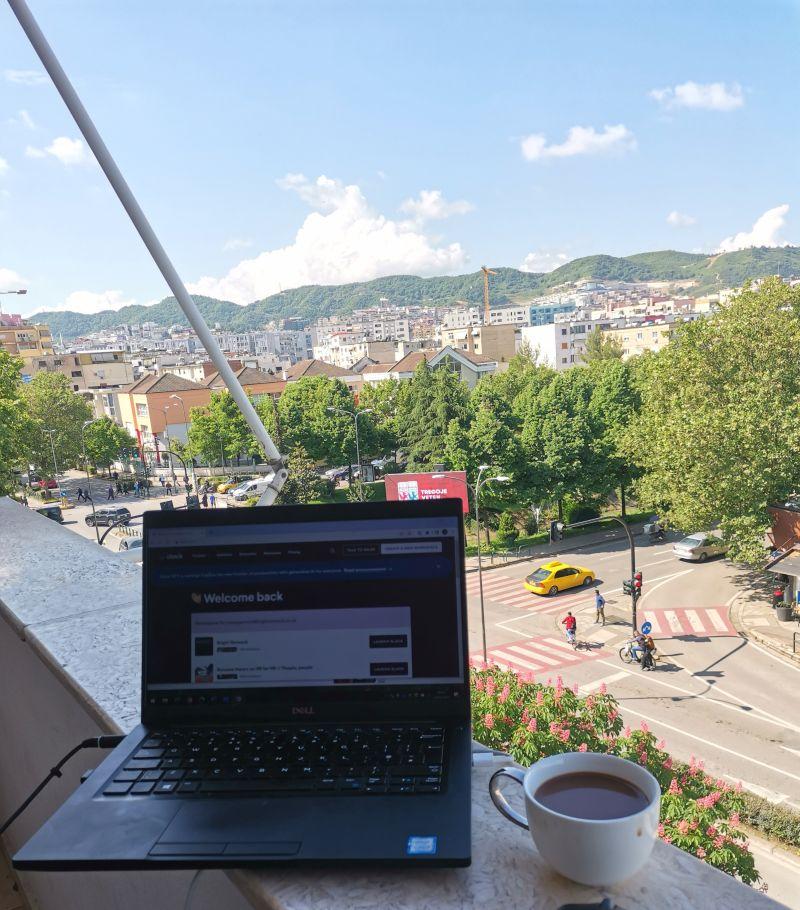
It should be described plainly, since the About page now describes everything else. We have no office in Tirana. We function as a fellowship of volunteers whose offices are our laptops and our preferred coffee shops, and we are quite content with that. Readers who assume a serious publication needs a serious address may count this as a weakness, and we would ask them to think again about what an address is for in this city. A newsroom here is a place where rumours are delivered, by people who know exactly where to deliver them. A coffee shop is a place where they are overheard and checked. Nobody can lease our premises or send a delegation to our reception. There is no reception. There are people who read documents in the original language and meet when a piece needs a second pair of eyes. That arrangement has produced six months of work; the buildings around it have produced the rumours.
The interviewer’s last line in March was that pressures are patient. They are. Six months is not long enough for them to have arrived.
What we can say is narrower than a verdict and more useful than one. The absence Alban Bici identified in a hotel room was real; the thing built to fill it has now produced six months of work that its intended readers can check and argue with; and the question has moved from whether such a publication could exist in English about Albania to how long this one lasts. The five-year answer is still his to give.
What we are for
One more thing belongs in an anniversary note, because the summer made it unavoidable.
The Prime Minister and the elite that governs with him spent this summer coming to terms with a fact they had not planned for: Albanians have changed. They no longer tolerate being taken for granted, and they said so in the street, peacefully and for long enough that the world took notice.
The internationals, whether based in Tirana or reading it from a distance, have the same adjustment ahead of them. Albania is no longer the country of the 1990s, poor and broken, sovereign on paper and supervised in practice, grateful for whoever arrived with a programme. It is a country of sovereign citizens. We are Europeans; we see ourselves inside the European Union and we are doing the work of changing to get there. But we are not anyone’s testing ground, pets or servants, and we have stopped pretending otherwise for the comfort of our guests.
Do not take Albania or Albanians for granted.
We exist to remind you of that.