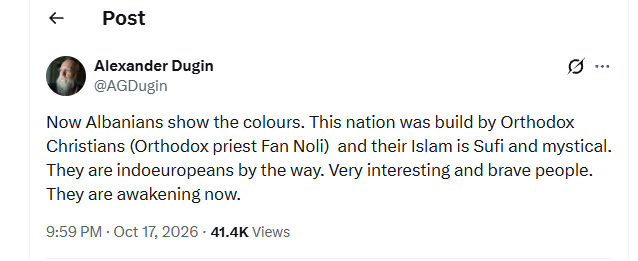
In 1997 Alexander Dugin wrote Albania into his map. In 2019 he told the Serbs they had awakened the multipolar world. On Saturday night, as Albanian institutions burned, he found an Albanian awakening.
Drizan Shala | Security Desk
At 20:10 on Saturday, Justice Minister Toni Gogu condemned the attacks on the Bank of Albania and the High Court, two institutions that do not answer to the government. At 21:59 Alexander Dugin gave the same evening a different reading. Albanians, he posted, were “awakening”. The nation had been built by Orthodox Christians such as Fan Noli; its Islam was “Sufi and mystical”; Albanians were “indoeuropeans by the way”. Very interesting and brave people. “They are awakening now.”
In 1997 Dugin had already reserved a place for Albania. Section 1.9 of Foundations of Geopolitics is titled “Orthodox Albania”. It sorts the country’s Sunnis, Bektashis, Catholics and Orthodox, describes the Bektashis as a Sufi order, places the Orthodox minority at the centre of Albanian nation-building, credits Fan Noli with founding the independent state and calls him a committed supporter of Russia. It has Noli in power in 1918; Albania declared independence in 1912 and Noli governed for six months in 1924. The history is wrong. The map is the point. Albania was written into a Russian-centred order thirty years ago, and the Noli claim was back on his X account this spring, months before the first stone was thrown.
On 24 November 2019, at an exhibition on the NATO bombing attended by defence minister Aleksandar Vulin, Serbia’s Ministry of Defence published Dugin’s remarks under the headline “Professor Dugin: In 1999, the Serbs woke up the multipolar world” (Profesor Dugin: Srbi su 1999. probudili mnogopolarni svet). Serbian resistance to NATO, he told his hosts, had awakened Russia and China against American hegemony; he invoked Lazar at Kosovo Polje and called the West evil. In his geopolitics Serbia is Russia’s extension into the Balkans. Seven years later the same man awards the same awakening to Albanians. Albania has not left NATO. Its government has not turned to Moscow. The Albanian street is what changed, and whom it is fighting.
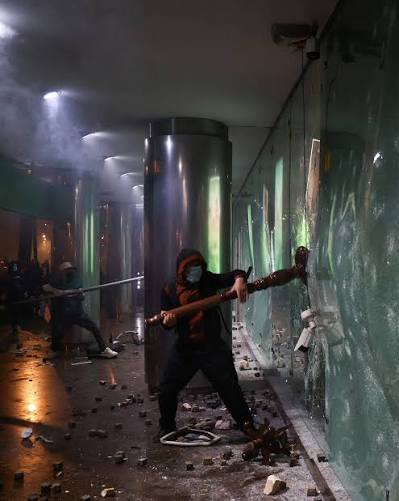
The street he was reading began Saturday morning outside the Education Ministry, the fifth day in a row, and moved in the afternoon to the Prime Minister’s office. Masked men pulled railings into the road, formed behind improvised shields, pulled paving slabs in sequence and threw them. Over eleven hours the crowd attacked the Bank of Albania with iron bars and then a petrol bomb, set fire inside the building that houses the High Court, torched the guard box at the Apostolic Nunciature three days after masked men removed the Holy See’s flag, threw petrol bombs at the perimeter of the Cybersecurity Authority (Shqiptarja, 17:10, with video), dragged a French-registered car in front of the Pyramid and burned it, broke into two commercial banks, looted Rruga e Dibrës and drew rubber bullets for the first time. Shkodër, Durrës and Korçë joined by evening. Police chief Skënder Hita’s five-day count, given that afternoon: 167 arrests, 132 injured officers, seven officers suspended over their own conduct.
A security analyst reads the list before he reads the crowd. Nothing on it lowers a rent or a university fee. The monetary authority, the highest court and a protected diplomatic mission are not where a grievance about wages goes on its own, and the question of who led the crowd there is open. What is not open is the value of the pictures: a central bank door in flames in a NATO capital is worth more abroad than it is on the boulevard.
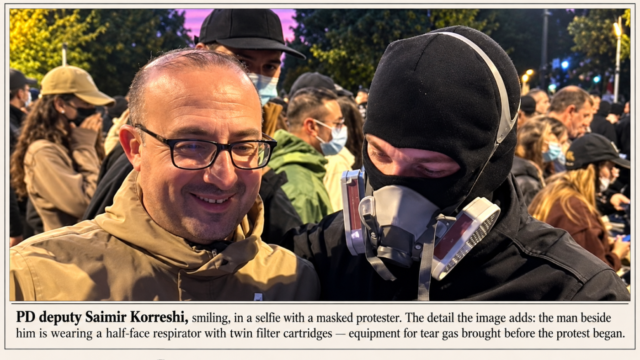
The grievance underneath is real and the government owns it. Rents that have outrun wages, degrees that buy nothing, bribes for a driving licence, a suitcase as the only plan. On Friday evening the same young people handed water to police officers before going home. On Saturday the petrol bombs came out. Protesters told Report Tv that the men beating them were “not the police, unknown persons”. Small groups in black burned bins first and buildings second and dispersed into side streets when the police advanced, the configuration seen this month in Paris, Liège, Brussels, Rome, Turin and Milan. In Tirana the men in black raised the “autochthonous” flag on the ministry wall and chanted for a Democratic Party deputy. Foreign nationals are among those detained; Report Tv has identified one as American. Nationality tells us nothing. Who assembled a week of masks, petrol and choreography, and taught it, is the question the arrests have not yet answered.
In 2023 Le Monde and the Dossier Center exposed Russian intelligence inserting small groups into genuine demonstrations in Paris, Brussels and The Hague, photographing anti-NATO messages against crowds assembled over pensions, and distributing the images. The Social Design Agency documents published by OCCRP list mass protest actions in NATO countries as a supporting measure of Russian policy, and describe operations built to hide their sponsor. Three Serbian men were convicted in Serbia for provocations against religious communities in France carried out, the verdicts said, under direction from Russian intelligence. The intermediaries have come from the Balkans before. No evidence yet connects Russian intelligence to Saturday’s violence; the European record shows what Moscow has done with other people’s protests, not who organised this one.
Each of Dugin’s three compliments is a borrowed Albanian story. Noli built an autocephalous church so that no foreign see would own Albanian liturgy, Athens first of all; Dugin claims the man whose project was Albanian sovereignty over its own altar. The “Sufi” Islam is the sovereign-Bektashi story handed back as a Eurasianist category. Albanian is an Indo-European language, and Dugin turns a fact about grammar into a certificate of civilisational belonging. A people is being sorted with its own favourite stories about itself.
When students filled Belgrade for a year, Vučić called it the dirtiest colour revolution in history and the Russian Foreign Ministry spoke of “templates from Western manuals” (šabloni iz zapadnih priručnika). When students fill Tirana, the same current calls it an awakening. The criterion is the government the crowd is against. Among the European streets burning this October, Moscow’s ideologue chose to bless the EU’s accession frontrunner and Washington’s most reliable ally in the region. Prime Minister Rama has blamed “foreign evil hands”. He has not said whose. The man who claimed the crowd has.
In Belgrade in 2019 the awakening was Orthodox Serbs against NATO. In Tirana in 2026 it is Albanians against their own Atlantic government. The categories were rearranged for the occasion; the destination did not move. The protesters did not ask Russia’s ideologue to speak for them. He did it anyway. The fire was in Tirana. The claim came from Russia.