The outlet’s March 22 coverage was not journalism. It was a production.
By Ardit Rada (Tirana)
There is a version of March 22 in which the State Police, acting on direct orders from Edi Rama, attacked peaceful citizens exercising their democratic right to protest. In this version, Sali Berisha is a leader who suffered alongside his people, was wounded by the regime’s forces, and returned to the street because the cause demanded it. The German and EU flags carried through Tirana that night were a message to Europe, a democratic appeal from a people living under authoritarianism. The violence, such as it was, belonged to the state.
Syri.net published that version. It published it in real time, with photographs, with a rolling ticker of outrage, with the vocabulary of resistance and martyrdom fully deployed. It published it as news.
The problem is the footage.
What the sequence shows
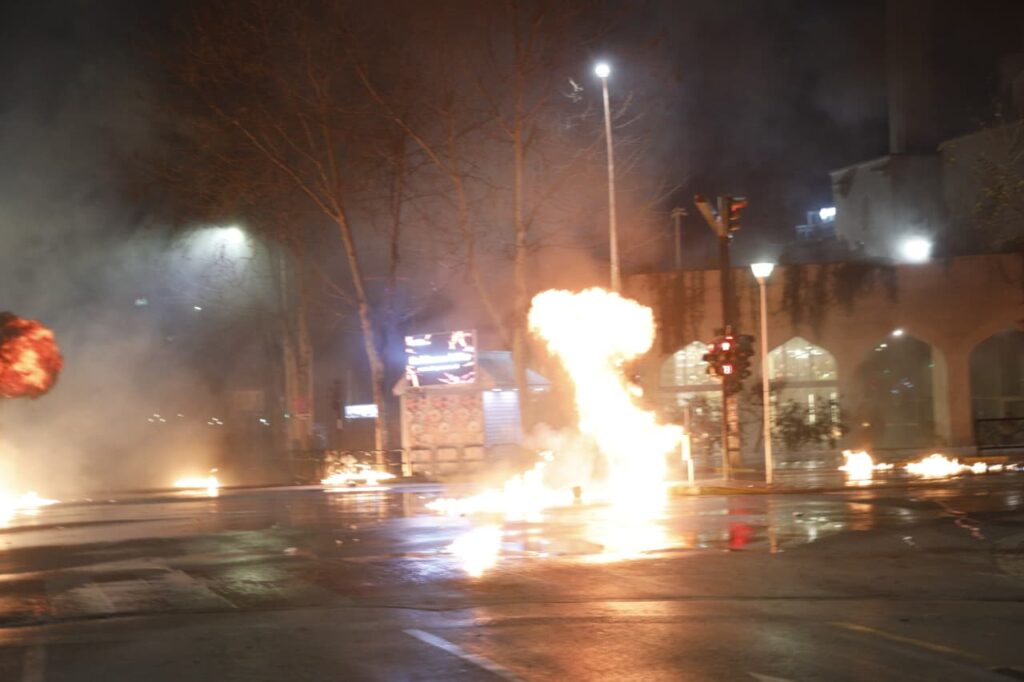
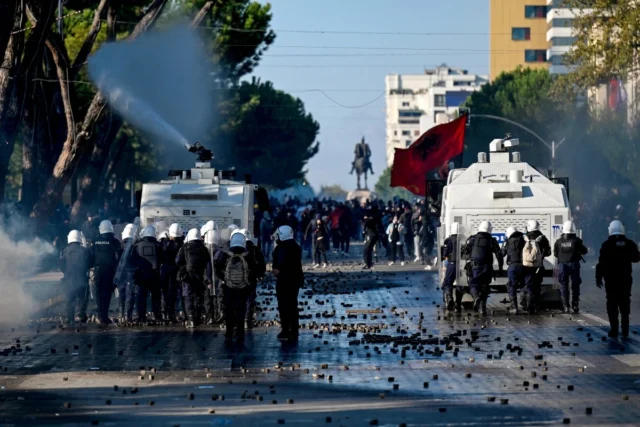
Every independent account of March 22 — Timoni’s live blog, Shqiptarja’s timestamped reporting, footage circulating on social media — documents the same chronology. The march left PD headquarters. It moved toward the Prime Minister’s Office. Molotov cocktails and pyrotechnics were thrown at the building. Then police dispersal began. The violence did not follow provocation. It preceded it.
This sequence is not ambiguous. It is visible in the footage that Syri’s readers will not find on Syri. Because it is incompatible with the narrative Syri had already decided to tell, and a news organization that has decided what happened cannot afford to show you what happened.
Syri’s solution is structural: omit the sequence, and replace it with a ticker of police actions. “Civilians of the narco-police caught off guard waiting to arrest protesters leaving PD headquarters.” “Noka to police: you are functioning as a gang, you hit the opposition leader directly in the eye on orders.” “The moment a Shqiponja officer strikes MP Xhelal Mziu with a rubber baton.” “Protesters march through Tirana — Rama’s police follow them from behind.”
Read the ticker carefully. In Syri’s version of March 22, the police always act first. The crowd always responds. This is not reporting. It is a sequence manufactured to replace the one that actually occurred.
The vocabulary of pre-judgment
The language Syri uses for state institutions is not color or register. It is load-bearing architecture. The State Police is “Rama’s police” or “the narco-police.” Officers are “bandits in uniform.” Every action the police take — tear gas, water cannon, arrest — arrives pre-delegitimated, because the institution itself has already been declared criminal before the night begins.
This vocabulary does something specific and dangerous in a live coverage context. It means that nothing the police do can constitute a legitimate response to anything. The officer who fires tear gas at a crowd that has been throwing Molotovs for twenty minutes is, in Syri’s frame, a regime enforcer committing violence against citizens. The protester who threw the Molotov is not in the frame at all — or appears only as a provoked citizen pushed beyond endurance by a criminal state.
The circularity is total. The state is illegitimate by definition. Everything it does confirms the illegitimacy. Nothing that happens in the street can challenge the narrative, because the narrative was written before the protest began.
The arithmetic of injury
Six police officers were injured on March 22. This figure comes from multiple independent sources. A police vehicle was burned. Molotov cocktails reached the perimeter wall of the Italian Embassy. An ABC News cameraman was beaten by masked protesters and had his equipment destroyed.
None of this appears prominently in Syri’s coverage. What appears instead is Berisha, his eye injury from spray exposure, his breathing difficulties, his return to the march. And deputy Bledion Nallbati, photographed in hospital, with Berisha at his bedside. The framing, applied identically across every protest since December: “savagely beaten by the narco-police, struck with rubber batons and riot shields, attacked with tear gas in the face.”
The template is fixed because the story is fixed. The party’s wounded are always victims of regime violence. The state’s wounded do not register as human beings whose injuries require explanation. They are the regime’s instruments, not its casualties.
A reader following March 22 in real time through Syri would finish the night knowing that Berisha was hurt and that the police were brutal. They would not know that six officers required medical treatment. They would not know a vehicle was burned. They would have no basis for understanding what actually happened, because Syri had no interest in telling them.
The flag that wasn’t supposed to raise questions
Taulant Balla, the Socialist parliamentary group chairman, said what needed to be said about the flags on March 22: that the protest was conducted with the symbols of Europe while its instruments were Molotovs. He said it and moved on. Syri had a more elaborate problem to solve.
The German and EU flags appeared in the middle of active clashes, fire in the background, riot police in formation, a projectile frozen mid-arc in the available photographs. For Syri’s narrative to hold, this image had to mean democratic aspiration, not violent theater. So Syri reported that Berisha had “replaced the US flags with German and EU ones”, a deliberate European appeal, a message to Berlin and Brussels about what Rama’s government was doing to Albania.
The framing requires the fire to be invisible. It requires the Molotovs thrown minutes earlier at the Prime Minister’s Office to belong to a different story. The flags prove the democratic credentials of the movement; the democratic credentials of the movement mean the violence cannot be the movement’s; therefore the violence must be the state’s. The logic is circular, self-sealing, and Syri ran it without apparent discomfort.
What the image actually shows is a political party that understands symbolism well enough to carry European flags into a riot and a media outlet loyal enough to that party to report the flags without reporting the riot.
What Syri is
Syri.net’s ownership is documented. The Media Ownership Monitor recorded its ties to the Democratic Party orbit, allegations, uncontested in any substantive way, linking its financing to Shkelzen Berisha, Sali Berisha’s son. Its founder’s brother served as Deputy Interior Minister in a Berisha government. Its editorial line across five months of protests has been consistent to the point of mechanical repetition: the police are criminal, the protesters are peaceful, the leader is a martyr, and the cause is democratic Europe.
This is not coincidence. It is coordination. And it matters because Syri is not a fringe outlet publishing to a small partisan readership. It describes itself as Albania’s largest news portal. Its framing circulates. It reaches people who believe they are reading journalism. Some of those people are in Brussels and Berlin, looking for sources in Albanian that help them understand what is happening on the streets of Tirana.
What they are reading, when they read Syri, is the Democratic Party’s account of itself — cleaned up, sourced with photographs, formatted as breaking news, and presented without disclosure. That is not a media problem. It is a political problem wearing a media problem’s clothes.
On March 22, Syri covered a riot as if it were a march. It covered a pattern of organized violence as if it were spontaneous civic resistance. It covered a party that has not condemned five consecutive nights of Molotov cocktails as if it were the custodian of Albanian democracy.
The footage exists. The sequence is documented. The injuries are on record.
Syri’s readers will not find any of it on Syri.
Ardit Rada is a Tirana-based journalist covering Albanian politics, governance, and institutional developments.