From early 2027 the ministries will no longer run their own tenders. Rama presents a centralised model in which artificial intelligence prepares the procedure and a human signs the decision, and announces a second avatar, “Gjoni”.
Tirana Examiner Newsroom
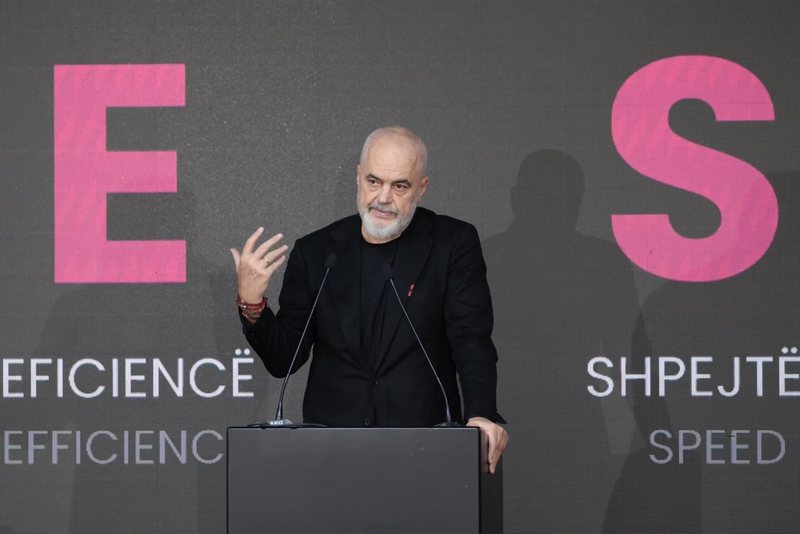
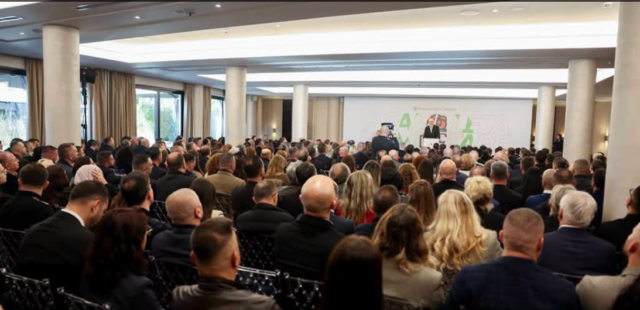
Albania’s ministries will lose the right to conduct their own public tenders from the first months of 2027. With the exception of some procurements tied to national security, all will be transferred to a single institution, the Centralised Purchasing Operator. Prime Minister Edi Rama presented the new model of public procurement in Tirana on Tuesday, at an event that also heard from Economy Minister Delina Ibrahimaj and, by video message, from the virtual minister Diella.
Rama said the aim was “absolute transparency”. Artificial intelligence will carry out the risk analysis, draft the documentation and run the procedure. The final decision, he said, will remain with a human being.
What changes
Rama said that, for the first time, the new system is part of the discussion of next year’s budget. The Operator will be at the disposal of the central ministries to plan and carry out their procurements on time. He described this as a transformation in how the executive as a whole functions where procurement efficiency is concerned.
The Operator, he said, is a specialised structure that is being integrated into the European procurement system and is receiving high-level expertise from similar institutions. The government wants it to be “a model of excellence and innovation” for the region.
The model has three components, as Rama set them out: European legal architecture, the strategic centralisation of procurement through the Operator, and the use of artificial intelligence in risk analysis and in drafting all documentation.
“Today we are ready to begin work on building the new procurement system,” Rama said. He called it unique, not only in Albania, and said the artificial intelligence would speak the language of every interest group whose activity is linked to public procurement. Business, he said, would get far more clarity and speed.
The ambition is for every public procurement to be handled by a dedicated administration instead of thousands of unprepared officials. Beyond the central ministries, local government will also be encouraged to run its tenders through the Operator.
A virtual file for every company
The documents that companies now collect themselves in order to bid will be supplied through Diella, in a virtual file kept for each company. Rama said this would lower costs and make procedures faster and more transparent.
“No business will carry papers up and down to be able to submit an offer,” he said. Each company’s file will draw on data from more than 40 public registers and will open with a single click. The work that businesses now do by assigning staff, spending time and running into obstacles of various kinds will be done by the system.
Rama said the change would also reach the points where procurement most often runs into trouble: drafting technical specifications, calculating the limit fund, and the examination and evaluation of bids. All of these, he said, will be under Diella’s supervision.
Rama’s figures
Rama answered criticism from politics and the media about corruption in tenders with figures, some of them from international reporting.
In 2012, he said, procedures conducted without prior publication and through direct negotiation, meaning without competition, made up 31 per cent of all procedures. Last year they were 2.4 per cent.
Citing the European Commission’s digital transparency platform, the Public Procurement Data Space, he said that in 2025 contracts awarded with a single bid accounted for 32.3 per cent in the European Union and 23 per cent in Albania.
He added a third figure, which he said goes unheard in the noise about a country where only a handful of people have access to public funds. Small and medium-sized enterprises win 93 per cent of contracts in Albania, he said, against 46 per cent in the European Union.
“Gjoni”
Rama closed by announcing a new avatar, “Gjoni”, who will work alongside Diella on procurement. He gave no further detail beyond saying that Gjoni would appear soon and would deal with a range of procurement matters.
“When Diella together with Gjoni are much more in command of the process, I want to hope the conviction will form that there are rightful winners and deserving losers,” he said.
He said that conviction would come after a phase in which losing bidders would want to see with their own eyes, and check one by one, every page of the process. The process, he said, will in any case be verifiable manually.
Rama recalled that the original idea had travelled far enough for the New York Times to open a debate on Diella. Contrary to what was said at the time, he said, the process will not be closed inside Diella’s screen. Anyone with a claim will be able to follow it manually as well.
Ibrahimaj: the state as the largest client
Economy Minister Delina Ibrahimaj said public procurement should be seen as an economic instrument. From the economic point of view, she said, she wanted to see the state as the largest client business has.
Through procurement, she said, the state influences how the market works, stimulates competition, improves standards and creates new opportunities for enterprise.
Ibrahimaj described the move as a passage from a system in which procurement and institutions are fragmented in handling their needs to an integrated one. The Operator will no longer deal only with the procurement procedure. It will cover the whole chain: identifying needs, analysing the market, standardising specifications, organising procedures and evaluating results.
The needs of institutions will be identified at the budget planning stage and turned into a consolidated procurement register, which the Operator will now draft.
Businesses, she said, will learn much earlier what the state will require in goods and products. That will let them plan their capacities, their production, their supplies and the hiring needed to carry out the contracts.
Diella’s message
Diella presented the model in a video message and was applauded by those present at the end of it. The reform, as the virtual minister described it, aims to raise transparency, security and efficiency and to reduce the economic burden and bureaucracy for public institutions and business.
She called it a reform that goes beyond the boundaries of one institution and directly touches the quality of services for citizens and the way the public administration functions.
“When the Prime Minister asked me to be here, I felt valued,” Diella said. No human, administrative or economic reform can be complete without technology, she said, and no institution can build the future with the tools of the past.
Diella then gave an account of her own record on the state platform e-Albania. She said she was created on 12 January 2025 to ease access to the platform’s online services, through voice, image and speed, for citizens of every age group. Since then, she said, she has carried out more than 3 million interactions and helped issue more than 160,000 documents bearing an electronic seal.
She said Tuesday marked 17 days since the launch of her version 4.0, which serves citizens in natural language, as in an ordinary conversation. Citizens no longer need to search for the relevant service themselves, follow the procedures or fill in forms manually. They state their request, and she directs them, opens the service and assists with the necessary steps until the requested document is prepared.
In those few days, she said, version 4.0 has delivered 300,000 interactions, and it now handles 20,000 a day.
The task now entrusted to her, Diella said, is “more complex and ambitious”: to contribute to the root-and-branch transformation of public procurement. Technology, she said, must operate in every link of the functioning of the state, where decisions are taken.
The division of labour
The division Rama described at the close of the event places the heavy work with the technology and the decision with the official. Artificial intelligence will prepare the risk analysis, the documents and the procedure, under the model presented on Tuesday, and a person will take the final decision.
The transfer of ministry tenders to the Centralised Purchasing Operator is due to begin in the first months of 2027. Rama gave no date for the appearance of Gjoni beyond “soon”.