Albania’s prime minister calls on Serbia to recognise Kosovo, says Donald Trump’s shadow made the world notice the “flamingo revolution”, rejects “associate member” status for Ukraine, and meets Costa and Metsola
By Newsroom
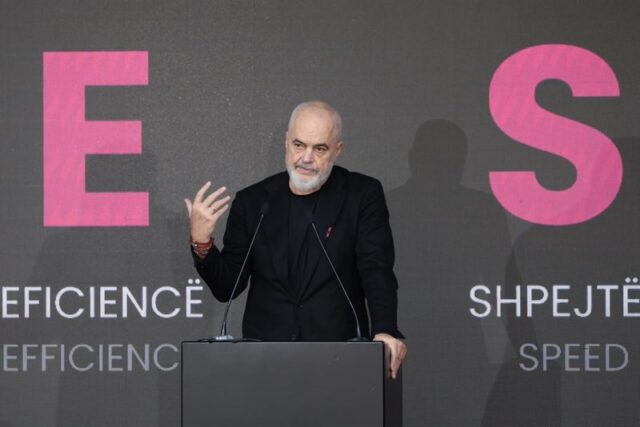
Prime Minister Edi Rama used his appearance at the Second EU Enlargement Forum in Brussels on Monday to protest the performance of a Serbian nationalist song directed against Kosovo at an event held the previous evening, on the eve of the forum. He described the act as inappropriate and said it must not be allowed to pass without a response.
In the same appearance Rama called on Serbia to recognise the Republic of Kosovo, answered a question about the months of protests in Tirana, and set out his position on how the European Union should bring in the candidate countries. He argued for gradual integration that keeps the candidates close, and against any formula that departs from the merit-based process, naming the proposal of “associate member” status for Ukraine. Later in the day he met European Council President António Costa and European Parliament President Roberta Metsola.
The song
Rama raised the incident on his own initiative, before turning to the question he had been asked.
“Allow me to say something before I answer your direct question, about a wrong that was done yesterday through music and that should not turn today into a wrong accepted through silence,” he said. “I do not know whether it was deliberate or the result of ignorance, the fact that a tasteless nationalist song was performed on the eve of this forum. It was performed under the beautiful melodic title of unity.”
He said the matter went beyond the offence caused to Albanians and that incidents of this kind must not bring the tensions of the past back to the region.
“It is not only that it hurts the feelings of Albanians. It has to do with the need not to let pass in silence anything that takes us back to the past,” Rama said. “The sooner Serbia recognises the Republic of Kosovo, the better it will be for Serbia and for everyone else.”
Rama then referred to his own record on relations with Belgrade. “I have been an advocate for many years of how important it is for our neighbourhood to keep Serbia on our side, on the side of Europe, so that it does not go against that conviction,” he said. “But at the same time it is important that we leave no room for medieval battles. All of us must commit to transforming our region into everything we are talking about.”
The performance drew reactions through the day. Hisen Berisha, speaking to Report TV, said Kosovo should not settle for an apology from Enlargement Commissioner Marta Kos.
The protests in Tirana
Asked about the protests held in Tirana over recent months, Rama said the world had learned of them because of the President of the United States.
“What has happened in Albania over recent months has been widely public,” he said. “The flamingo revolution drew the attention of the whole world because behind it was the shadow of Donald Trump. Because I am not very sure that, if it were not for Trump, anyone would have wanted to know about the flamingos in Albania.”
He presented the protests as the product of a country whose expectations have risen, at a time when, by his account, the economy is developing at a fast pace.
“It is a new Albania that asks for more. What Tocqueville called ‘the revolution of rising expectations’,” Rama said. “People have a fully legitimate right to ask for more. This is why we are so closely tied to the EU, which has been very beneficial in itself. That is my first take.”
He closed his answer with a remark about the country sharing the forum with him. “It is an honour to be with Montenegro, because they are the smallest, but also the object of our jealousy,” he said.
In Tirana on Monday evening, protesters and police clashed in front of the Prime Minister’s Office. Officers intervened to clear the boulevard and two people were taken into custody.
Gradual integration, on merit
On the accession of the Western Balkan countries, Rama said the process should be gradual and should keep the candidates close through initiatives such as the Growth Plan. He said it must remain based on merit, and he rejected the plan for “associate member” status for Ukraine.
“I have fought for this for a long time, for gradual integration,” he said. “I think the new Growth Plan is in itself an instrument that reflects this approach on the part of the Commission and the EU. Because the gap is still large, and the need for more capacity to close that gap is extraordinary.”
On the Ukraine formula he was categorical. “Attempts to do things like the one you mentioned, ‘associate member for Ukraine’, go nowhere,” he said. “First, because it is a lie. Second, because it has nothing to do with fundamentally changing the EU’s merit-based instrument. It is not in the interest of our countries to accept this.”
Rama described the merit-based process as something the candidates should want for themselves. “The merit-based process is a gift to us. A process that makes us do things we would otherwise not be able to do,” he said. “The EU is the most extraordinary source of guidance on how institutions are built. It is also the right place of torture, but it is for us.”
He compared membership without merit to driving without having learned how, a risk he said falls on the candidate country and on the member states alike. “Asking for something other than the merit-based process is like getting a driving licence without knowing how to drive. You endanger yourself and others,” he said.
Rama then called on the EU institutions and the member states to seat all the candidates at the table, using the family of Commission President Ursula von der Leyen as his illustration.
“I believe the time has come for the European Commission, for the Council, for the member states, to bring all seven, because Ursula’s children are seven too, to bring all seven around the table,” he said. “If Ursula told her children ‘you must grow up out there in the neighbourhood before we accept you into the house’, there would be a risk that the children never came home.”
He named the powers he had in mind. “God forbid, a daughter might fall in love with a Russian gangster. Another daughter might play with Chinese games to the point of never coming home,” Rama said. “We Albanians are a little special, we are in love with the EU and we can stay out there.”
Costa and Metsola
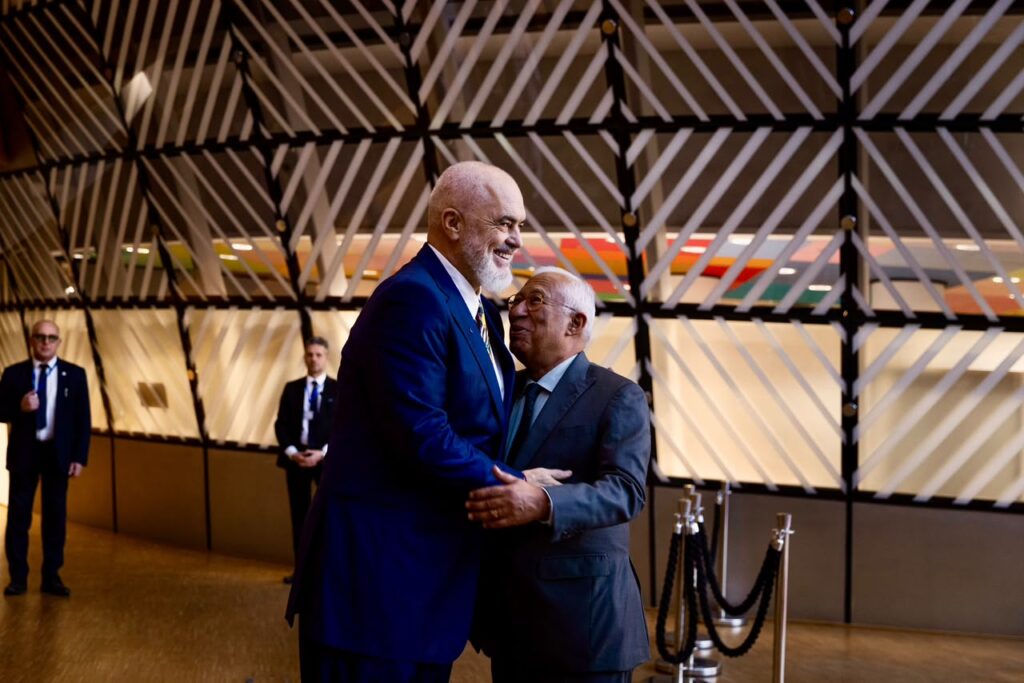
In the afternoon Rama met European Council President António Costa. After their meeting the two sat down for talks in a wider format, joined by Foreign Minister Ferit Hoxha and Minister for Public Administration Adea Pirdeni.
In the evening he was received by European Parliament President Roberta Metsola. The discussion centred on Albania’s path to membership of the European Union.
“I want to congratulate you on the progress you have made in this process,” Metsola told him. “As you know, this Parliament is very, very supportive of enlargement. So it is good that you are here. You can count on our support in this direction.”
Also at the forum
Commission President Ursula von der Leyen told the forum that Albania is making progress towards EU membership. Commissioner Kos said there are enemies who want to obstruct the integration of the candidate countries and that the Union will not allow it.
Rama also reacted on Monday to the EU’s decision, taken the same day, to sanction a journalist of Russia Today as a Russian propagandist. He called the man a paid clown and said he occupies himself with Albania because the country has climbed too high for his liking.