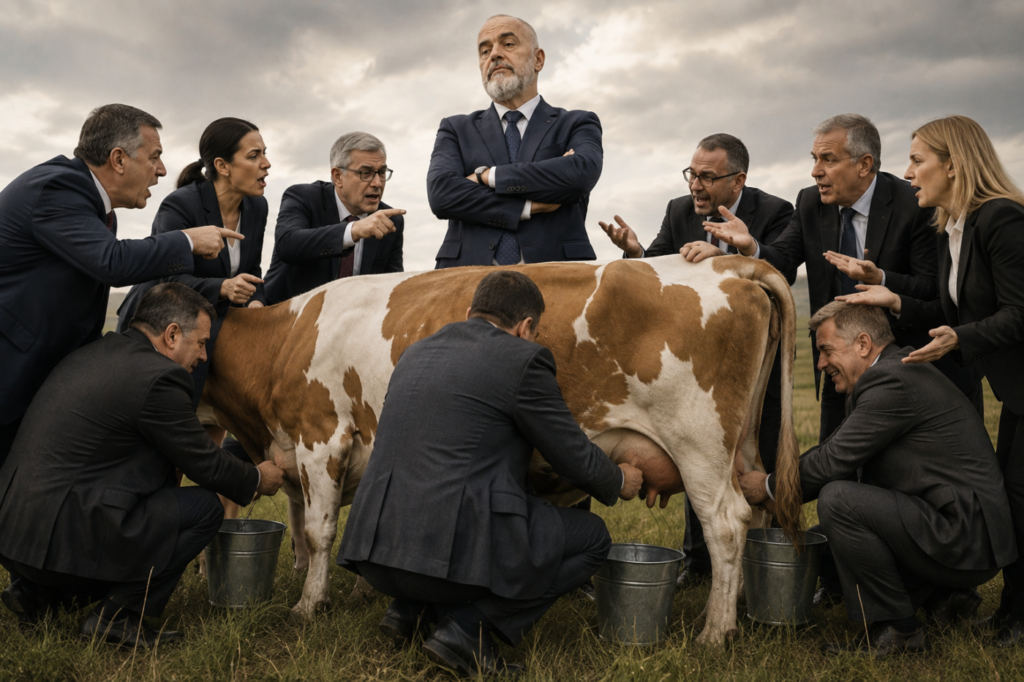
The prime minister is entitled to a vision. His ministers are paid to execute it, not to review it.
By Ylli Manjani (Tirana)
Political platforms baptized “Besa” or “Pasqyra” are, beyond doubt, the newest form of political marketing Edi Rama has chosen for communicating with the public. One may agree or disagree with their content, but one thing is not up for discussion: they represent the political vision, at this moment, of the man who governs the country.
Let us be clear, there is nothing unlawful or unusual in this. Whoever governs has not only the right but the obligation to lay out his vision, propose ideas, open debates and seek support for them.
On this point Edi Rama is entirely legitimate.
The problem begins one step further on.
When the ministers, the MPs and every political subordinate line up behind the prime minister to produce his echo, the picture turns ugly. People paid to govern, to solve problems and to give account appear every day as commentators on their boss’s vision. They do not communicate what they have done, let alone what they have failed to do; they communicate what Edi Rama has thought. Every one of them presents himself as a boss, just like his boss.
The presence in public life of boss-ministers and boss-MPs has grown alarmingly, with articles and posts that convey no personal thought, if they have any. These are texts without identity, without character, without responsibility. Political parrots repeating the same formulas, the same metaphors and the same tone. Instead of reinforcing their boss’s message with executive solutions, they weaken it. They wash the color out of a political construction he himself is trying to build with care.
A few days ago, for instance, I read a pathetic piece by a minister criticizing the services citizens do not receive, without a single word about his own failure to deliver that service. Never mind the language of compassion for the citizens, deployed like a fourth-grade composition. Bah!
If Edi Rama seriously believes that “Besa” or “Pasqyra” can be useful instruments of communication, then he should give his ministers one very simple instruction: be executives, not analysts. Still less public critics of the sectors you run.
A minister is not a philosopher of the administration. He is not paid to issue public diagnoses of the state’s problems but to solve them. An MP is not an echo of the prime minister’s voice but a representative of the citizens.
Report, for heaven’s sake, on what you have done, what you have solved, where you have failed and what you will do tomorrow. That is executive politics. The rest is propaganda.
Propaganda, when practiced by subordinates, becomes servility.
God, how pathetic the language of communication has become under these conditions! It is no longer political communication; it is a contest over who copies Rama’s style best. A language of flattering flourishes, slogans and moralizing, so artificial that it provokes public fatigue and, at the limit, disgust. The irony is that many of these texts read as if even their authors do not believe them.
If Rama is seriously considering a law on “Pasqyra” as well, it would be more useful for him first to look into the mirror of his own cabinet and collaborators. There he would find the first problem of public communication: subordinates who behave like leaders on Facebook and like spectators in government.
Let him put a stop to the theoretical communications, the mind-numbing flatteries and the grotesque imitations of the leader. They persuade no one; they only repel.
In the end, let everyone communicate as he pleases. But one thing is clear: servility does not produce authority, it produces contempt. Today, paradoxically, it is not the opposition but Edi Rama’s own subordinates who are making government communication more tiresome and more wearying than ever.
Editor’s note: Ylli Manjani is a former Albanian Minister of Justice. This piece appeared on his blog on 31 August. “Besa” (the Pledge) is the Socialist Party’s strategic document for the second half of Edi Rama’s fourth mandate, presented in July. “Pasqyra” (Pasqyrë Albania, the Mirror) is the citizen complaints and tracking platform Rama presented on 23 August and put before his cabinet at the Pogradec retreat the following day. The title is an Albanian proverb about a household in which everyone gives orders and nobody does the work.