A week in Tirana in which every institution was asked, one way or another, whose voice is whose.
By Ardit Rada (Tirana)
Sometime in the past week, and nobody outside a small circle knows exactly when, two lines quietly vanished from Gjergj Erebara’s Facebook profile. Journalist at BIRN Albania. Journalist at Reporter.al. They had stood there for years. As late as July 12 they were still visible; by this week the header read journalist, Tirana, University of Tirana, and the newsroom’s name was gone.
That deletion is the first of three documents this city produced in a single week. The second came from Taulant Balla, chairman of the governing party’s parliamentary group, who put the word shame over a post announcing he would raise a journalist’s conduct with the international funders of the newsroom in question.
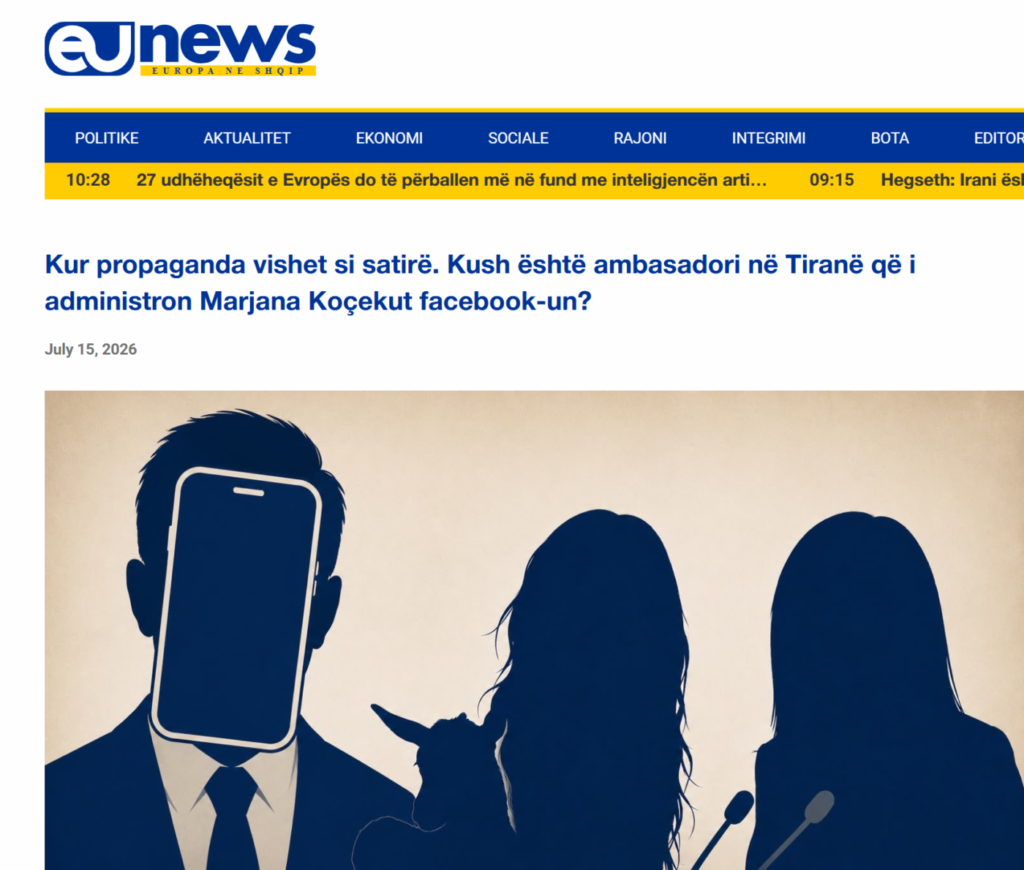
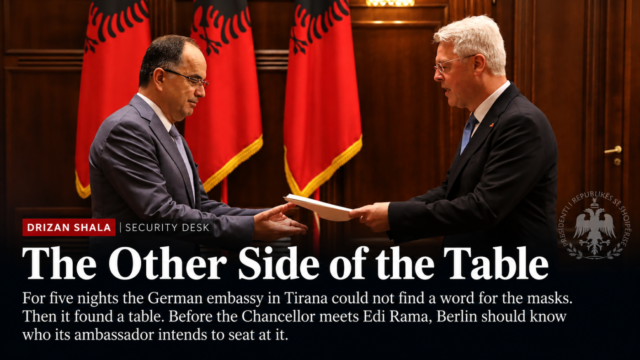
The third had a longer fuse. On July 15, an anonymous portal piece asked, in its headline, which ambassador in Tirana administers the Facebook of the deputy Marjana Koçeku, and alleged that her statement of solidarity with Erebara had been written on an ambassador’s phone. The piece named nobody. The capital named Silvio Gonzato, head of the EU Delegation, almost at once. And when this publication put ten written questions to the Delegation, the answer arrived in its inbox on Tuesday evening, a written statement, for attribution: neither the Ambassador nor Delegation staff have had any involvement in the matter referred to, and the Delegation carries out its work in full political neutrality.
An erased affiliation. A complaint routed to donors. A formal denial of ghostwriting. Different actors, different registers, and underneath them a single question that all of Tirana spent the week asking in different accents: who is actually speaking here, and in whose name?
The premise of a small capital
Tirana is a capital where the distance between a rumour and a record is a few hundred meters. The draft circulates before the statement does. A talking point can travel from an embassy reception to a newsroom desk to a plenary speech inside two days, and the phone call that mattered is described at dinner tables by evening, with embellishments.
None of this is unique to Albania, but the scale changes what professional ethics are for. In a large system, codes of conduct protect the public from what it cannot see. Here the public sees nearly everything, sooner or later, and so the codes end up protecting something else. They protect the institutions from what everyone already suspects about them. The journalist’s disclosure rule, the diplomat’s duty of non interference, the politician’s obligation to attribute blame on evidence: these are lanes. And in a city with no privacy to speak of, the lane is the only thing separating an institution from the rumour about it. Once the lane blurs, a rumour no longer needs to be true. It only needs to be plausible, and plausibility here is a tax assessed on past behavior.
This week the tax came due for everyone at once.
The journalist
The Erebara case has been examined at length in these pages, so a summary will do. A genuinely credentialed journalist named a protest movement from his own account. He then argued its case in near daily essays under an investigative newsroom’s masthead for a month, one of them filed in the news category, and from his personal profile he celebrated the collateral damage of the movement’s boycott campaign, all while that same newsroom covered the movement, the campaign, and the police response to it. Disclosure offered to readers across those six weeks: none.
Then the pressure arrived, and the descriptions of the man began to move. His author page calls him an editor of BIRN in Tirana. The staff list of BIRN Albania does not contain him. His own profile said journalist at BIRN Albania until the week that became inconvenient. The organizations defending him now call him an external contributor. Four descriptions of one man, expanding when authority was useful, contracting when liability appeared.
Nobody had to invent any of this. It is public, dated, and much of it was published by the newsroom itself. That is the thing about a small capital: his crossing happened in the open air, in front of every reader and every adversary he has, which is precisely why the rules he crossed exist. This reporter has argued before that institutional impartiality is a warranty over the whole output, not a property of single articles, and that such warranties are voided by failures of process rather than by any particular false fact. The process failed in public view. What it cost is still being counted.
The politician
Balla deserves more care than his critics have given him, because at the origin of this sequence he is the injured party. What circulated from the journalist’s personal account was a manipulated image. A fabrication. Even the organizations that hurried to the journalist’s defense concede the point; their own statement describes the image as altered. A public official confronted with a forged artifact of himself has a grievance that no theory of press freedom erases.
And his question, who does this man actually speak for, was not a smear. It happens to be the question this publication has spent the week asking, and the reason it needed asking was supplied by the newsroom: the soft perimeter, the editor title here and the missing name there. When an organization keeps its own boundaries deliberately vague, it cannot act wounded when an offended party assumes the boundary includes the man it titles and platforms daily. Even the funder channel is not in itself illegitimate. Donors publish standards so that conduct can be raised with them. A documented complaint to a grantee’s funder is oversight functioning, not censorship.
And the strongest corroboration of Balla’s question arrived, in the end, from the other side. If the affiliation he pointed at had been an innocent formality, the two lines on Erebara’s profile would have cost nothing to keep. They were deleted instead, quietly, in the days after the chairman made them expensive. This publication draws no conclusion about whose hand did the deleting or on whose advice; it has refused to guess at motives throughout this affair and refuses here. But a deletion is an admission of weight regardless of motive. Nobody removes a line that means nothing. Whoever erased the newsroom’s name from the journalist’s profile treated that name as exactly what Balla said it was: a live connection, real enough to have become a liability. His question did not merely deserve an answer. It received one, in the form of an erasure.
The lane question enters on a narrower point: altitude. A private complainant writing to a donor is one thing. The chairman of a governing party’s parliamentary group doing it publicly, with a one word verdict attached, in a week when press aligned with his party was trying out prosecutorial vocabulary on journalists, is another thing, and the difference is not the grievance. It is the sender. From that height, in that week, a justified complaint gets read in every chancellery that receives it as pressure, and that reading costs Balla the case he was entitled to make. Everyone in this city saw the fabricated image. Everyone also saw who escalated. Both entries went into the ledger the public keeps. A grievance that legitimate deserved an instrument nobody could mistake for a threat, and the lane, it turns out, exists mostly to protect the man with the strong case.
The diplomats
Which brings the week back to its strangest document, the denial, and to the allegation underneath it, which deserves fuller handling than the opening gave it. The portal piece claimed a specific chain: the text was offered first to an opposition deputy, who declined to publish it; it was then passed to Koçeku, who did. It showed no message, quoted no source willing to be identified, and displayed no evidence of any kind. Its entire cargo hung from the question mark in its headline.
Nobody in Tirana treated it as a question. The name attached itself more or less by lunchtime. The ten questions this publication then sent to the Delegation were specific: any communication with either deputy in the relevant window, any draft text conveyed, and, as a general matter, whether Delegation staff ever draft or suggest text for Albanian public figures at all. The answer came back inside a day, attributable, for the Ambassador, about that article. A categorical denial of the conclusion. On the particulars, nothing.
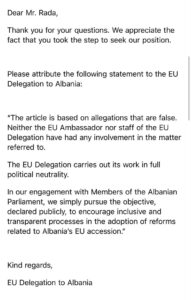
To be plain about it, because the discipline requires it: the allegation is unsubstantiated on the public record. It surfaced at the precise moment it would serve a governing party’s campaign against foreign funded journalism. And Koçeku, whose statement reads exactly like everything she has ever published, down to the Gheg, is entitled to the presumption that her words are her own until evidence establishes otherwise. Evidence. Not assertion.
But one finding survives the denial, and it is the uncomfortable one. When the claim appeared, nobody found it unthinkable. The political class started assigning a name within hours. The portals that relayed it felt no need to argue for its plausibility, because none was needed. The Delegation itself understood immediately which unnamed ambassador the city would read into the piece, and answered accordingly. Think about what that willingness to believe actually measures. Not the conduct of one man on one evening. It measures years. The communiqués that read like campaign material. The receptions where talking points change hands. A long habit, among some missions in some seasons, of treating Albanian public debate as a garden that wants landscaping. Diplomats in an accession country are participants by design, and most of that role is public, legal, and useful. Its boundary is Article 41 of the Vienna Convention, and the boundary is not a technicality; it is the difference between encouraging a country’s voice and replacing it. The Delegation has now certified in writing that it stands on the right side of the line. In a city like this one, the way to keep that certificate is not to issue statements. It is to conduct yourself so that the next anonymous allegation dies of implausibility within the hour, because everyone who matters laughs at it.
This one was not laughed at.
The same repair
Rank these crossings however you like. The pattern matters more than the ranking. A journalist spoke in a movement’s name while wearing a newsroom’s. A chairman with a just grievance pressed it from a height at which grievance might read as pressure. An ambassador stood accused, credibly enough to require a written denial, of speaking in a deputy’s name, and a deputy is now stuck proving her own voice belongs to her. A newsroom, asked whose voice its most prolific contributor was, edited the question.
The repair is the same in every lane, and it is humiliatingly simple. Say who you are. Sign what you write. Disclose what you touch, and when somebody asks you a particular question, answer the particular question rather than the conclusion. The codes governing journalists, diplomats, deputies, and civil society differ in vocabulary and article numbers, but on this they converge, and they converge on it because it is the only ethics that functions in a place where nothing stays private for long. A great capital lets an institution survive on managed opacity. Tirana offers no opacity to manage. There is the lane, the whole city watching, and the tally everyone keeps.
It has been an expensive week for every lane in this city. Whether it was worth the price depends on who decides to pay the invoice, and who keeps pretending it was addressed to someone else.