The Newsroom
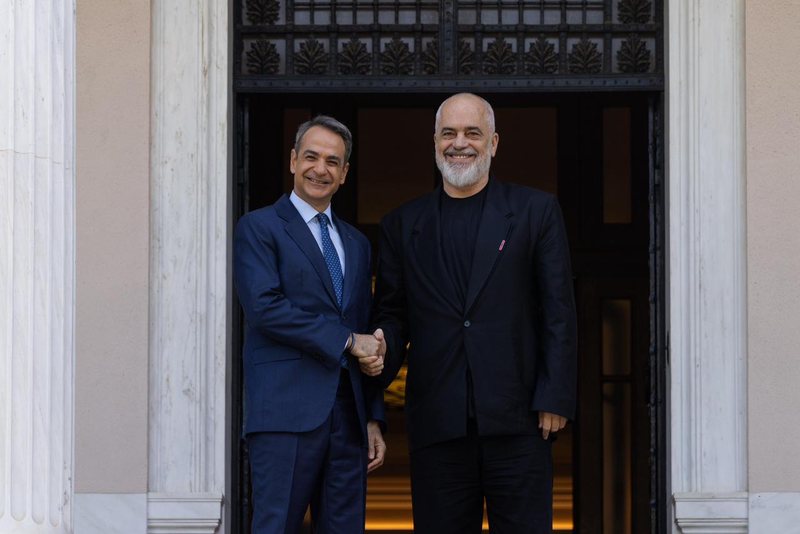
Edi Rama arrived at Megaro Maximos on Wednesday in white sneakers, apologized for them, and was told he was creative. The exchange, captured for the Greek press pool, is the image that will circulate. The substance underneath it is that two prime ministers have publicly committed themselves, on their own timeline, to converting the best Albanian–Greek atmosphere since 2022 into a written instrument before the year is out.
It was the first official meeting in Athens between the two leaders after a period of several years, during which the bilateral passed through its worst phase in more than a decade. Mitsotakis opened by framing mood and substance together. He reaffirmed Greece’s continued support for Albania on its difficult road toward European Union membership, and described a significant opportunity still available to resolve outstanding bilateral issues and to consolidate genuine friendship between the two peoples. Rama’s reply locked the register in. He said he was relieved that what had to remain in the past had remained in the past, because it gave him more occasion to return to a country he loves. He then committed both governments to the same end state: a bold strategic partnership document in which all issues are addressed and no question remains open between them, “brenda këtij viti,” within this year.
The emotional register, relief and friendship and a new level in Albanian–Greek relations, is itself the message. Both leaders had decided the relationship needed its tone rebuilt before any serious text could sit inside it, and Wednesday was the performance of that rebuild. The protocol byplay over the sneakers, Mitsotakis telling Rama that creativity in dress is appreciated, is the same message in a lower key: warmth staged for the cameras because both governments want the warmth on the record.
The distance between Wednesday and the last serious Tirana–Athens moment is worth naming. In May 2023, the arrest of Fredi Beleri in Himara days before a municipal election he then won from custody put the bilateral at its lowest point in a decade. Athens worked the levers available inside Brussels, Albania’s progress on the Fundamentals cluster slowed, and Greek minority politics in southern Albania returned to the foreground of every readout. Mitsotakis’s Wednesday formulation, that what had to stay in the past has stayed in the past, is the diplomatic equivalent of a signed release from that phase.
The setting around the meeting sharpens it. Rama is in Athens for the Delphi Economic Forum, not for a state visit. Ferit Hoxha, Minister for Europe and Foreign Affairs, is at the same forum on the panel focused on EU enlargement in the Western Balkans. Mitsotakis converting a forum appearance into a Maximos reception with a press pool and an on-record exchange upgrades the optics beyond what the calendar required; the Greek government chose to make the visibility matter. The parallel Albanian presence at Delphi, at ministerial level on the enlargement track, tells the same story from the other side. Tirana is working Greece publicly, at a European forum framed around accession, and Athens is reciprocating at head-of-government level.
The rest of what follows is analysis, not readout.
Neither prime minister named the files the strategic partnership document is expected to carry. That list is where the weight actually sits. Maritime delimitation in the Ionian, referred to the International Court of Justice by the October 2020 Rama–Mitsotakis agreement and not meaningfully advanced since. Cham property restitution, the most politically charged dossier in the Albanian domestic register. Greek minority rights and the associated property disputes in Himara and Dropull. The post-Beleri judicial file, which Athens has never formally closed. Pension rights for Albanian citizens who accrued contributions inside Greek social security. The long pending bilateral on dual citizenship. A single document that resolves all of this, rather than listing it, would be the most consequential Albanian–Greek agreement since the 1996 Friendship, Cooperation, Good Neighborliness and Security Treaty. A single document that lists it and defers the harder chapters to implementing protocols is the more common outcome of nine-month diplomatic timelines, and would still be politically useful to both governments in a pre-accession year. The readouts do not tell us which version the negotiators are building toward. The calendar between now and December will.
The wider calibration is the one both capitals know without saying. Greece is the member state most structurally positioned to shape Albania’s pace inside the Fundamentals cluster. A government that was working the accession brake as recently as 2024 has now staged, on the record and in a press pool, a constructive posture for that pace. Read that way, the “brenda këtij viti” commitment is not only bilateral. It is a time horizon inside which Athens will want the partnership document and Albanian accession progress to be legible together.
What the sneakers got, the substance will have to confirm. The meaningful test is not whether a document is signed in December. It is which of the politically heavy chapters the document actually carries. Maritime delimitation and Cham restitution are the two that matter. If both are inside the text at year’s end, Wednesday was the reset the readouts described, and the strategic partnership is the settlement. If either is left to further dialogue, the partnership is the political wrapper, and the settlement is still deferred.