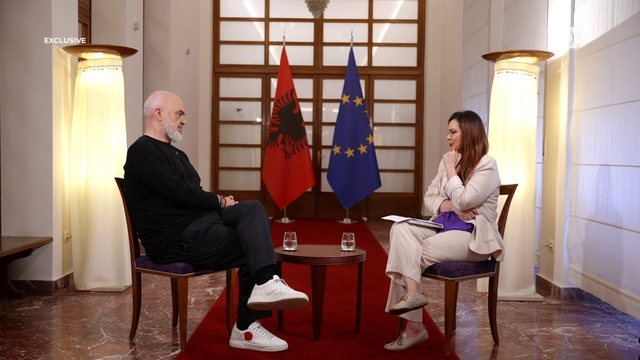
The saga of reflections continues. “At the Iftar Table” is Prime Minister Edi Rama’s latest book, a collection of reflections from iftar dinners held during his time in office.
Speaking to Monika Stafa on “Exclusive” on Top Channel, he explains that the book’s publication came in part from his deep love for the Albanian language.
Monika Stafa: Mr. Prime Minister, I wanted to first congratulate you on your book “At the Iftar Table” — not so much as the author of a series of speeches delivered at iftar dinners, but perhaps because I was more struck by the reason you chose to publish it. You said, in a podcast sometime around late November, that you did it for the sake of the Albanian language. I have never heard any author give such a reason for writing — except Ismail Kadare.
Edi Rama: That is one way of looking at it. But the way I see it, it is simply a man who has fallen in love with language, and who finds in his mother tongue a reason to write — something that fills me with enthusiasm even when I am composing a simple message to someone, or when I used to write replies to people on Facebook. It is a love for the Albanian language. I have no way of comparing myself to Ismail Kadare or to anyone else. I simply love Albanian, I enjoy writing it, and it gives me great pleasure when what I write ends up printed and bound in a book.
Stafa: One day I went to the Babel bookshop, to the shelf where Arlinda had placed your book. Two gentlemen were there; one came up to me and said of the author of that book: “He was my classmate at the arts school. He was the only one who would secretly bring books, hide them in his jacket, then read to us and discuss them with us. He works in a sculptor’s studio today.” Did you really love books so much that you would smuggle them in and discuss them with friends?
Rama: This refers to a time when many books were banned — it is not a question of books that were available to everyone. Back then, a great many books were forbidden. We found all sorts of ways to gain access to them, stories that would seem unbelievable today. I remember, for instance, how we once got hold of a book on Cézanne — one of the forerunners of that epochal transformation in painting who essentially opened the path for those who came after and were called the Cubists. The book reached us only after we received word that it was kept in a particular house, in which there was a girl who had a connection to a young man who was a friend of a friend, and through that chain we managed to get access to the girl, who took the book from her father’s library — but on the condition that it be returned before three o’clock. Because her father came home at that hour, and if he noticed that the book was missing — a banned book being, in some sense, a kind of bomb — there would be trouble. We were at school, far from home, unable to leave to see the book. So it was placed in the bathroom, up in that part above the cistern — I am not sure what it is called in Albanian. It was exactly like Al Pacino’s revolver in the restaurant scene in The Godfather, where he arranges to meet the police chief for dinner to negotiate a deal, then goes to the bathroom, retrieves the gun, and shoots him. And we would leave the classroom one by one, look at the book, and return to class. These are things that would be unimaginable today, but at the time they were the very reason we kept pushing ourselves — and also the motivation that inspired us to pursue painting, to pursue art, and to nurture the dream that we would one day make our mark.
Stafa: Do you have time to read today, and what do you read?
Rama: To be honest, everything has changed today — and not only for me, but for the overwhelming majority of people. Those who still have the ability and the discipline to isolate themselves and read books regularly are very fortunate. I do read, but no longer in any systematic way. For some time now I have been focused only on a few areas connected to what I do, because I am required to read more for professional reasons than out of desire or curiosity. Some of that reading I do in books; a considerable portion I do on my phone.
Stafa: Do you meet Albanian writers, friends — and who?
Rama: I met Ismail Kadare from time to time, until he passed away. Otherwise, not really.
Stafa: I have followed your passion for art and knowledge in particular. Beyond the knowledge you gain from learning, what other kind of relationship do you have with it?
Rama: For me it is curiosity — not academic passion, not a will to learn as such, though it does become a will to learn again when the duties of office require me to read and understand things that are part of my longstanding formation. There is nothing particularly unusual in any of this. I am simply very much in love with the Albanian language — I find it quite extraordinary — and I take great pleasure whenever I am given the opportunity to play with its words. As for the rest that has to do with books, it is largely curiosity, or more precisely, reading. Because the book in its classical sense is now only one part of reading; the other part, as I said, is digital, or driven by professional necessity.
Stafa: In one of your speeches you said that it is the path toward the spiritual.
Rama: There I was speaking mainly about the holy scriptures. And honestly, my searching through the Quran was driven by curiosity — a desire to understand Islam better, and to verify with my own eyes and my own mind things that had become troubling at a time when Islam was under scrutiny. And Islam is absolutely extraordinary. As for the Bible, I had it in hand and read it long ago, in the time of the banned books. But not the Quran. I came to the Quran much later — much later, and only after it had become a permitted book.
Stafa: In your speeches you praise Albanians very warmly, so warmly that one sometimes thinks you go too far — while also criticizing the European club for not seeing us as beloved or as consolidating, integrating partners, as you write. Do you genuinely believe that Albanians are valuable and capable enough to merit being consolidating partners within that great family that is Europe? Where does that belief come from?
Rama: I am not entirely sure that I praise Albanians in the general sense, because I do not believe in sweeping assessments of peoples or nations. I would say that every nation has its forces of light and its forces of darkness. Every nation has its extraordinary people, its ordinary people — who in general are deeply similar to one another regardless of the color of their skin, the language they speak, or the geography they inhabit. But in certain respects I do think we have reasons to be proud of our forebears. One of them is the way our ancestors managed to endure and survive while being threatened, more than once, with dissolution, absorption, and assimilation. Another is the way our ancestors protected Jews during the Second World War — that is something unique. And what makes it unique is precisely that it is comparable: Albanians did it, while many other peoples and nations did not. And then there is the way that certain Albanians at certain moments in history managed to accomplish things that seemed, at the time they were done, entirely impossible. So I do not believe in — and I hope I do not — idealizing our people, because that does not help. But on the other hand, I am grateful to fate that I am Albanian and not something else. And if I were given the choice, I would choose to be Albanian again.
Stafa: You speak constantly of religious coexistence — not merely as a form of propaganda, but as an added value of ours, as a cultural treasure. When you speak about it on the international stage, do people receive it with skepticism or doubt?
Rama: I mention it, and perhaps I should mention it even more, because I regard it simultaneously as a very important system of security — for peace, for the undisturbed continuity of our people. There are countless cases in which religious diversity within a community has opened terrible wounds, brought death, brought destruction, brought irreparable upheaval. It is like something extraordinary that, when you possess it, you do not value. There are many extraordinary things we have and do not value. We are not inclined to value what we already have. We are not inclined even to imagine that we might wake up one morning and no longer be able to see — we take it for granted that when we wake up we will see the light. Yet how many people are there who would give their lives just to see that light once, because they are blind? We do not appreciate, when we wake up, that we have the day before us, that in its simplicity — or with whatever it holds that we consider ordinary — we have our family, our home, our friends, that we can sit down at a table, eat and talk about something. How many people would give their entire lives just for one such day? As many as you like. From the simplest things to the most complex — when we have them, we do not value them. But we must never forget, and I never forget, what a hell Albania would be if that brotherhood — or that religious harmony, as Pope Francis called it when he came here — were to unravel and be replaced by discord, conflict, and war. It would be a catastrophe. As for foreigners, I believe they have by now developed a perception of Albania much closer to reality than the one they held until not so many years ago, when they respected us formally but neither believed in us nor valued us. And yet they still need to hear more — about the brotherhood, about religious harmony, about what we did for the Jews, about how deeply we are committed to the West, about how much we have suffered as a nation and as a country from our past, from the dictatorship, about how we learned everything in its most extreme form precisely because we were on the wrong side of history, when we isolated ourselves and aligned ourselves with dictators and the world’s tyrants. These are things we must help others to see and to know about us.
Stafa: How good are Albanians toward foreigners, and toward one another?
Rama: They are better toward foreigners than toward one another. That is beyond dispute. But not only toward foreigners in the sense of those who speak another language — also toward strangers who knock on the door, who speak Albanian and are themselves Albanian. They are better toward them too.
Stafa: Where does that come from?
Rama: It is not something unique to Albanians — I believe many peoples share it. What makes us somewhat more striking in a negative sense in this regard is that the way we behave toward one another is more flamboyant, more noisy, more brutal — while others may harbour the same sense of dissatisfaction toward the other person but do not express it as bluntly. I believe this has been aggravated, especially by the isolation we endured, and then by humiliation. But I do not think it is a distinctly Albanian trait.
Stafa: In one of your speeches in the book I read that in this space of faith, there is room even for those who do not believe. Do you believe, Mr. Prime Minister?
Rama: I have never felt comfortable speaking about something as personal as faith in this sense. I am certainly not someone who frequents temples — I regard them with great respect and curiosity, but I do not attend them. When it comes to faith itself, I do not feel at ease speaking about it because it is very difficult to convey, and very personal. People perceive and understand the existence of something that is named differently in different traditions, but in every case shares a common denominator: belief in a force, an energy, a space beyond oneself. So I find it very difficult to speak about.
Stafa: We live today in a different time from before the pandemic. We are full of anxiety and uncertainty because of technological development, which has done us good but also has a darker side — bringing a great deal of unsuitable content and misinformation, compounding a crisis in how we understand the world. Am I right in that observation? What is the relationship between faith and where a person should place their trust today — this new, technological human being?
Rama: I do not believe that people today believe less than they did before the internet appeared. In fact, there are studies suggesting that the growing power of science to explain phenomena has not reduced people’s belief in God. On the contrary, there are more people who believe in God today than there were before this explosion. What some of them may have lost faith in is the path of the Church, the Mosque, the Synagogue — the temples, the institutions. That is connected to a broader crisis of institutions in general, of the state in general, especially in countries where there is freedom and democracy. At the same time, many people believe in belief itself — they believe that believing is not a wrong thing to do.
Stafa: Why does the human being need that?
Rama: Human beings often cannot explain the things they long to understand. Even science itself cannot explain certain things all the way to the end. And I see nothing wrong in people believing, in a person believing. On the contrary. In fact, in a certain sense, even the existence of communities gathered around a faith — beyond the question of whether within that community one manages to touch or remains in unverified search of God — offers an opportunity to share, within a social group, a community, values that help the person in daily life, regardless of how much they see or do not see God.
Stafa: We have long been accustomed to religious conflicts and religious divisions. But now it seems as though a different kind of division is emerging in the world — that between the rich and the poor. And between them a wall is rising, a very high wall.
Rama: Of course, polarisation is an increasingly acute problem in capitalist societies, in democracies, in countries where freedom of competition and the free market — including globalisation and its effects — have caused wealth to concentrate in fewer and fewer hands while the distance between them deepens. But on the other hand, there is a great deal of evidence pointing in many directions to the fact that the world has never been better off than it is today — in factual terms, in terms of hunger, in terms of access to water, to services, to education, to healthcare, and so on. What makes polarisation so much fiercer today is the far greater proximity that the information world has created, that social platforms have created, where wealth and consumerism have assumed an almost monopolistic position in everything that is seen and consumed — images of wealthy people, affluent people, well-dressed people, equipped with houses, cars, and private jets — while the rest observe with great clarity the enormous gap separating them from this elite, and that sharpens the sense of conflict considerably.
Stafa: In this book, how much is there in the way of an appeal to human love in these speeches, and how much weight do the truths expressed there carry?
Rama: When I decided to hold the first iftar dinner here at the Prime Minister’s Office, to be honest I did it as a step toward a community that, for various reasons, had not infrequently felt prejudged as a result of prejudices against Islam. We should not forget that in Europe and in the West those prejudices deepened considerably, especially after the attack on the Twin Towers and all the stereotypes that linked Islam to terrorism and Islamism, and linked the Muslim faith and Muslims to an organic incompatibility with the West. Beyond that, it is not that I had some deep reflection that came to me step by step, year by year, until I arrived at a point not of impatience but of genuinely looking forward with great pleasure to that iftar dinner. There is something very beautiful in that ritual, and I now understand very well both the strictly educational dimension that Ramadan holds for those who observe it, and the profoundly healthy nature of the practice of Ramadan — which is truly impressive in its effects on a person’s physical health, mental wellbeing, and inner life. And in that context, naturally, one’s capacity to generate positive energy toward others is far greater than on ordinary days, just as negative energies naturally diminish compared to ordinary days.
Stafa: And for those who believe that religions are invented — what do you say?
Rama: I think that even if God did not exist, humanity did very well to invent Him. Better with God than without.
Stafa: You are a Christian, and you live every day with the conviction that faiths are reflected in one another. How did you arrive at that conclusion?
Rama: I was baptised Catholic by my Catholic grandmother, and that is a fact. I am Christian by family, and that too is a fact. But I am not among those Christians who queue up to enter the doors of the Church and submit themselves to its rituals, because that is not how I conceive of my relationship with faith. That helps me to look upon the faiths of others without any reservation whatsoever, and to understand that in the faiths of others the same God is in fact reflected. And in the end, the holy books appear to have been written by the same author — one and singular. Along these lines I also conceived the idea of building the Park of Faith: creating a space where there are no churches, no mosques, no synagogues, no other temples, but where through flowers, through trees, through fruits, through stories drawn from different holy books, one comes to know the different faiths in a different way — with the sky as the ceiling that unites them all, rather than the ceiling of a church or a mosque.
Stafa: In your speeches you often preach the pursuit of goodness and justice. In the role of Prime Minister, is that goal always achievable?
Rama: In the role of Prime Minister it is always achievable not to deliberately choose evil or injustice. That is always within reach. It does not compel you to be deliberately bad or deliberately unjust — though it can happen, as it happens to everyone, that in good faith you make a decision that may not be the right one, that may not bring good, that may cause harm. But in good faith.
Stafa: Somewhere else in the book you write: “There are no wars between faiths — only wars between the ignorant.” We live in a world full of conflicts, and each of these wars has a religious dimension. And yet you say, borrowing from Dostoevsky, that “Beauty will save the world.” What is that beauty, Mr. Prime Minister?
Rama: That is a belief, not a formula for salvation. But it is a belief, because poetry, painting, books, and the counsels of science have not prevented human beings from killing one another, and have not stopped any war. And yet the path of humanity is the path of striving toward perfection and toward leaving a mark. And it is in that striving for perfection and the leaving of a mark that intentions and values sometimes become entangled — and unfortunately, often distorted. Because even one who chooses to become a suicide bomber sees it as a path to perfection and as a way of leaving a deep mark on the history of their people. So in the end, life is entirely a matter of choice — because if God exists and has made us all human beings, He has also left us the freedom to choose. He has not resolved any dilemma for us by magic or by decree from above. The dilemmas are ours, and we must make our own choices. Then in the end comes the judgment that each of us…
Stafa: Do you believe in the judgment that comes at the end?
Rama: I believe in the judgment that comes at the end — but it depends on whose. I will not venture to explain, or to explain to myself, which is the highest form of judgment. But I believe that the judgment of those who knew you, the judgment of those who trusted you, the judgment of those who did not know you but can look upon the traces you left — these are all important. My father, God rest his soul, used to say: “In the end, nothing has value except the good memory left behind.” And that makes a great deal of sense.
Stafa: And finally — when will we be able to walk through the Park of Faith?
Rama: The Park of Faith is a complex undertaking, and it will take years to become what it should be, because its living elements will need time to grow. But I very much hope we do not lose too much time before starting — and then it will take a few more years before we can see it as it should be. But you are young, so you will have the chance to walk through the Park of Faith.
Stafa: When is the next book?
Rama: I have no plan, but it will come on its own.