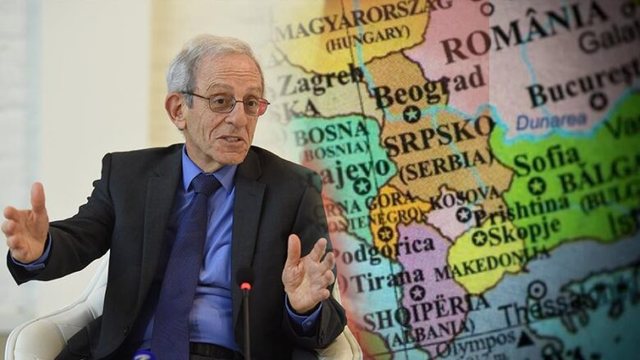
Daniel Serwer delivered these remarks in Tirana on 28 May 2026, at an event organized by the Albanian Institute for International Studies, where Albert Rakipi posed the question that gives the talk its title. Serwer is Professor and Senior Fellow at the Foreign Policy Institute of the Johns Hopkins School of Advanced International Studies, and among Washington’s longest-serving observers of the Balkans; he first came to Albania as a US election observer in 1997. We publish his remarks as a guest contribution, a view from Washington. The arguments are his own, and the editorial line of Tirana Examiner should not be read into them.
It is a great pleasure to be back in Tirana almost three decades after my first visit. I was here in 1997 as a US government election observer.
The only thing that hasn’t changed since is Sali Berisha. But I can’t complain, as I’m almost as old as he is and also still kicking.
US policy toward the Balkans has changed. And America has changed.
To answer the question that Albert Rakipi posed for the title to this talk: no, America is not still America. Nor will it be again for several more years, at best. By the time it returns to something resembling what President Ronald Reagan called the shining city on the hill, the world will have changed.
Let me focus first on the US, then a bit on Albania and its progress toward EU accession.
America has reverted
The presidencies of Donald Trump have shifted American foreign policy away from its post-World War II focus on defending and expanding the democratic world.
The America that you and I grew up with, an America committed to equal rights, is newer and less established than you think. It started in 1948 with integration of the Army and in 1954 with the Supreme Court decision to integrate America’s schools. It really took full legal form only with implementation of the Voting Rights Act of 1965, which ensured Black people in the American South could vote.
Until then, racial discrimination throughout the country and white supremacists in Congress were still common. We like to forget it, but before the Second World War we had a major America First movement (yes, that is what they called themselves) that was sympathetic to the rise of fascism.
America is not entirely based on equal rights
The liberal democratic order that you are fond of was gestated during the war and born in the early Cold War. I know the significance it has for Albanians; I have seen the movie Lamerica. But the America of Albanian dreams is a recent invention.
Yes, our Declaration of Independence, whose 250th anniversary we will celebrate in July, asserted that all men are created equal. But the men they referred to were property-owning white males. Only generations of political protest extended equal rights to women, minorities, and gay people.
Our Constitution created a governing system that gave, and still gives, more weight to less populous states, because all states have two senators no matter their population. The original version even distributed representation based not on the population of voters, but on population including three-fifths of a person for each slave.
Even today, America remains remarkably segregated de facto in housing, education, and religion. The conservative Republican majority on the Supreme Court has now almost completely gutted the 1965 Voting Rights Act, at the behest of the Trump Administration. It wants a colorblind approach that will ensure white dominance in practice.
The majority of most minorities vote Democratic, so redrawing districts to favor Republicans amounts also to disempowering Black people. All you have to do is claim that the new Congressional districts you draw are based on political rather than racial criteria to ensure that they will pass muster in the courts.
When will this end?
You may well ask, when will this anti-liberal approach end? When can we have the America of our youth back?
The answer of course is that I don’t know. The nice thing about American elections is that you don’t know the results in advance.
But certainly today Trump is unpopular. I would not have qualms about predicting a Blue Wave if the election were going to be held tomorrow. Trump is underwater on virtually every important issue: the economy, prices, jobs, taxes, immigration, the Iran war, and foreign policy in general.
There will be opportunities, starting in November, to shift gears. If the Democrats win at least one of the Houses, they will be able to stop some of Trumpism domestically. They will likely focus on curbing corruption in the sale of pardons, in the assignment of Pentagon contracts to companies his family has an interest in, and in the distribution of supposed compensation to the January 6 rioters.
But only with control of the White House and a new majority on the Supreme Court will we be able to reverse the worst of Trumpism. Meanwhile, we will have to live with its mistakes.
Foreign policy
They are glaring in foreign policy, which admittedly is not something most American voters pay attention to, but I know it matters to you.
While some of the pro-democracy rhetoric remains, Trump’s foreign policy has emphasized a geopolitical, “might makes right” approach that always existed. In the past it was deployed only when necessary. The American mantra was “Multilaterally if we can, unilaterally if we must.” Your Kosovo cousins owe their independence to a unilateral moment.
The geopolitical approach is now dominant. Trump has said clearly he follows only his own morality and his own mind. Unfortunately, neither is capable of good judgment.
Trump is also emphasizing deals, transactions that benefit the United States, in place of international community consensus, solidarity, consultation, and cooperation. This approach has undermined NATO and left the US isolated from its NATO allies in going to war in the Middle East.
In geopolitical terms, which are the ones Trump values, Russia and China are the important countries today and consistently get the benefit of the doubt from Trump. No one else really counts, unless they do what Trump wants.
I can offer you lots of explanations for his softness toward Putin: personal rapport, ideology, financial benefits, kompromat, and others. But I can’t tell you which one is correct. All I know is that Trump can be relied on to be soft on Putin and hard on Zelensky, even if Moscow rejects his peace initiatives and targets US assets in Iran.
In the Middle East, it was Binyamin Netanyahu who got the best of Trump. The Israeli Prime Minister has dragged the US into war against Iran not once, but twice. I won’t be surprised if he manages to get Trump to end the ceasefire and renew the war.
Trump has driven the United States into a dead end that is too narrow for a U-turn. The result is Iranian control over the Strait of Hormuz, giant American military and reputational costs, serious physical, reputational, and economic damage to Gulf Arab allies, worldwide increases in oil, gas, and fertilizer prices, and impending recession. Not to mention a windfall in oil revenues for Russia, amplified by Trump’s decision to relieve Russia of sanctions, and a close-up view for China of the latest American military capabilities.
The Balkans
What, you might well ask, does all this mean for the Balkans, and specifically for Albania?
First, the Americans have stopped caring about multi-ethnic democracy in the Balkans. This is clear in their de-sanctioning and welcoming to the White House of Milorad Dodik, who represented a serious threat to Bosnia’s sovereignty and territorial integrity. This is not surprising. They don’t care about multiethnic democracy in the US. Why should they care about it in Bosnia and Herzegovina?
Second, Washington’s approach has become far more transactional. The de-sanctioning of Dodik and support for the Bosnia gas pipeline project are both linked to Trump’s cronies. The connection is not an accident.
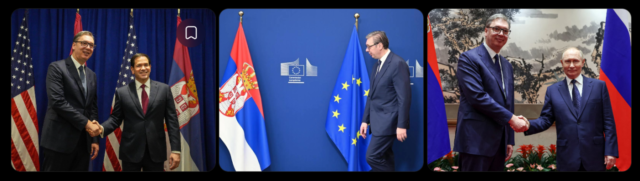
But, you may ask, why is President Vucic not getting a warm welcome? Maybe because of the failure of his family’s proposed hotel in Belgrade? Maybe because someone convinced President Trump that Serbia had harbored hackers committed to his defeat in 2016? Maybe because he hasn’t hired the right lobbyists, or offered good enough deals to the Trump family and friends?
But Vucic isn’t getting much criticism either. Washington doesn’t complain about his retreat from democracy and his corruption. The Americans do nothing to support free media, an independent judiciary, or the student protests in Serbia. When I ask why not, the answer is “stability.”
I am generally a critic of the idea of stabilocracy. Ask Gruevski, Djukanovic, or Izetbegovic whether the Europeans and Americans were prepared to help them in the name of stability. But Serbia is a clear case: a regime supported because it promises stability, even though it is a primary source of instability. Washington is afraid that Belgrade might upset the apple cart in the Balkans, causing problems the US can ill afford to solve under current world conditions.
Can you benefit?
Some countries in the Balkans are trying to benefit from Washington’s transactional approach. I would put Albania and Kosovo in this category with their willingness to join the Board of Peace and offer troops for a possible stabilization force in Gaza.
I cannot criticize Tirana and Pristina for trying to butter up Trump. I can only imagine what they are asking in return, but I hope it is something valuable. If Trump is transactional, you can be transactional in return.
For Albania the main objective should be EU membership. For Kosovo, it is NATO membership. Both are problematic for the Americans.
NATO
NATO is still standing, even if on uncertain ground. But it will not be easy to convince the Trump Administration to support membership for tiny Kosovo, which would bring marginal military capacity and some risk to the Alliance.
Realistically, Kosovo cannot hope in a Trump Administration to benefit from Article 5. Trump has even weakened its deterrent effect by casting doubt on whether he would defend anyone in Europe. But the Alliance can still help with planning, training, and interoperability, which will be vital for Kosovo’s defense, as well as for Albania’s.
I hope volunteering for Gaza service will help to convince Washington that Kosovo will benefit NATO. While I worry that the Alliance mutual defense commitment is no longer reliable, Kosovo joining would be an important signal to the rest of the Balkans.
And I am an enthusiast for Albania joining with Slovenia and Croatia to cooperate in defending themselves. I wish Montenegro would join that effort.
The European Union
On the EU, I have bad news. The Trump Administration regards the EU as a rival and seeks to weaken it. That’s why they supported Brexit and have levied tariffs against Brussels. That’s why EU enlargement is not mentioned in the State Department paper published last week.
Trump has fought with Denmark about Greenland, Germany about Ukraine, France about Iran, and Italy about the Pope. The list is endless. Montenegro and Albania can expect no support for their membership in the EU from the US. They may even face opposition, which I hope they will defy.
The EU today is a vital proponent of liberal democracy and the rules-based world order, as well as a serious counterweight to Trumpism. Joining it will engage Albania in a noble enterprise: ensuring that the ideals of the rules-based order are preserved through the current geopolitical, “might makes right” madness.
The biggest challenge for Albania is of course rule of law. I hope your government will see its way to meeting the EU’s requirements. But there is another, less visible problem: I doubt the EU is going to be willing to admit new small members with a veto.
I did not like the Rama/Vucic proposal, which smelled like an effort to avoid the rule of law requirements. But I don’t think Tirana should resist extension of qualified majority voting to foreign policy. We all need to learn the lesson of Hungary’s invidious behavior under Orban.
The future
By the time you are firmly in the EU, I hope America will be returning to something like its former self. But the world will have changed. I hope the aggressors in both Ukraine and Iran will have been defeated, strategically if not militarily.
If that happens, Russia will be in renewed decline. China will be facing demographic implosion. Perhaps America’s Asian allies will have realized that they will need to be able to defend themselves. Europe will be a stronger pole within NATO, as well as a stronger economic and political force in the world.
America will need to renegotiate its entry. Maybe Albania will be able to help.