From the Stability of Dayton to a New Era of Uncertainty
by Gerta Zaimi (Tirana)
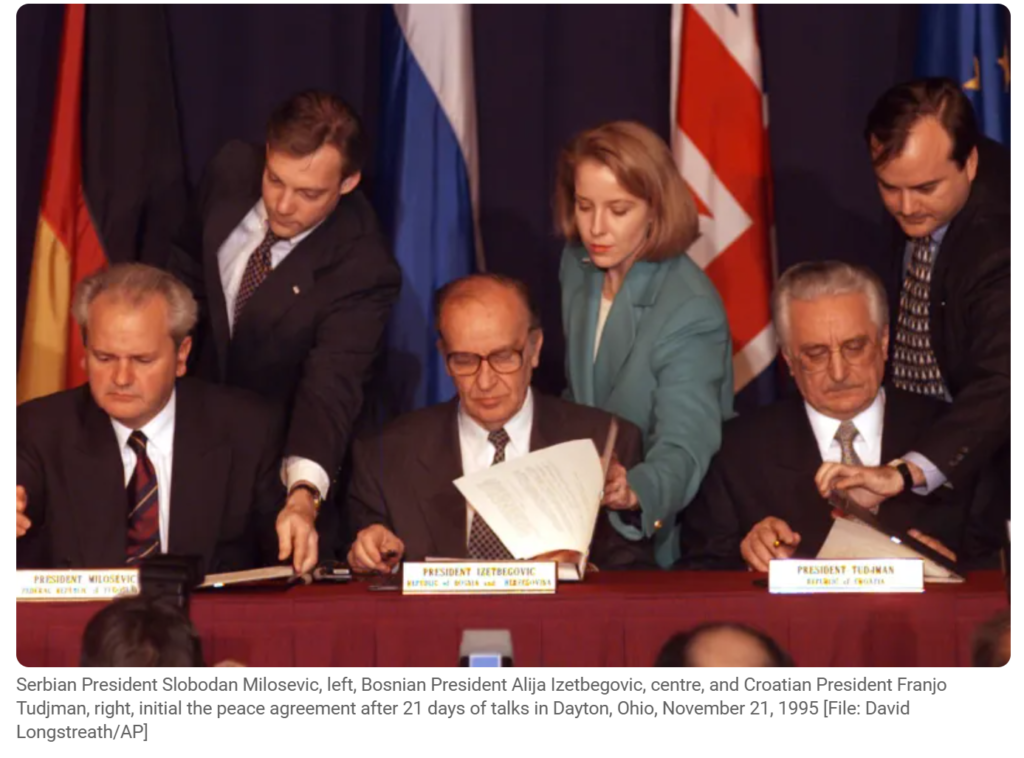
On May 11, 2026, Christian Schmidt announced that he would step down as High Representative for Bosnia and Herzegovina after nearly five years in office. As the international overseer responsible for implementing the 1995 Dayton Peace Accords, Schmidt occupied one of the most sensitive positions in postwar Europe. The Dayton framework ended Bosnia’s devastating civil war by dividing the country into two entities: the Serb-majority Republika Srpska and the Bosniak-Croat Federation, home to most of the population.
Schmidt says his departure is due to personal reasons. Until a successor is appointed, he will remain in office, with reports suggesting that two Italian candidates are now under consideration.
To the broader public, the announcement may seem sudden. For longtime observers of Bosnia, however, it comes as little surprise. Schmidt himself appeared to hint at such an outcome in recent weeks.
In a statement published on the official website of the Office of the High Representative, Schmidt described the move as “a personal decision” and confirmed that he had already informed the Peace Implementation Council, the international body overseeing the Dayton framework.
He also urged the international community to begin the process of selecting a successor. Diplomatic discussions in Brussels increasingly point toward the appointment of an Italian figure. In his farewell message, Schmidt stressed that none of the decisions he made as High Representative had ever been overturned and insisted that the role itself “remains important.”
Yet Schmidt’s departure appears to involve far more than personal considerations. Bosnia is once again becoming an arena for wider geopolitical competition between the United States and the European Union, while the political rehabilitation of the Russia-backed separatist leader Milorad Dodik increasingly unfolds in plain sight.
The central question is no longer simply why Schmidt is leaving, but what political arrangement may be emerging behind his departure.
Schmidt was deeply unpopular among Bosnia’s Serb leadership, particularly Dodik, who refused to recognize his legitimacy from the beginning. Moscow also rejected Schmidt’s appointment, while critics frequently accused him of favoring Croatian political interests inside Bosnia.
According to journalist Michael Martens of the Frankfurter Allgemeine Zeitung, Schmidt ultimately paid the price for “months of pressure from the United States” aimed at forcing his resignation. Martens argues that the Trump administration recently intensified those efforts aggressively, including through what he describes as a backstage ultimatum.
The Italian name reportedly circulating through European diplomatic channels belongs to a figure who previously served as ambassador both in Belgrade and Moscow, raising immediate questions about the degree of Serbian and Russian approval behind the transition.
The timing of Schmidt’s departure is also striking. It coincides with the controversial approval of the Southern Interconnector, the liquefied natural gas pipeline project linking Bosnia and Croatia, now increasingly associated with American strategic interests in the region.
His resignation comes amid the awarding of a 1.5 billion dollar contract tied to the project. The beneficiary is not the US government itself, but an American company established only last November and led by Jesse Binnall, Donald Trump’s personal lawyer, together with Joe Flynn, the brother of former National Security Adviser Michael Flynn.
Michael Flynn resigned during Trump’s first administration amid scrutiny over his contacts with Russian officials concerning US sanctions policy.
For some analysts, the broader picture is becoming increasingly difficult to ignore. Reinhard Veser, also writing in FAZ, argues that Washington has effectively decided to support “the region’s greatest source of instability, Dodik, Putin’s closest ally in the Balkans,” in exchange for geopolitical and energy interests connected to the interconnector project.
Dodik himself reportedly succeeded in securing removal from the US sanctions list following an intensive lobbying campaign. At the same time, Washington appears determined to position itself as the dominant supplier of liquefied natural gas to Southeastern and Central Europe as Europe continues reducing its dependence on Russian energy.
Former Swedish Prime Minister Carl Bildt summarized the situation bluntly: “Always under attack from Moscow, the High Representative was ultimately brought down by the United States, while the European Union remained weak and unfocused.”
No political actor appears more satisfied with Schmidt’s departure than Dodik himself. The Bosnian Serb leader previously dismissed Schmidt as a “powerless tourist,” and after the resignation announcement he wrote on X that Schmidt was “leaving Bosnia the same way he arrived: without legitimacy.”
Buoyed by what he sees as a political victory, Dodik also declared:
“The victory of Banja Luka over Sarajevo is a historic and existential victory, not merely a political one. That is why we must unite around sovereignist policies in Republika Srpska. Around policies that empower and represent the people.”
Yet the geopolitical story is more complicated than a simple confrontation between Washington and Moscow.
Schmidt arrived in Bosnia as a figure closely associated with Angela Merkel and enjoyed strong support from Croatian Prime Minister Andrej Plenković following years of lobbying by Croatia’s nationalist political establishment.
During his mandate, Schmidt was repeatedly accused of favoring the HDZ, Bosnia’s main Croat nationalist party, even at the expense of institutional balance and the rule of law. Ironically, it is precisely Dragan Čović and Dodik who now appear aligned in supporting Schmidt’s departure, driven by overlapping separatist ambitions and converging interests around the American-backed energy project.
Bosnian analyst Jasmin Mujanović argues that Schmidt’s current predicament is inseparable from the political compromises that accompanied his rise to office in the first place.
“The removal of Milorad Dodik from office may have happened thanks to Schmidt’s amendment to Bosnia’s Criminal Code,” Mujanović notes, “but Dodik is no longer under US sanctions, and Schmidt’s departure will ultimately be the consequence of his own political choices.”
“If Schmidt is leaving because of a political conspiracy,” he adds, “then we must also admit that he arrived through one.”
Whatever the full truth behind these developments, Bosnia is entering a period of profound instability. The burden of that instability will not fall primarily on Washington or Brussels, but on Bosnian citizens themselves, who have once again been left outside the real negotiations shaping their future.
Dodik’s rhetoric leaves little doubt that separatist ambitions remain alive. What has changed is the broader international environment around him: an increasingly passive European Union, an America guided by transactional geopolitical priorities, and a regional order where the rule of law and democratic reform appear increasingly negotiable behind closed doors.
Gerta Zaimi is an Albanian journalist, geopolitical analyst, and researcher specializing in Balkan politics, Middle Eastern affairs, and security studies. She has researched international relations, violent extremism, and regional geopolitics through academic and policy institutions connected to the University of Florence. Her work focuses on Bosnia, Kosovo-Serbia relations, Islamist radicalization, and the intersection of energy, security, and great-power politics in Southeastern Europe.