A fabricated story about an Albanian island helped ignite the protests convulsing Tirana. Now a United States senator has made it the centerpiece of his re-election.
Tirana Examiner
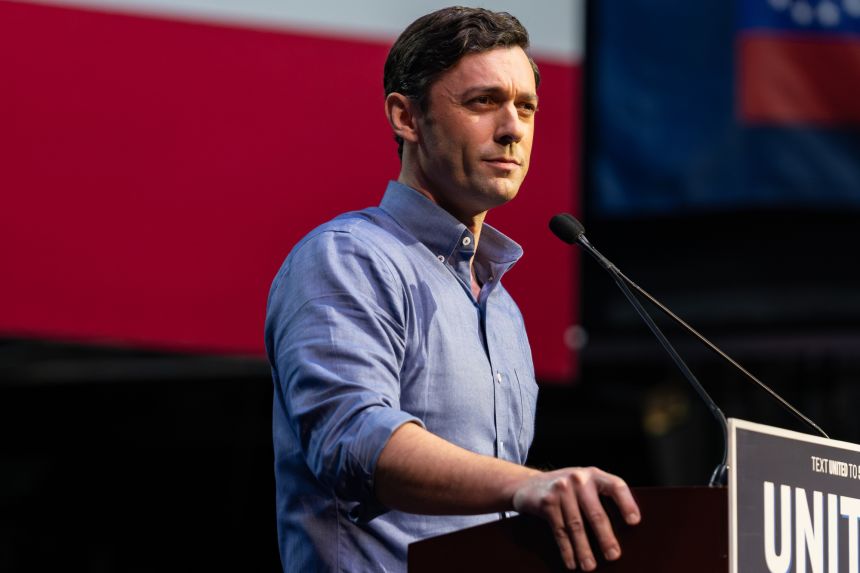
Picture the scene in Savannah. A United States senator, locked in the hardest re-election fight any Democrat faces this cycle, stands before a friendly crowd and tells them a fairy tale about a faraway island. There is a wicked prince, the President’s son-in-law. There is a stolen paradise, some of the last wild coastline in the Mediterranean. There is a captive king, a foreign prime minister who hands the treasure over on command. And there is the ending the crowd came to hear: one day soon the guilty will raise their right hands before Congress and answer for all of it, so help them God.
It is a well-made story, and Jon Ossoff tells it well. The trouble is that almost nothing holding it up is true, and that the story was never his. He imported it, whole, from a country where it was manufactured for a purpose that has nothing to do with Georgia.
Begin with the island the senator says Jared Kushner is buying. Sazan is not for sale. It is, and under the arrangement on the table remains, the property of the Albanian state, which keeps its title and takes an equity share in whatever is built there. A man cannot purchase what the owner has declined to sell and means to keep. Move to the resort the senator says has been green-lit. No permit to build it exists. The project sits today inside an environmental review it has not passed, an in-depth assessment demanded by the very government Ossoff casts as Kushner’s footman. Then take the favor he dates with such precision, the strategic blessing bestowed, in his telling, a few weeks after Trump won a second term. The Kushners’ interest in that coast goes back to a swim off a friend’s yacht in 2021. Their master plan sat before Albania’s national planning council in September 2024, six weeks before a single American had voted. A bribe paid out for victory does not arrive trailing a year of paperwork behind it and a pending environmental review in front.
The senator’s whole architecture rests here, and it does not survive contact with the public record. Strip away the proper noun and the menace in his voice, and each charge collapses into the same thing: not a finding but an insinuation. Follow the insinuation to its source and you do not land in Savannah. You land in Tirana.
We have watched this story assembled from a great deal closer than coastal Georgia. It was built through the spring to do a specific job: to put bodies in the street. The job succeeded. The protest movement that resulted, christened the Flamingo Revolution for the birds of the lagoon, has filled the boulevards of the Albanian capital for weeks, and somewhere along the way it stopped being about a resort and became a campaign to bring down a twice-elected government. That is the prerogative of Albanians, and a healthy democracy argues loudly about how it develops its coast. But a story told to move a crowd is not thereby true, and this one did not grow in clean soil.
It grew in soil worked, with evident enthusiasm, by every power that profits from Albania’s failure. The narrative traveled on networks that Albanian and allied analysts trace to the same familiar capitals that meddle everywhere along the Western Balkan seam, and the government in Tirana has pointed openly at Tehran and at Moscow. It traveled, too, with an uglier passenger. The online campaign carried a torrent of antisemitism aimed at Kushner and his wife, and on the ground it produced the desecration of the Israeli Embassy, chants a decent movement would have disowned, and placards that would not look out of place in the cruder corners of the last century. This is the provenance of the tale Jon Ossoff carried to a Savannah stage. He did not mention it. Perhaps he does not know it. A former investigative journalist ought to have asked.
For that is the part that should sting. Before the Senate, Ossoff spent years making documentaries about corruption and the abuse of power, and he still tells audiences that the work defines him. A man with that training knows the difference between a charge and a fact, between an open file and a closed one. He knows a sourced story from a merely useful one. He reaches, as his clinching proof, for the one criminal investigation in this affair, the frozen account, the prosecutors closing in. Look at what that investigation actually is. It is run by SPAK, Albania’s independent anti-corruption prosecution, the institution the United States spent years helping to build and never tires of praising as the proof that Albanian justice has come of age. And it is aimed not at Kushner but at the Albanian operator who sold the disputed land, a figure its files tie to forged titles and to far darker trades. The prosecutors have said in plain language that their case touches no company associated with Mr. Kushner. The senator took an investigation pointed at an alleged forger and told a crowd it was the net tightening on the President’s son-in-law. He inverted even the one fact he troubled to cite.
So this is the shape of the thing. A narrative was minted abroad to topple a government, amplified by the enemies of a Western-leaning state, and stained by the oldest hatred in Europe. It crossed the Atlantic, lost its accent and its fingerprints along the way, and surfaced in the mouth of an American senator as a piece of homegrown populism: the greedy in-law, the plundered Eden, the reckoning to come. The laundering is nearly complete. What began as influence operation in the Balkans is now an applause line in Georgia, and the senator delivering it has either failed to check where it came from or decided that checking would spoil the effect.
Albania is a small country that has spent thirty years climbing out of one of the cruelest tyrannies Europe ever produced, trying to make itself the kind of place the West would want inside its walls. It is a NATO ally and a candidate for the European Union. It asks very little of the United States beyond the courtesy of not being lied about on a campaign stage. A senator who built his name on telling the truth about the powerful has, for the price of an applause line, told a powerful lie about the weak, and told it in words first drafted by the people who most want Albania to fail. He has performed someone else’s dirty work under stage lights, and never once stopped to ask whose it was.