Kreshnik Spahiu asked the question no foreign correspondent will. The days since have answered it for him.
by Elis Zenelaj (Tirana)
The wire went up overnight. The people of Zvërnec walked down to the water on a morning in late May the way they had walked down to it all their lives, and found their own beach fenced against them, barbed and posted and waiting for a billionaire from across the sea. They put their hands on the wire and tore it out of the ground. That is how this started. Not with a party and not with a program, but with a fence, a village, and a refusal.
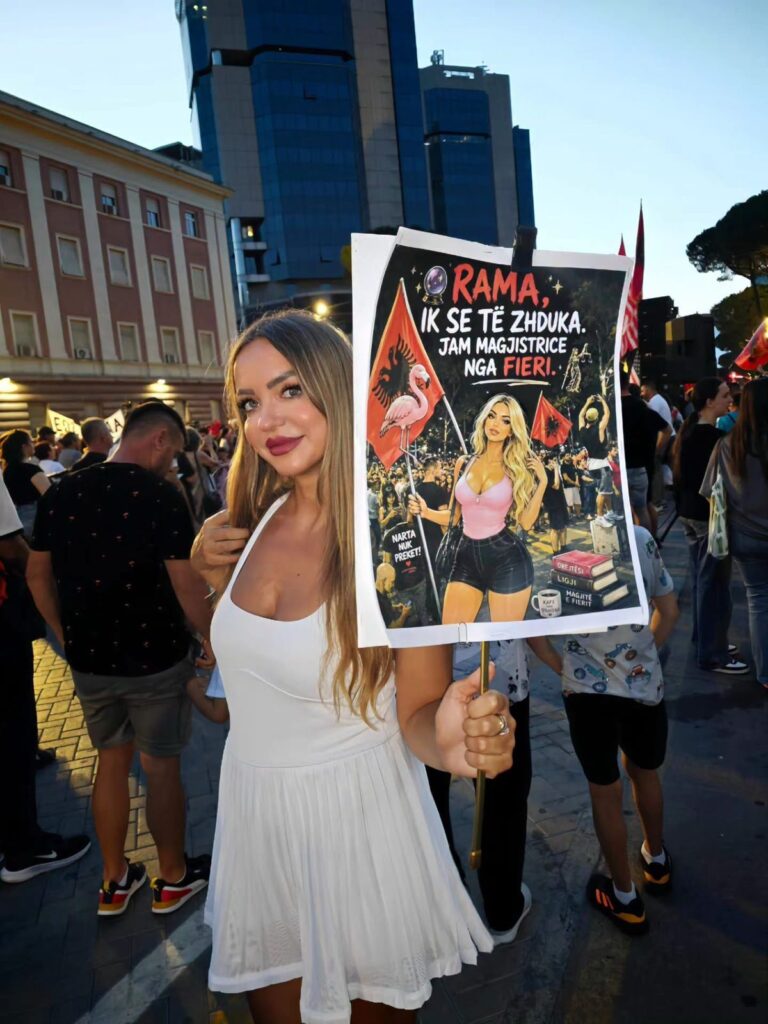
Within a week the whole country stood behind them. They were young, most of them, younger than the governments they had grown up cursing. They brought paper flamingos and bottles of water for strangers. When the police came with the water cannon, they came back the next evening with white roses and pressed them into the officers’ hands. They wanted one thing, and it was a small and enormous thing. Leave the coast alone.
Go down to the boulevard tonight and you will not find that protest. You will find its address, its hour, its crowd. But something has moved out, and something else has moved in, and only one man in this country has been willing to say so without flinching.
Kreshnik Spahiu calls it a quarrel between generations. The bread spread with sugar against the children of the potato chips, he writes, reaching back to Agolli’s old prophecy of a war between the soft generation and the hard one. The movement the world had named Generation Z has been lowered, in his bitter little coinage, to level Zh, the last rung of our alphabet, the bottom of the page. He asks the thing the foreign desks will not. Why did the twenty-year-olds give their voice away? Why did the children of Western lecture halls go quiet the moment the old white felt caps stepped to the front? The perfume of the square, he says, has gone over to sweat. Did the old wolves take it, he asks, or did the agencies.
You feel the truth of it before you can argue it. The young have not gone home. They have only stopped being the ones who speak. Row by row the microphone has slipped backward out of their hands, until the camera finds, at the very front, a face that does not match the crowd, a man wearing a harder kind of certainty, formed in an Albania the kids behind him were lucky enough never to live in.
On a Monday that man read the movement’s demands aloud at the prime minister’s gate. His name is Dritan Goxhaj, and there is a tape of him, surfaced again this week, explaining how a country truly changes its masters. Rotation, he says into the camera, is made by the bullet. The act is easy. It only wants support. The square that had put roses in the hands of the police stood and let him speak in its name, and said nothing.
The silence kept its shape after that. A young man climbed to the same microphone and told the crowd the American Embassy had been threatening him, in its own name, intimidating the youth of Albania. The Embassy, which rarely troubles itself with a boulevard, troubled itself: the accusation, it said in plain daylight, was false from the first word to the last. Spahiu had seen the shape of this before it had a name. Whatever was true of the threat, the stone had been thrown at America from the protest’s own stage, and not one hand in that crowd reached out to pull it back.
He counted, among the small treasons, a call to march on the Fourth of July. It read, when he wrote it, like a columnist’s suspicion. Then the date stepped into the open. From the boulevard on the twenty-third of June came the announcement that the diaspora would come home for American Independence Day, that messages were arriving from abroad, that support was on its way. The hunch had become a calendar entry. And abroad the cameras had long since made up their minds, filing Tirana under Trump and never under Rama, translating a rebellion against an Albanian prime minister, in newsrooms that will never smell the salt off the Narta lagoon, into a quarrel with the United States.
Then the cruelest turn, the one Spahiu set down almost too quietly, in a second column. Read the five demands as they were finally carried up the steps in the movement’s name. They speak of the government, the system, the whole rotten scaffolding of power. They do not speak of Zvërnec. Not once. The fence, the lagoon, the birds, the beach a village clawed back with its bare hands, have dropped out of the story like a name you swore you would remember and somehow lost.
This is what he is telling us, beneath the alphabet and the wordplay. The protest was taken the way the beach was taken. Not by force, the young had already beaten the force, but by the oldest sleight of hand this small country knows. Let the people fill the square. Wait until it is full. Then walk to the front and speak in their name. The wire at Zvërnec came down in May. The new wire is the kind no camera can catch. It goes up a little higher every evening, around the meaning of the thing itself, while the crowd keeps its eyes on the boulevard and forgets to ask whose hand is on the microphone.
Spahiu leaves them at the alphabet, a generation marked down to its final letter. Let the bird have the last word instead. The flamingo was always a traveler. It does not stay where it was born. One morning you lift your head and the whole rose-colored cloud of it is gone, peeled off the lagoon and bent toward some other shore, and you are left standing in the water you came to save, unsure of the very hour it left you, no longer certain it was ever yours to keep.
CLICK here to read Spahiu’s Op Ed