They speak of reform. The letter they sent to the ambassadors describes something else: the transfer of power from elected institutions to an unelected authority.
Albatros Rexhaj
The letter from the Protest Coordinating Group, delivered to the Western ambassadors in Tirana, closes with a sentence that betrays the whole document: “These demands represent the clear and legitimate expression of a sovereign people.” Let us begin where they end, at the word “people.” Which people. Who holds this will. Who has vested in the thirteen names beneath this letter the right to speak in the name of a nation. The answer is simple and unpleasant: no one. And precisely there, in that emptiness, lies the entire truth of this letter. The word repeated most often in it is “reform.” The word that is missing, because it dares not be written, is “power.”
Popular sovereignty is not the mood of a gathering. It is a procedure. It has a single bearer, the voter, and a single place where it speaks, the ballot box. Everything else is interpretation. A body of people, however sincere, however loud in the square, does not inherit the general will merely by proclaiming itself its bearer. The man who sells the people’s vote without holding that vote in his hand is no less a usurper than the man who seizes it by force. Both speak in the name of someone who has not authorized them.
And let us state plainly the fact that undoes the whole stage set: Albania is a pluralist democracy, with functioning constitutional institutions, with periodic elections and with an open process of negotiation with the European Union. It has flaws, it has unfinished battles with corruption and with the quality of the vote; no one denies this. But the flaws of a democracy are mended within it, by vote and by law, not by handing power to a body that no one elected. Whoever claims to be living under a regime that falls with nothing more than a letter addressed to foreigners is not describing the Albania of 2026. He is describing an imaginary country, one he needs only as a justification.
Because that imaginary country belongs to another century, and that century is precisely the key.
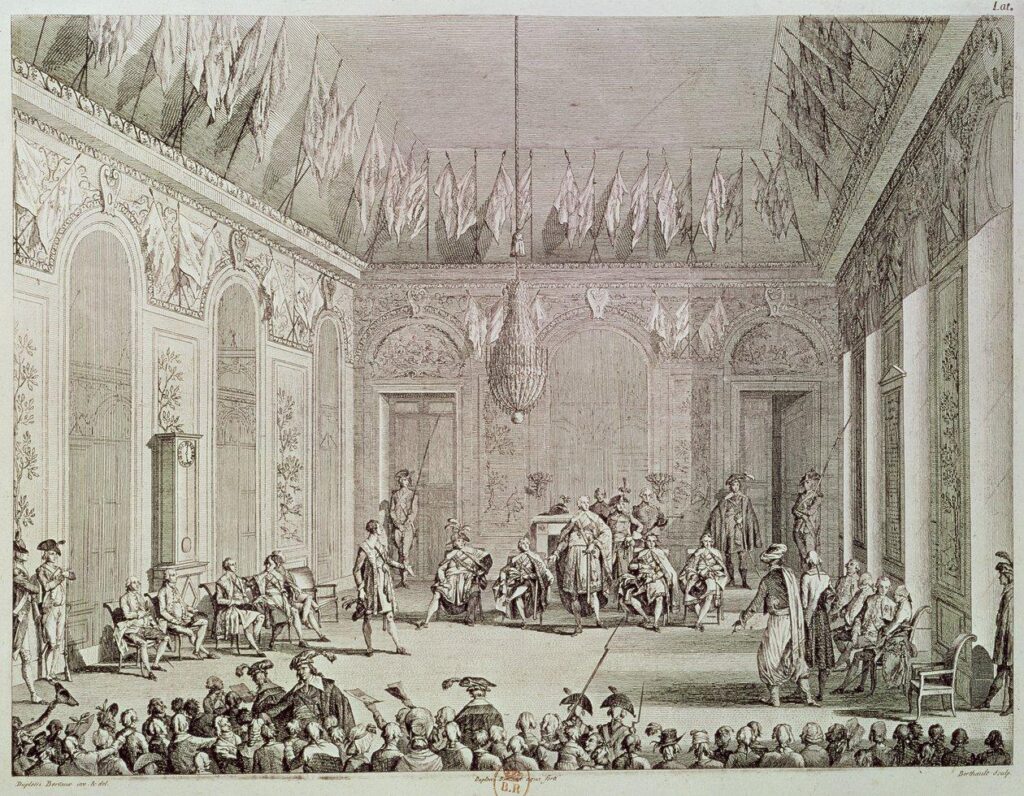
The language of the “sovereign people” and of the “will of the people” is not the language of a European civic movement. It is the language of the French Revolution, of Rousseau turned into an axe by Robespierre, the vocabulary with which a few decided what millions wanted and imposed it upon them in their name. Yet the mechanism they propose is not even that of the Jacobins. It belongs to what came after them, when the revolution tired and power was gathered into hands without a vote. Resign, prime minister. Hand over power. In comes a government that no one elected, with a one-year mandate that no constitutional order provides for, and that government then decides how society is to be reorganized. The model they propose follows the logic of the French Directory: power passes to a body that does not flow directly from elections and that seeks to reorganize the political order before returning the word to the voter. And there is a detail that makes the Albanian case heavier still. The Directory, however open to criticism, was a constitutional organ created by the Constitution of the Year III; it had a legal basis under the order of its own time. The one-year government demanded today does not have even that. No article of the Albanian Constitution recognizes it. So what is proposed is the logic of the Directory, without even the legal cover that the Directory at least possessed. Step down, you who hold the votes. In we come, holding none. And then we govern.
The Directory had one defining trait, which these signatories have reproduced without even knowing it. It did not merely govern without a mandate. It annulled the elections it did not like. On 18 Fructidor of the Year V (4 September 1797), after a coup, the Directory annulled the electoral victories of the royalists. On 22 Floréal of the Year VI (11 May 1798), it declared invalid a part of the victories of the Jacobin left as well. In both cases, the Directory used the force of the state to void election results it did not like. The body that spoke more than anyone of the will of the people was the same one that denied the people its vote whenever the vote came out wrong. Return now to the square in Tirana, on the twenty-seventh day, when the crowd demanded the annulment of the coming elections. This is no longer a literary comparison. It is the same movement of the spirit, repeated word for word after two hundred and thirty years. Those who wish to speak in the name of the sovereign begin by asking the sovereign to give up the one thing that makes him sovereign, the right to vote. Whoever asks the people to give up the vote does not love the sovereign people. He loves himself in power.
Then there is the paradox that reveals everything. A letter that invokes the “will of the sovereign people” is not addressed to the people. It is not addressed to the Assembly, nor to the President, nor to the Albanian citizen. It is addressed to foreign ambassadors. The self-proclaimed sovereign goes to seek confirmation of his own sovereignty beyond the borders of the country. Whoever truly holds the legitimacy of the people does not go begging for recognition at the doors of embassies. There goes only the man who knows he does not hold it at home, and who hopes to receive from abroad what the voter did not give him.
Now the demands, one by one, because it is there that reform is revealed to be a costume, not a purpose.
“A total constitutional reform, to be approved by popular referendum.” It sounds solemn until you ask what it means. The Albanian Constitution does not recognize the referendum as the ordinary route of constitutional amendment; amendments are approved by the Assembly with a qualified majority, according to constitutional procedure, and the referendum remains a conditional possibility, not the main gate. So either they do not know the mechanism they claim they wish to set in motion, or they know it and wish to bypass it. Both are a verdict upon people who appeal to the rule of law. They demand legality with one hand and its breach with the other, within the same paragraph, because the law interests them only as a word, not as a limit upon themselves.
The fourth point also reveals the interest hidden behind the word. The repeal of the framework for Strategic Investments, of the law on protected areas, of the mountain areas package. Note the contradiction, because there the mask falls. They appeal to shared Euro-Atlantic values and in the same breath demand the demolition of the legal framework that brings in precisely the Western capital those values carry. They want the destination, membership in the Union, but they ask that the road leading there be torn up. Removing all of this legal framework does not automatically produce a better model of development. It produces a normative vacuum, with direct consequences for the legal certainty of investments, the very certainty that every open European economy guards as a foundation. The demand to demolish the rules, presented as protection, leaves behind no more protection. It leaves behind less order.
And then the fifth, which says everything without meaning to. “The drafting of a new social contract between citizens and the state, through consultations with independent intellectuals and nonpartisan technical experts.” The problem here is not the metaphor of the social contract; it is used today as well, and rightly. The problem is the claim that this contract can be rewritten by a body of experts that holds no democratic mandate. Albania has its state. It has its constitution. It has its road to Brussels open before its eyes. Whoever proposes to rewrite the foundational contract with an unelected body is not modernizing the country. He is asking to seat himself in the chair where the elected sit, without passing through the vote. Because “independent experts” and “nonpartisan representatives” always means us, those who wrote the letter, those whom no one elected.
So let us read the chain for what it is. Resign, elected prime minister. Power passes to a government that no one votes for. That government, untouched by the vote, takes a twelve-month mandate. Within that mandate it rewrites the constitution. It rewrites the Electoral Code. It rewrites the law on party financing. And then, upon the rules it wrote itself, the elections are held that decide who governs next. Stop at this step, because everything is hidden there. The body that no one elected will write the rules of the election that elects its own successor. Whoever holds power without a vote and at the same time drafts the electoral law is drafting his own ballot. This is not a caretaker government. A caretaker government keeps the chair warm and leaves. This one rebuilds the chair, decides who sits in it, and writes the rules for how the one who comes next will be chosen. Power that flows from no vote, that answers to no vote and that can be removed by no vote, is not a transition. It is simply power, the oldest kind, the kind that existed before democracy and dreams of returning.
This is why the title is not a provocation but a conclusion. They do not want reform. Reform is the pretty name they gave to the appetite. What they truly want is read between the lines, in the government that no one votes for, in the elections they wish to annul, in the electoral law they wish to write without a vote in hand, in the social contract they wish to redraft themselves. They want power, and they want it stripped of the one thing that makes it bearable: the weight of the vote that legitimizes it. They want to govern without being elected, and to call this democracy.
And here comes the part that ought to trouble us more than the letter itself. This document has been circulating for days, and no one in Tirana has read it as it deserves to be read, line after line, with a cold eye. The class that should have done this work is split into two camps, and both are a desertion. One camp plays at a false neutrality: it measures the crowd, counts the days, weighs the slogans, asks “will the protest win” as if this were the only question, and with this question it evades the duty to judge. The neutrality that refuses to read is not impartiality. It is fear on its best behavior. The other camp has surrendered to the applause, chasing the likes that populist frenzy hands out generously to anyone who flatters the square. It does not write for the reader; it writes for the algorithm. It has confused the public with conscience, and the number of likes with the truth.
A document that asks an elected government to hand power to the unelected should not be applauded and should not be “balanced.” It should be interrogated. The first duty of the press and of the intellectual before a movement is not enthusiasm. It is reading. When no one reads, every appetite for power dresses itself in the word reform and passes unchallenged.
The sovereign they invoke has an address, and it is not the embassy. It is the ballot box. Until they go there and take what they ask for by vote, they are not the voice of the people. They are thirteen signatures waiting from abroad for permission to govern at home. This is the essence of the document: not reform, but power.