The bill goes to a plenary vote on Thursday after the High Court, the prosecutorial council and the judges’ representatives told the committee that a 0.38 coefficient falls short of the Constitutional Court’s standard. The government says the setting of salaries remains parliament’s competence.
The Newsroom (Tirana)
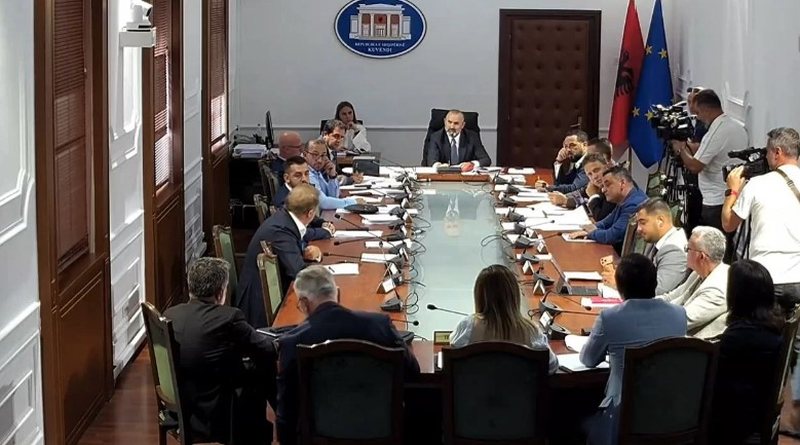
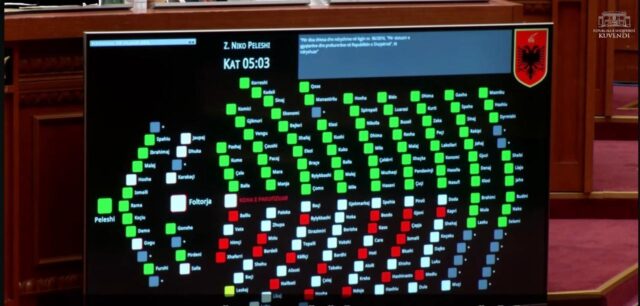
Parliament’s Committee on Legal Affairs approved the Socialist majority’s bill on magistrates’ salaries on Tuesday by eight votes to three, sending the new pay formula to a plenary vote scheduled for Thursday, 17 September. The Committee on Economy and Finance had approved it in principle a day earlier.
The bill, deposited on 30 July by Socialist deputies Aulona Bylykbashi and Admir Kadeli, one day before the deadline set by the Constitutional Court, keeps the salary of the President of the Republic as the reference for magistrates’ pay and raises the coefficient from 0.36 to 0.38. On the President’s salary of 425,000 lekë that gives a reference of 161,500 lekë, an increase of about 8,500 lekë a month. The bill applies its financial effects from 1 April 2023, the date fixed by the Court, and retains the existing mechanism of indexation by government decision no later than every two years.
The proposal is far below the parameters the two justice councils adopted after parliament missed the deadline. On 26 August the High Judicial Council (KLGJ) voted 9-0 to set the reference at 222,425 lekë from 1 August, up from 156,825 lekë, with a further 14,000 lekë for qualification. The High Prosecutorial Council (KLP) followed on 28 August with the same figures. The councils’ reference is therefore 65,600 lekë above the old one and about 61,000 above the parliamentary proposal; the gap of roughly 80,000 lekë cited in the debate includes the qualification component. The councils grounded their decisions on the reasoning of the Constitutional Court’s judgment, treating the expiry of the deadline as bringing into effect the senior-public-administration reference the Court had named for the calculation of arrears.
The sponsors’ case
Presenting the bill to the Economy Committee on Monday, Bylykbashi said the Court had not imposed a single numerical formula and had left the choice of model to the legislator, on condition that it respected constitutional standards and produced no reduction in pay. The President’s salary was chosen, she said, because it is a stable base fixed by law and adopted annually within the budget. The coefficient of 0.38 reflected both the constitutional guarantees owed to magistrates and “the real financial possibilities of the state”. By the sponsors’ calculation, the gross salary of a first-instance magistrate would reach about 90 per cent of the President’s salary once seniority and functional supplements are added.
A Ministry of Justice representative told the committee that 0.38 meets the conditions set by the Court; the Ministry of Finance described the cost as affordable. Democratic Party deputy Eno Bozdo announced that the PD group would vote against, saying the situation was “a direct consequence of the failure to respect the decisions of the Constitutional Court” and that the government had been asked for a bill in April and had not brought one.
The judiciary rejects 0.38
At Tuesday’s hearings in the Legal Affairs Committee every justice institution heard opposed the formula, though not on the same grounds.
Gerd Hoxha, head of the Union of Judges, said the Constitutional Court’s judgment “is not negotiated” and that the new parameters “have been in force since 31 July 2026”. The councils’ figures were the floor, he said; parliament could negotiate above them, and the judges were prepared to discuss spreading arrears over two or three years rather than receiving them at once. Adopting the bill as drafted would send magistrates back to the Constitutional Court, he said, “and the likelihood is that the decision will be the same”. He recalled that magistrates had won their pay disputes in court in 2019 and in 2022, and objected that the bill had been drafted without consultation.
KLP chair Mirela Bogdani said the council had not been given the bill in detail before the hearing, but that a 0.02 increase was “minimal” against the council’s own calculation and “does not reflect the standard set by the Constitutional Court”.
The High Court framed its objection more narrowly. Deputy chairman Ilir Panda said the court accepted the need for parliament to legislate and did not dispute in principle its authority to choose a new reference. The judgment, he said, “is not an orientation but an obligation for the legislator”, and the problem lay in the concrete result of the formula: the Court had required a dynamic reference, tied to a salary that rises over time and preserves the level of financial protection, and a fixed coefficient of 0.38 did not deliver it. The High Court asked parliament to replace the coefficient with a mechanism capable of maintaining that standard, to separate the regulation of future pay from the arrears generated after 31 July, and to avoid automatic effects on other public officials. “The aim is not to adopt a law, but to adopt a law that implements the judgment of the Constitutional Court,” Panda said.
The majority: a missed deadline does not transfer the power
Justice Minister Toni Gogu conceded that parliament had missed the 31 July deadline, “and there is no need to justify ourselves”. The delay, he said, did not change the division of competences, and the bill was “the correction of a mistake that was made”. “A legal gap, however much of our own making, is not a free competence taken by whoever arrives first,” he told the committee. “The answer to our delay is for parliament to do its job, not for the constitutional architecture to be rewritten by the need of the moment.”
Ulsi Manja said the Court had not authorised any organ other than parliament to touch the budget, and that the councils could not make the formula themselves without an act of parliament. The majority did not want to return to the Constitutional Court “time after time” with the justice system, he said, and the invitation to address its concerns remained open.
The opposition’s procedural challenge
Speaking in the Committee on Human Rights, PD group leader Gazment Bardhi called the bill unconstitutional and said the Court would strike it down “again”, since it not only failed to reflect the judgment but did “the opposite of what is required”. He said the initiative had bypassed the Legislation Council, a body of ten experienced jurists, and that its explanatory report stated the draft had been prepared by an employee of the parliamentary administration. He blamed government inaction for leaving the judiciary without pay and said that under normal parliamentary procedure judges would remain unpaid for several more months.
Bardhi’s statement about the drafter is his account of the explanatory report; Tirana Examiner has not established from the published parliamentary file who prepared the text.
Two weeks without payrolls
The dispute moved from constitutional interpretation to the Treasury at the start of September. When KLGJ and KLP submitted August payrolls at their new parameters, the Ministry of Finance on 2 September declined to process them and asked the councils to resubmit at the previous parameters, noting that the Constitutional Court itself had filed its August payroll at the old figures. Court administrations in Tirana, Vlora, Fier and Lushnje reduced or suspended work as salaries went unpaid.
On 8 September twenty judicial authorising officers and the heads of the Union of Judges, the National Association of Judges and the Association of Prosecutors filed a criminal complaint with SPAK against Finance Minister Petrit Malaj, the ministry’s secretary-general and district treasury heads, alleging abuse of office and obstruction of the execution of judicial decisions. No decision has been taken on the complaint. On 10 September the General Meeting of Judges declared KLGJ decision 435 binding for as long as it remains in force, said it would reject any law below the councils’ parameters, and threatened to reduce court activity to urgent matters. On 11 September the Administrative Court ordered the Treasury to process the payrolls of the Special Court against Corruption and Organised Crime pending the dispute.
Prime Minister Edi Rama has said that only parliament can open the Treasury for this purpose and that pay will rise by parliamentary decision on 17 September “in full respect of the judgment of the Constitutional Court”.
What the judgment requires
Judgment 15/2026, decided in February and announced on 15 April, found that the 2023 pay law had produced a concealed reduction in magistrates’ salaries and required parliament to enact a new formula by 31 July, with financial effects from 1 April 2023 and a reasonable scheme for the payment of arrears. It states that the fundamental rules of magistrates’ pay are to be set “by law”, through a transparent parliamentary procedure, and that parliament may adapt the formula by reference to the civil-service category, the President’s salary or any comparable solution. If no amendment was made by the deadline, arrears were to be calculated on the senior-public-administration reference of the Court’s 2022 judgment. The judgment names no organ other than parliament to set the new pay.
Two questions therefore sit before Thursday’s vote. The first, whether the power and the duty to set magistrates’ pay rest with parliament, is answered in the judgment’s own text. The second, whether the 0.38 formula parliament has chosen satisfies the substantive protection the Court required, is not answered by the councils’ decisions of August and will return to the Constitutional Court if the law is adopted and challenged.