The Newsroom (Clinton Township, MI)
The State Department’s written testimony to the House Foreign Affairs Subcommittee on Europe gives Albania a paragraph of its own and four concrete interests: dismantling criminal organisations, market access for American companies, a defence loan, and sales of American equipment. The official who submitted it did not read that paragraph aloud. In the hearing room Albania shared one sentence with two neighbours, and the longest exchange about the country was a congressman’s question about a “narco-trafficking cabal” answered with a compliment to SPAK.
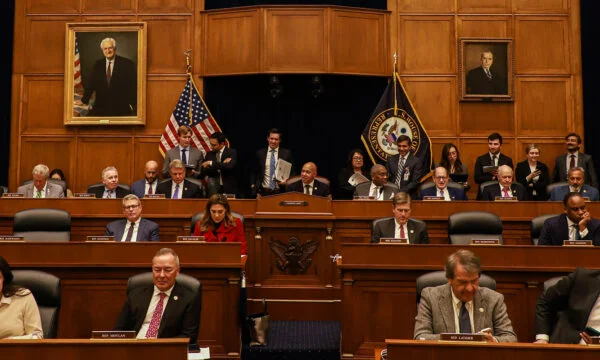
The hearing, “U.S. Policy and Regional Security Challenges in the Western Balkans”, was the subcommittee’s second on the region in ten months, after the December 2025 “Flashpoint” session with outside experts. The sole witness was Daniel J. Lawton, Deputy Assistant Secretary in the Bureau of European and Eurasian Affairs. Chairman Keith Self (R-Texas) presided, Bill Keating (D-Massachusetts) sat as ranking member, and most of the ninety minutes went to Serbia, the Mladić funeral, Kosovo, KFOR and Bosnia.
Lawton’s prepared statement, posted to the House repository the day before, builds US policy on three pillars: stability, room for American business, and countering threats to the United States, “including from Balkan transnational criminal organizations that directly cooperate with Western Hemisphere cartels.” It then goes country by country. On Albania, in full:
“We are working closely with our NATO ally Albania to dismantle transnational criminal organizations and expand market access for U.S. companies. A recently finalized Foreign Military Financing loan will help Albania meet its NATO defense spending commitments and increase the sale of U.S.-made equipment.”
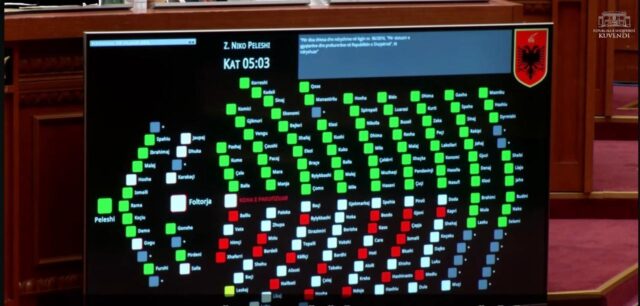
The loan is not named or valued in the text. It is the $302 million Foreign Military Financing direct loan agreement with the Defense Security Cooperation Agency that the Kuvend ratified on 27 July with 74 votes and no opposition present, that the State Department announced as signed on 3 August, and that DSCA re-announced on its own site four days before Lawton’s statement was filed. The Democratic Party has challenged the ratification law before the Constitutional Court on procedural grounds while saying it supports the agreement itself. Washington’s stated purpose for the money is the same in every version: Albania’s progress toward the Hague commitment of 5 percent of GDP on defence by 2035, spent on capabilities of American origin.
Spoken, the paragraph became this: “Let me say quickly, we’re also working closely with our NATO allies, Albania, Montenegro, and North Macedonia, on our shared security goals, as well as to counter transnational criminal organizations.” The market-access line, the loan and the equipment sales stayed on the page. North Macedonia’s paragraph, which in the written text mentions the US–North Macedonia Strategic Dialogue held in April and LNG connections from Greece to Serbia, and Montenegro’s, which cites a newly concluded Intergovernmental Agreement on the Adriatic–Ionian corridor, were cut the same way. Bosnia, Kosovo and Serbia kept their paragraphs in the spoken version. Serbia was “this pivotal country in the regional balance.”
Rep. Joe Wilson (R-South Carolina), who had opened his time with his bill on free elections in Serbia, turned to Albania halfway through. “It’s been reported that corruption, organized crime, and election integrity in Albania is being affected by the Edi Rama government,” he said, “in fact, promoting the creation of a narco-trafficking cabal.” He recalled that “over the years the United States has actually been very successful with anti-crime, organized drug-trafficking authorities to address the issue,” and asked what the administration was doing “in response to the Albanian narco-trafficking.”
“I can assure you that the United States continues to work with the Albanian government to counter transnational criminal organizations that operate from there,” Lawton replied. “These organizations have international links with cartels here in the Western Hemisphere. In particular, we found that the special structure for combating corruption and organized crime has been relatively effective in addressing some of the issues that you raised.”
The structure is SPAK. The government Lawton named as Washington’s partner against organised crime is the one Wilson had a minute earlier named as its promoter. Election integrity went unanswered and the word “cabal” was not repeated.
Wilson moved on. “It’s exciting to me to see the most slavish communist country during the Cold War now is free, and so we want Albania to succeed.” The rest of his time went to Serbia’s oil company, Chinese air defence and the Serbian delegation at the Khamenei funeral.
Keating had brought a report released that morning, “Pay for Play in the Balkans: How the Trump Administration’s Bosnia Policy Enriches the President’s Personal Allies and Short-Changes the American People”, signed by the subcommittee’s Democrats. Before reaching Bosnia he named Jared Kushner. “As President Trump designated Kushner to negotiate globally with the countries including Russia and Ukraine, he’s pursued billion-dollar real estate deals, first in Serbia, now in Albania. If this type of self-dealing took place in any foreign country, any common-sense American official would call it out. I hope my Republican colleagues join with me.” Keating also cited the Western Balkans Democracy and Prosperity Act, passed in December 2025 under his lead, a statute whose scope includes Albania; his questions on it were about Dodik.
Rep. Jim Costa (D-California) asked what the Department had done to implement that Act and whether the administration supported EU membership for the Western Balkan states. “We retain sanction authorities, and we will act if stability is threatened or necessary to secure U.S. interests,” Lawton said; the authority Congress had given “served as a deterrent effect.” On the EU: “We believe it’s a sovereign decision for the countries of Western Balkans to make in coordination with the European Union.” He repeated the formula to Rep. Warren Davidson (R-Ohio): “We don’t take a position on membership.” Nobody applied the question to Albania.
Rep. Dina Titus (D-Nevada) came back to Albania in the last seconds of her time, listing what she called the administration’s “corrupt policies in the Balkans”: the Dodik delisting, the Bosnian pipeline concession, then: “In Albania, where they are protesting, Jared Kushner is using his connections with the administration to develop a multi-billion-dollar luxury resort.” She paired it with the November 2025 Serbian law on the former Yugoslav Army General Staff site and asked what “the sale of Serbian government building to the Trump family” said about the president. The chair called time before Lawton could answer. Neither Democrat named the Albanian site; the Kushner project in Albania is the Sazan and Zvërnec development. Nobody asked Lawton about it.
Self’s one reference came in his opening statement, as an example of the administration’s attention to the region. “I want to applaud the Trump administration’s focus on the Western Balkans,” he said, citing energy exports and “the nominations of ambassadors for Montenegro, Serbia, Bosnia and Herzegovina, and a confirmed ambassador for Albania. I urge the administration to put forward nominations for Kosovo and North Macedonia now.” The ambassador question, he added, “is a common issue I hear both in my office and my travels through the region.”
The ambassador is Eric Wendt, a retired Army lieutenant general who commanded NATO’s Special Operations Headquarters. He was nominated on 13 April, cleared the Senate Foreign Relations Committee 19–3 on 4 June and was confirmed by the full Senate on 7 August in an en-bloc 51–47 vote. He is the first Senate-confirmed US ambassador in Tirana since Yuri Kim left in June 2023; for three years the embassy was run by chargés d’affaires. At his May confirmation hearing he set out his lines of effort as fighting corruption, organised crime and drug trafficking; defence spending, military cooperation and cyber-security; and commercial diplomacy for American business. Lawton’s Albania paragraph covers the same ground in two sentences.
Davidson asked which countries the Balkan criminal organisations were connected to and what they did. Lawton named none. Transnational groups “look for the weakest link, where they feel they can generate or gain a foothold and influence,” he said; they work across the region “not just to gain a foothold into Europe, but also to launder money and to affect the U.S. homeland.” Albania, Serbia, Montenegro and Bosnia sat undifferentiated in that account, and no member asked him to separate them.
In a second round Self noted that Washington “starts a strategic dialogue with Serbia at about the same time that we stop a strategic dialogue with Kosovo,” adding, “Those things do not go unnoticed in the region.” Keating called it “important to highlight” that the Kosovo dialogue “remained suspended.” The written testimony lists a Strategic Dialogue with Serbia in July, another with North Macedonia in April, and an Intergovernmental Agreement with Montenegro. Albania’s paragraph names a loan.
The Sazan flotilla, the September protests beyond Titus’s aside, the SPAK resolution in the Kuvend and last week’s reshuffle went unmentioned.
What Washington wants from Albania is written down: fewer criminal networks, more American companies, more American-made equipment, bought with an American loan. What it said out loud was shorter, and the one time a member of Congress attacked the Albanian government, the Department answered by praising its prosecutors.