The Newsroom (Tirana)
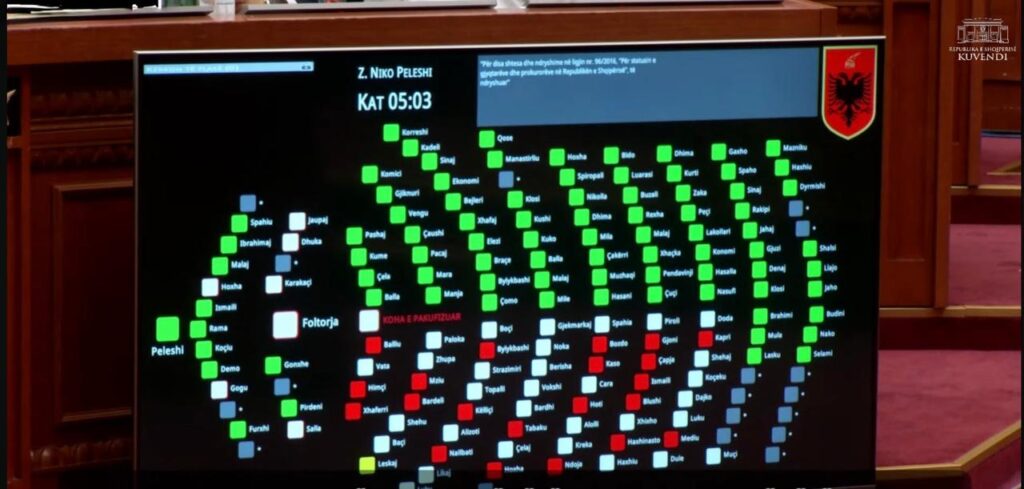
Parliament adopted in the early hours of Friday the Socialist Party’s amendments to Law 96/2016 on the status of judges and prosecutors, setting a new formula for magistrates’ pay. The vote, at about 01:40 at the close of the plenary session of Thursday, 17 September, was 84 in favour, one abstention and 24 against. Prime Minister Edi Rama voted in favour from the chamber; Democratic Party leader Sali Berisha was absent at the moment of the vote.
The adopted formula raises the coefficient of the reference salary from 0.36 to 0.38 of the President’s salary, an increase of roughly 8,500 lek. The magistrates’ demand, endorsed by the High Judicial Council (KLGJ) and the High Prosecutorial Council (KLP), was roughly nine times higher, close to 80,000 lek. The government has calculated 1.5 billion lek in retroactive obligations from April 2023, to be paid in instalments over two years.
Background
The pay dispute escalated after Parliament failed to adopt a new formula by 31 July, the deadline the Constitutional Court had set before its decision repealing the previous pay provisions took effect. After the deadline passed, the KLGJ and KLP decided that from 1 August the reference salary would be calculated at 222,425 lek, plus a 14,000 lek qualification supplement. The Ministry of Finance did not execute payrolls on that basis, arguing that the setting of salaries is a competence of Parliament. The European Association of Judges issued a statement on Thursday afternoon saying it was concerned and that the legislator was trying to circumvent the Constitutional Court’s decision.
Morning: PD request to withdraw the bill rejected
The Democratic Party opened the session by asking that the bill be removed from the agenda for further consultation with the justice institutions. The request was rejected with 79 votes against.
“Today in Parliament there is a very important matter for magistrates, carried over for seven years. There are three decisions of the Constitutional Court that your majority has refused to implement, or more precisely, has violated,” said Gazment Bardhi, head of the PD parliamentary group. “While we were discussing in committees, the opinions of the justice institutions came to us. Your version has not been consulted. You are before the responsibility to withdraw it today, because we risk violating the Constitution. We must take sufficient time for this Parliament to take a decision that gives a final solution. We cannot keep them insecure in their financial treatment, because they would not serve the country properly.”
Socialist group leader Taulant Balla called the request hypocritical. “Parliament, since 1998, has a consolidated practice as regards the procedure it follows in transposing the decisions of the Constitutional Court. The Legislation Council has completed its task. Indeed, the Constitutional Court should take an example from our Legislation Council. I am glad to hear that the PD comes out in defence of judges and prosecutors. This is positive news, because it shows reflection from those insults and threats we are used to hearing often. Today we are here to vote a bill. Our vote on the PD’s request is against. It is a hypocritical request. They told me we were late and now that we have brought it, you tell us to postpone it.”
Democratic MP Jorida Tabaku said parliamentary procedure had been violated, noting that the Human Rights Committee had requested a hearing with the heads of the justice institutions while the Law Committee closed its discussion without taking up the request. “Albania is the only country that has been left two months without paying the Constitutional Court, or two months without pay for judges. The only country where the prime minister and ministers attack prosecutors and judges. It is the only country that uses the judicial system whenever it needs it for the politics of the day and on the other hand tramples on it. The parliamentary process for the adoption of this law has been violated. The Rules of Procedure likewise. The Constitution and their rights are not negotiated.”
The bill as presented
Socialist MP Aulona Bylykbashi presented the bill in the evening. “The 0.38 coefficient is the result of a balanced assessment. It corrects the freezing effect found by the Court, secures financial treatment in keeping with the importance and the restrictions of the function and, at the same time, preserves the affordability of the obligation for public finances. The financial effects of the formula will be recognised from 1 April 2023. The obligations created for the period from 1 April 2023 to 31 July 2026 will be able to be settled gradually, but no later than two years from the entry into force of this law.”
Bardhi: “constitutional coup”
Bardhi announced the PD’s vote against. “The bill we are discussing today does not concern only the judiciary, nor only the legislature, nor only the executive. It concerns the Albanian state, it concerns the institutional and constitutional system of the Republic of Albania. You have not decided to challenge the judiciary, but to challenge the Albanian state, to challenge the constitutional order in the country. In short, you have decided to continue a constitutional coup begun since 2017 on this matter.”
“Judges and prosecutors are not asking for a rise in their pay. If they were asking for a new pay rise, they would not have the support of the Democratic Party parliamentary group either. The truth is that the prosecutors and judges of the Republic are asking to receive the pay that this Parliament set for them in 2016.”
“The Constitutional Court gave Parliament four months to resolve the matter before its decision repealing the pay law entered into force. So it showed itself entirely responsible, unlike you and unlike this Parliament, which showed itself entirely irresponsible.”
Gogu: “the pay passes through only one door”
Justice Minister Toni Gogu said the setting of magistrates’ pay was the legislator’s competence and acknowledged the 31 July deadline had passed.
“Today the Parliament of Albania has two duties, not one, it has two duties. On the one hand it must protect the independence of the justice system, the judiciary, and on the other it must protect every cent of the Albanian citizens, who pay for that justice. The 31 July deadline, we said in committee, has passed. That is why this majority has come today to fill the void that the passing of that deadline created. It has not come to comment on it, not to anathematise it, not to curse it, it has come to fill that void. And today there is a law before this Parliament, preceded and guided by a question, by the right question: Who decides on judges’ pay? And it did not invent the question. It took it exactly from the decision of the Constitutional Court, which unpacks the constitutional principle and writes: the obligation of Parliament to adopt the necessary legal changes. Not the government’s, not the councils’, not the Minister of Justice’s, the obligation of this Parliament.”
“The judge’s pay passes through only one door. The magistrate’s pay passes through only one door. The doctor’s pay passes through only one door. The nurse’s pay passes through only one door. The firefighter’s pay passes through only one door. And that door is the law. The law. The basic rule that has built the whole architecture of pay in this republic is: no one should have the discretion to set their own pay. Because when someone sets their own pay, it is no longer a general rule, but an exception. The state budget is not that cupboard with many drawers where each power or each institution has its own drawer. There is only one chest and that chest is the Albanian citizen’s. It is not the chest of ministers, nor of the government, nor of judges or doctors. It is the chest of Albanian citizens, which this Parliament guards and you guard, honourable colleagues.”
Bylykbashi (PD): “the matter will go again to the Constitutional Court”
Democratic MP Bylykbashi said the bill violated the Court’s decision and predicted the magistrates would prevail.
“The debate over judges’ pay is a debate not at all noble, at a moment when in the square there are people whose pension does not stretch, whose pay does not stretch and who cannot make it to the end of the month. When they hear us, they tear their hair out. But still this is not a populist discussion. There are some who say where will we find the money for magistrates’ pay. It is enough to spare the massacre of the public budget that you carry out every day with the corruptive model you have, and there is money not for magistrates, but to raise the pay of all those who serve in the administration. There is no one who does not know what gigantic theft of millions of euros you have done with these concessions and PPPs. The KAYO-Yeffet model is the peak.”
“Today there are no judges, there are over 200,000 cases sitting in the courts. There are more than half a million people in court cases, a quarter of the population. This is the justice that the Justice Reform produced in ten years. What you want to vote today is in flagrant violation of the decision of the Constitutional Court. This is not a constitutional conflict, but a deliberate constitutional crisis caused by Rama. But this crisis will be won by the judges and prosecutors. In this crisis something very important will be defined: the separation of powers, checks and balances. I prefer the lesser evil, I support the judges and prosecutors. The time has come to undo this totalitarian control over every aspect of the life of this country. To create the islands of independence. The matter will go again to the Constitutional Court, you have no other solution.”
Manja: “the majority has never cut magistrates’ pay”
Ulsi Manja, Socialist MP and chair of the Committee on Legal Affairs, Public Administration and Human Rights, said the majority’s previous appearances before the Constitutional Court had concerned only the size of the increase.
“Initiatives such as this that affect the state budget require the opinion of the Council of Ministers. There is a claim here that the initiative we are going to vote is entirely different from the initial version deposited by the initiators. No, honourable colleagues. What you do here, your soul weeping for the pay of judges and prosecutors, is politics. It is true that after the adoption in 2016 we have gone several times to the Constitutional Court, but never as a confrontation between the legislature and the judiciary, but over the measure of the pay rise. The majority has not made cuts to magistrates’ pay. The financial independence of the justice system is important, but the responsibility of managing public finances is also very important for the Parliament of Albania.”
Malaj: prosecutor sent judicial police to the Treasury
Finance Minister Petrit Malaj told Parliament that a district prosecutor had sent a judicial police officer (OPGJ) to the Treasury branch where the magistrates’ payrolls are blocked, and that a criminal report had been filed.
“A district prosecutor sent judicial police to the Treasury branch and told the employees either execute the payment or we will arrest you. Where does this happen? This is not a flexing of muscles; can you tell me where is the violation committed by the Treasury employee or the Minister of Finance? A criminal report has been filed on this matter. The Treasury verifies whether there is a legal basis; if everything is in order the payment normally goes through. This mechanism protects public money.”
Xhafaj: “paid more than any judge in the region”
Fatmir Xhafaj, chair of the Committee on Citizens’ Initiatives, Cooperation and Institutional Oversight, said: “Magistrates in Albania are paid much more than any other social group in this country and than any judge and prosecutor in the region. The debate should be whether the pay system is constitutional, rational, sustainable and proportional within the system itself and with the national pay system. In 2016 we made an exception to the then pay pyramid, giving a super-rise to the pay of prosecutors and judges. It was an exception to the rule at a certain moment. The government and Parliament have the obligation to establish the necessary proportionality of pay.”
The President’s consent
Manja said there was correspondence between President Bajram Begaj and Parliament in which the President consented to the law entering into force immediately, as Article 3 of the bill provides. Bardhi and Tedi Blushi asked that the correspondence be made available.
“You have requested the approval of the President of the Republic for the law to enter into force immediately and apparently the President has returned this reply giving this consent. Can the President’s correspondence and his confirmation be made available to the deputies of Parliament? Because we have no knowledge of this fact, that the President’s approval was requested and he gave his consent, without seeing for which law he is giving consent,” Bardhi said.
“In fact the correspondence with the President on the immediate entry into force of the law is an attribute of the Parliament of Albania. I refer to the text of the bill, where in Article 3 it says the law must enter into force immediately. If the President has given his consent, let it be made known to colleagues,” Manja replied.
Blushi requested a five-minute break until the correspondence was distributed. Session chair Evis Kushi said: “I want to inform you that the consent from the President of the Republic has arrived, we will photocopy it immediately and make it available to you.” Article 84(4) of the Constitution permits immediate entry into force in cases of necessity or emergency when the Assembly so decides by the required majority and the President consents, after public notification.
Rama: the Court is the referee
Speaking from the rostrum before the vote, Rama framed the dispute as a question of the balance of powers, citing the Venice Commission opinion delivered in the case of former minister Olta Xhaçka.
“It is unbelievable how representatives of an independent power, simply and only out of spite for the other side, hand over their power to another power with such ease. And this has nothing to do simply and only with what we are talking about today, the pay of judges. This has to do with the balance of independent powers in a parliamentary republic,” he said.
Reading from the Venice Commission text, he continued: “The competence of the Constitutional Court, as a judicial and not a political body, must not intrude into the sphere of the constitutional legislator, which has the exclusive competence to create new constitutional norms. The boundary between interpretation of an existing norm and creation of a new norm is not always easy to determine, but the perception of a gouvernement des juges, that is a government of judges, must be avoided. The competence to create new constitutional norms belongs to the legislative power, while to the Constitutional Court belongs the competence to authoritatively interpret the norms.”
“In very simple words, the Constitutional Court is the referee. It can stop the game, it can find the foul, it can annul the goal, but it cannot take the ball and say: ‘The ball is mine. I will take the penalty.'”
“If we raise our hand wrongly and the Constitutional Court tells us: ‘With this raising of the hand this norm was violated, therefore this norm is struck down’, the Constitutional Court can never, in no case and for no reason, tell an independent power such as Parliament how it must raise its hand. This does not happen. ‘And now raise your hand for the text I have written for you, for the formula I have chosen and for the sum I have set’: the Constitutional Court cannot say that to the Parliament of Albania.”
“Today there is a peculiarity, because today here in the chamber there are 84 votes that are necessary to adopt this norm. But if you are not going to be hypocrites, you will have to accept that, if these 84 votes were not there, it would be entirely impossible to reach a result based on a specific order of another power. The Constitutional Court can strike down a tax that discriminates unconstitutionally against a category of citizens. The Constitutional Court cannot, however, set the tax rate, how much it should be. It can strike down a pension provision that infringes equality or legal certainty, but it can never draft the pension scheme itself and determine how many lek this pensioner or that other pensioner will receive. The Constitutional Court can strike down an unclear penal provision, but it cannot itself write the new criminal offence and the measure of punishment. These are choices that require law, public debate, financial assessment and a parliamentary vote.”
“First of all, did the Constitutional Court have the right to review the formula adopted by Parliament? Absolutely yes. To find a certain incompatibility, in its view? Certainly yes. To strike down the relevant provisions and demand the adoption of changes? No one disputes it. But, on the other hand, the Constitutional Court cannot tell the legislators what the solution must be, under that norm within which they must move.”
“The pay of judges cannot be reduced”
Rama said the pay rises granted to magistrates under the justice reform had been deliberate and had broken the country’s pay pyramid.
“We raised the pay of magistrates in a stratospheric way for the norms and level of our salaries, with full will and with the reasoning that a root-and-branch reform of justice and the need to place on the barricade of a new justice a group of motivated magistrates made it necessary. And thus we broke the pay pyramid. So, if the pay pyramid is this, as in every state, we lifted the judges up here. Now, by what logic do you demand, and anyone else demands, that every time the salary is raised here, it must also be raised here?”
“By this logic, it follows that in all subsequent generations we will build the only republic, the only kingdom, the only empire, the only system the history of the world has seen, where judges are above it. This is an act of irresponsibility. To say that ‘my pay is cut because it is not raised’, while I am at the level up here, above the pyramid, as a magistrate, and to say that ‘every time the others are raised, I too will be raised, because my quality of life is affected’, is delusion in its object.”
“Precisely for the reason that the legislative power is an independent power, every democratic constitution has a provision that our Constitution also has: the pay of judges cannot be reduced. It is specific. The Constitution does not say ‘you cannot reduce the pay of anyone else whatsoever’. It says: ‘The pay of judges cannot be reduced.’ Why? Because the Constitution and all democratic constitutions have in mind precisely the tension that is created between powers. And for this reason they guarantee that judges and prosecutors can act freely, without being threatened by the revenge of another political power, which could put them under pressure by cutting their pay. But are we in the conditions of a pay cut? To say that it is a hidden pay cut simply because they are raised by this much and the others by this much, while they continue up top, seems to me unreasonable.”
“Deadlines are not set for Parliament”
On the 31 July deadline, Rama said: “Respect the decision of the Court? Certainly, certainly! But never can a Constitutional Court tell a legislator: ‘Raise your hand like this, because I decided it.’ And fortunately, in this case it has not said so. It has left full discretion. As for the breach of the deadline, deadlines are not set for Parliament. It is another nonsense. No one can tell Parliament, except its own members, when it will convene and what it will convene for. Here four hours of debate take place over the agenda. How does another power come out over there and say: ‘You will convene by the 31st’? Because if you do not convene by the 31st, on the 1st we will storm the doors of the Treasury. What is this?”
Investigators at the Ministry of Finance
Rama denied that the bill amounted to pressure on the justice system, pointing to the Special Prosecution.
“Here there is absolutely no kind of challenge, no kind of war of any nature with the justice system, no kind of pressure, absolutely nothing of the kind. Because let me remind you of something else, if we follow the thread of the logic of those who presented this as an attempt at pressure: the Special Prosecution has not requested pay rises. SPAK has not requested pay rises, nor has it submitted the payroll other than under the old formula. So this fails as logic, even if I were for a moment to take it as given, which it is not. Here it is a matter of European state-building.”
“We have entered a new phase. We clearly have a new independent power in this city and precisely because it is a new independent power, we are seeing things that are unimaginable in a consolidated democracy: with investigators going to the Ministry of Finance, with prosecutors going to the doors of the Treasury, with judges threatening Treasury officials. So we are in the conditions of a body which is savouring its independence. Is this what we want? Is this what you want? I do not believe this is what we want.”
“I believe we have a responsibility to strengthen this dynamic of the separation of powers, but we have at the same time a responsibility to show where one power ends and where the other begins. The Constitution does not speak of two authorities and one independent power. The Constitution speaks of three independent powers. They are mutually independent and mutually intertwined.”
“Your duty is not to allow us to raise our hand wrongly, but our duty is to tell you that you can never tell us how to raise our hand. If these two get confused, we have a very big problem, which tomorrow can become much bigger.”
“Coordinated movements”
Rama also addressed what he described as coordination between judges’ associations and the judiciary.
“To say that on that date another power was suddenly born, which determined what in fact only the law can determine, and on the other hand to see an interaction of associations with the judicial body of Albania, to see coordinated movements… In my knowledge, judges do not even talk to one another before taking a decision, because it is forbidden to them. Within a panel they discuss, but they do not tell the other how they will decide in the end. Meanwhile, to see this organisation is extremely worrying and I think that all the deputies here, regardless of which side they belong to, will not take this so lightly, because life goes on and all developments in this direction are developments that damage the Republic of Albania, they are not developments that help it.”
A new law, with the Council of Europe
Rama said the government had begun work on a new law to rebalance the pay pyramid and had opened contacts with the Council of Europe and its European Commission for the Efficiency of Justice (CEPEJ).
“Here there is a need to make a new law, to put an end to this story, which has its origin in that moment when, in the making of the reform, the time was not set for when the pyramid would be balanced. It was not said clearly and it was not said bluntly that you will receive this now from Albanians’ taxes, much more than everyone else, because the reform requires an effort from you, but this will not be a permanent increase. Every time the others are raised, you will be raised too: it follows then that we would create the first state in the world. And I challenge everyone to bring me, at least in the last 2,000 years, a system where judges have been above everyone in terms of taxes. It does not happen. It is nonsense.”
“We have started contacts with the Council of Europe, with that European Commission for the Efficiency of Justice. And I received all of those you had in the relevant committee, because they asked for a meeting and we organised the meeting, according to their wishes and conditions, in the sense of giving everyone the opportunity to speak, for us to speak and to tell them that here there is a problem, which we will address together. We cannot go into a conflict of powers and we are ready, not ready, but we are fully committed to make a new law. There are a number of ways to do it, but this story that every time a salary is raised in the Republic, a salary must be raised over there, must come to an end. This is absurd.”
“Two successes, two failures”
Rama described SPAK and the Special Court (GJKKO) as the two successes of the justice reform and the two governing councils as its failure.
“For my part I see two successes in the justice reform: SPAK and GJKKO, with all the problems they have. Two successes. But if there is a failure, it is those two councils over there. And if there is a reason for the Parliament of Albania to be concerned, it is precisely to reflect on the justice reform. And not on that part of the reform that has become the main leitmotif day after day: ‘Prison, prison, prison, prison, prison!’, but on that part of the reform that is the leitmotif of the life of those tens of thousands of people who have been turned into files covered in dust.”
Exchange over the protests
The session also produced an exchange between Rama and Tabaku over the anti-government protests, now in their 110th day, which gathered outside Parliament during the sitting.
“When you have protesters 110 days under your door and you say ‘they are chasing us away’… Try once, go out there, because these people of yours have tried and they have been dragged away,” Tabaku said. “Instead of listening to them and taking what the people out there are demanding as an alarm bell, you behave again with the same arrogance that brought those people out into the square. Today there is a call from citizens and the call is: ‘Rama, resign!’ Listen to it, since you listen to the crowd, and carry out their demands.”
Rama replied: “Mrs Tabaku, you were not here when I made the reply to all your repetitions, with your body trembling, about ‘100 days of protests, 100 days of protests’, and I want to repeat it to you like this, to your face. When citizens protest under the government’s window, it is called democracy, and when they do it without a thorn getting into their foot, it is called pride. All the more when they do it on the same boulevard where people have been killed and wounded. But when the citizens who protest tell the opposition and you personally ‘go away’, then it is a contagious disease that that protest does not want. And they are not to blame, because you are a contagious disease of chronic defeat. Whoever comes near you loses, loses, loses.”
Other votes
In the same session, Parliament ratified the Convention establishing the International Claims Commission for Ukraine, signed in The Hague on 16 December 2025 (102 votes in favour). Gogu told the chamber Albania becomes the tenth state to ratify, that 25 are needed for entry into force, and that some 65,000 claims are lodged in the Register of Damage. “A damage that is only registered remains memory. A damage that is assessed and compensated becomes justice,” he said. Parliament also ratified the Council of Europe Framework Convention on Artificial Intelligence, Human Rights, Democracy and the Rule of Law (107 in favour), and approved the International Olive Council decision amending Article 36 of the 2015 International Agreement on Olive Oil and Table Olives (107 in favour), keeping the agreement in force until 31 December 2026 with the possibility of extension; Agriculture Minister Andis Salla said Albania has been a member since 2009 and the change carries no new cost beyond the existing annual contribution.