In two public conversations in two days, the Prime Minister tied the Tirana protests to the Kushner project, Iran, the opposition and organised crime, defended the Zvërnec investment, and said the Student List has opened nothing on Kosovo.
Tirana Examiner Newsroom
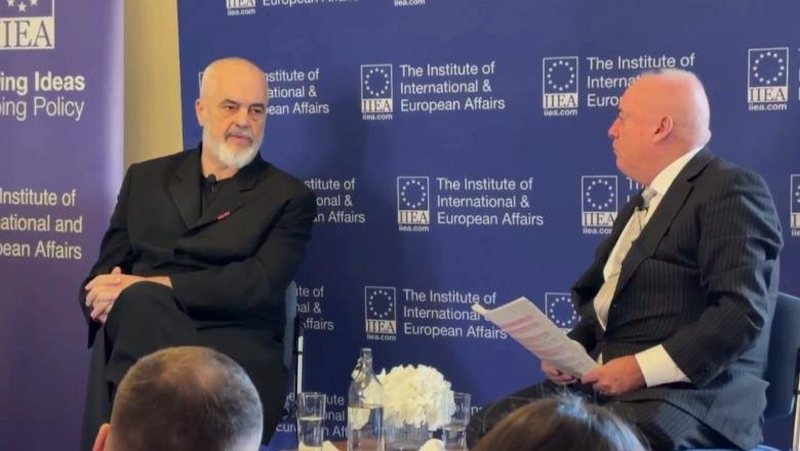
Prime Minister Edi Rama spoke at the Paris Peace Forum on 10 November and at the Institute of International and European Affairs (IIEA) in Dublin on 11 November, the eve of the ninth meeting of the European Political Community. In both he took questions on the protests in Tirana, the Zvërnec project, EU accession, corruption, Serbia and Kosovo.
Paris, 10 November
Asked what the Albanian protests share with those in Italy and France, Rama separated two phases. The mass demonstrations of early June, he said, drew large numbers of people from all walks of life with concerns about the project linked to Jared Kushner, which he called “famous or infamous, call it what you like” and compared to a red flag waved at a bull. What remained afterwards was a very small number of protesters who escalated into violence, which he said had nothing to do with the original protest. He described the situation across Europe as a clash between the real world and the world of social media, where many young people get information, disinformation and the inspiration to escalate.
Asked whether the protests expose weaknesses in democracy and human rights, he compared the background to a pot in which everything boils. He listed general concern for the environment, antisemitic nonsense fed by “the Khomeinist Republic of Iran”, opposition parties large and small that no longer hide much behind young people radicalised by Antifa illusions, people with legitimate concerns about the cost of living, and people brought in and paid by organised crime. The response, he said, runs on several tracks: dialogue and reflection, measures in the new budget to ease the cost of living, and the work of police, prosecutors and courts against those who broke the law.
On whether young Albanians still believe in membership, Rama said Albania was for decades “the North Korea of Europe” and came out of it as “Western Taliban”, fanatics of the West. For Albanians, he said, the EU is what it was for its founding fathers, not an ATM but a space of freedom, security, peace and cooperation, and everyone in the country agrees on it whatever their politics. Albanians are the best Europeans to be found in Europe today, he said. When the moderator called that a fine ambition, he answered that it is a fact.
He rejected the premise that emigration is rising. It runs parallel to development, he said: wages, tourism and exports grow and expectations grow with them, which he attributed to Tocqueville’s idea of rising expectations.
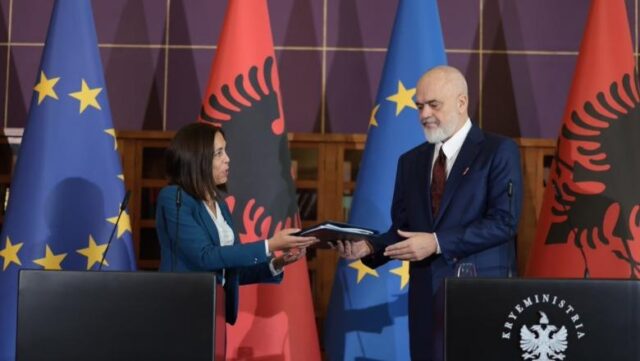
On dates, he said nobody can promise anything about Europe. The Commission’s latest report says next year is when work on the accession treaty should begin, and if all goes well Albania closes negotiations at the end of next year. The rest depends on where the EU will be in two or three years, and on France, which votes next year. Democracy, he added, is a chapter that never closes, for France as for Albania.
Questions from the floor:
- Artificial intelligence. Regulation belongs to the EU and development to Albania. The country has the first AI minister, has used AI to transpose the acquis, a task that took Croatia seven years, and is working on public procurement run entirely by AI. He said 95 per cent of public services are online. Germany is a large ship that turns slowly, he said, and Albania a speedboat.
- Freedom. Answering a 26-year-old who cited Lea Ypi, he said that at that age he had to fight to cross Albania’s border. Freedom is to be where he wants, speak with whom he wants and say what he thinks, though in his post he cannot say everything.
- The Bektashi state. Asked whether Albania will pursue it after accession: yes, work continues, and it remains to be seen where it arrives.
- Serbia and Kosovo. Kosovo is an independent state with no way back into a new Serbian fantasy, he said, and the sooner Serbs accept that as a fact of life, the sooner they stop being haunted by that ghost.
- Ukraine. A fast-track exception is a lie, he said, and it is not happening. Ukraine deserves full credit for fighting for Europe, and the new enlargement package is clear on four frontrunners: Albania, Montenegro, Ukraine and Moldova. Skipping the process is like getting a driving licence without knowing how to drive.
He repeated his call for the EU’s “Helmut Kohl moment”: seat all seven negotiating countries at the table while the merit-based process continues, as Ursula von der Leyen raised her seven children at the table and not in the street.
Asked for his ten-year dream, he said he hopes the EU manages to save itself from itself. Europe must face the “devil” of social media, he said, because the political centre has become a mass grave into which Europe could slip for good.
Dublin, 11 November
At the IIEA, Rama said Albania is at a defining moment and sees an open door. Everything is proceeding by the rules and in agreement with the Commission, he said, and the government will make every effort to close negotiations within 2027, ambitious as that is.
He was asked about the protests, his closeness to the Trump family, and Albania’s possible exposure to announced investigations into the Trump administration after the midterm defeat. The “flamingo revolution”, he answered, is the result of very great hatred of Donald Trump, and without Trump’s shadow nobody would have heard of the flamingos. Those who hate Trump found Tirana’s boulevard for their battle, he said, as Caesar found southern Albania to fight Pompey.
He said he was warned when Trump was elected that his friendship with George Soros and his son was a risk, and that he does not put old friendships up for discussion. When he met Kushner, Trump’s future was unclear and he was “a candidate for prison”. He saw an American who wanted to do something for Albania. Kushner has received no treatment different from other local and foreign investors, only 8 per cent of the island can be built on, and the project is a reason for pride and not fear, he said.
He called foreign influence a fact. The Iranian regime had a hand in igniting the protests through social media, and many other hands followed. The June protests were taken seriously and measures followed, he said. “Now there are no flamingos, there are other birds”: the opposition and a combination of far left and far right, alongside people with legitimate grievances, and then violence.
On dialogue with students, he said he does not see many students. Of all those arrested in the first wave of violence one was a student, and the rest had criminal records and came masked. It will get worse, he said, unless Europe draws a red line on social media.
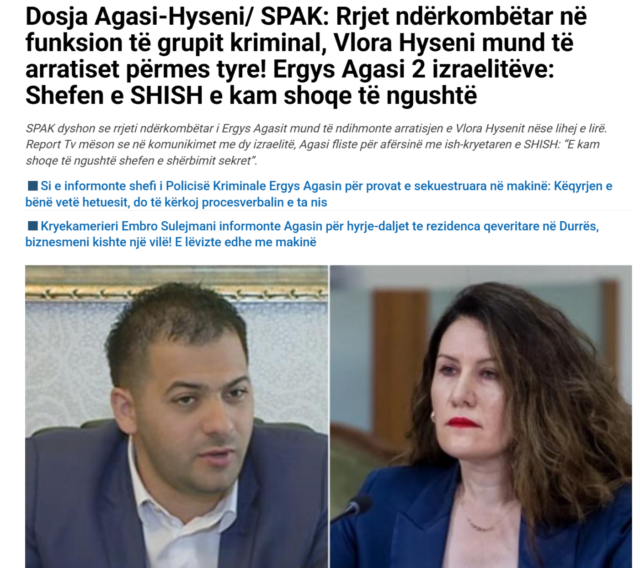
Asked how Albanian institutions can be trusted while senior figures are under SPAK investigation, he said that anyone can be investigated without interference and that this is the core of trust. A country long defined by a culture of impunity is no longer one, and the Commission’s report says so. Albania has corruption, he said, and for the first time a system that fights it.
On Serbia, he described the Student List as a social and political experiment. There is no opening on Kosovo or on sanctions against Russia, and it is too early for enthusiasm, he said. Without an open approach to Kosovo, the ghost of the past will keep Belgrade from a catharsis.
He called relations with Greece excellent. The maritime border is unresolved and the two sides have agreed to take it to an international court.
On Ukraine, he said nobody misses Russia, but Europe made a very great mistake from the first day by abandoning diplomacy, concentrating on arms and betting on final victory. He said he cannot understand the German judgment of Angela Merkel over cheap Russian gas.
On emigration, he told the Irish audience the trend will change, as it did in Ireland, when the country gives people a real choice between staying and leaving. Some are already returning.
The European Political Community meets in Dublin on 12 November with 48 heads of state and government, co-chaired by António Costa and Micheál Martin.