Diplomatic missions warn that political protest cannot justify attacks on people or property after incendiary devices were thrown at a cultural residence hosting international artists in Tirana.
by Besa Ruka (Tirana)
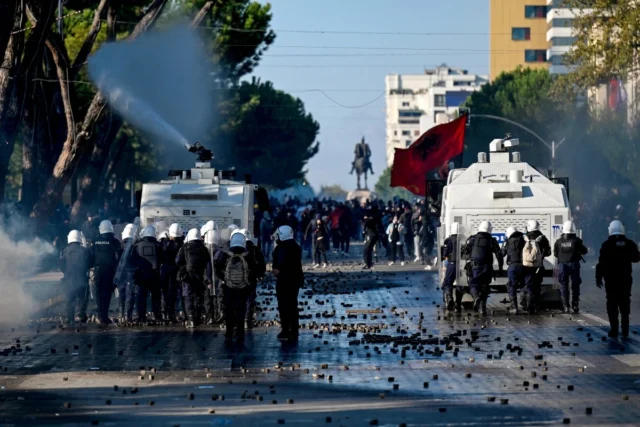
Albania’s European partners issued coordinated condemnations Sunday after incendiary devices were thrown during a political protest in Tirana, striking “Vila 31,” a historic compound currently operating as an international artists’ residence.
The incident — involving Molotov cocktails and pyrotechnic projectiles — drew formal statements from the Delegation of the European Union to Albania, the French Embassy, and the German Embassy.
Each reaffirmed the right to peaceful protest. Each drew the same boundary: violence that endangers lives is not protected political expression.
What Happened
Video and official accounts show protesters throwing incendiary devices toward the compound known as “Vila 31,” formerly linked to Albania’s communist-era leadership and, since 2025, repurposed as an international residency program managed by the French-founded Art Explora initiative.
Foreign artists were reportedly inside the building at the time.
Prime Minister Edi Rama visited the site afterward, stating that the artists had been “traumatized.” Police confirmed arrests. Prosecutorial procedures are ongoing.
The European Union: “Lives Were Put at Risk”
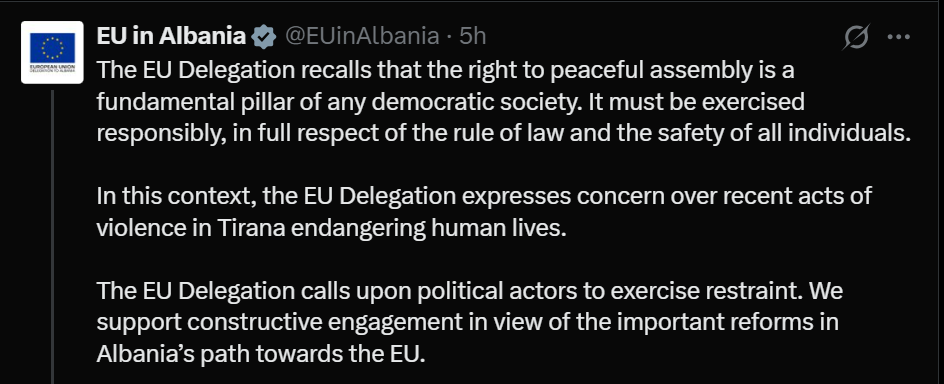
The EU Delegation described the right to peaceful assembly as a “fundamental pillar” of democracy but stressed it must be exercised “in full respect of the rule of law and the safety of all individuals.”
It expressed concern over acts of violence that “put lives at risk” and called on political actors to show restraint.
The statement also reiterated support for constructive engagement on reforms tied to Albania’s EU accession process.
France: “Intolerable”
The French Embassy issued a stronger formulation.
Since 2025, it noted, the villa has functioned as an international artists’ residence managed by a French foundation. Protest organizers “could not ignore this fact,” the embassy said.
“The endangerment of residents and the damage caused are intolerable,” the statement read. “The right to protest is not compatible with any form of violence.”
The attack therefore extended beyond domestic political confrontation. It directly affected a French-managed cultural institution hosting foreign nationals.
Germany: Political Responsibility
The German Embassy aligned with the EU statement but underscored political accountability.
“Political protest and the right to demonstrate can never justify violence against people or property,” it said. “Political leaders must fulfill their responsibility for peaceful coexistence in a democracy.”
Legal Context
Under Albanian criminal law, the use of incendiary devices against occupied property may constitute a serious offense, particularly when human life is endangered.
Across the European Union, Molotov cocktails are classified as improvised incendiary weapons. When used against residential or occupied structures, prosecutions typically involve aggravated charges, especially where risk to life can be established.
Political Fallout
The opposition has framed the protest as legitimate political dissent. Government officials have described the attack as an act that “could have led to loss of life.”
Several figures are under investigation. As of publication, no final indictments have been announced.
What distinguishes this episode is not that a protest turned violent — such events occur across Europe — but that incendiary devices were thrown at a building housing foreign cultural residents under French management.
That fact prompted synchronized diplomatic reaction.
Not because a protest occurred.
But because fire was directed at an occupied building.
And in European legal and political terms, that is a different category entirely.