Brussels wants a Balkan success. What it may get instead is a member state shaped by the same contradictions it chose not to confront.
by Albatros Rexhaj (Tirana)
The accession process is real. So are the forces riding inside it.
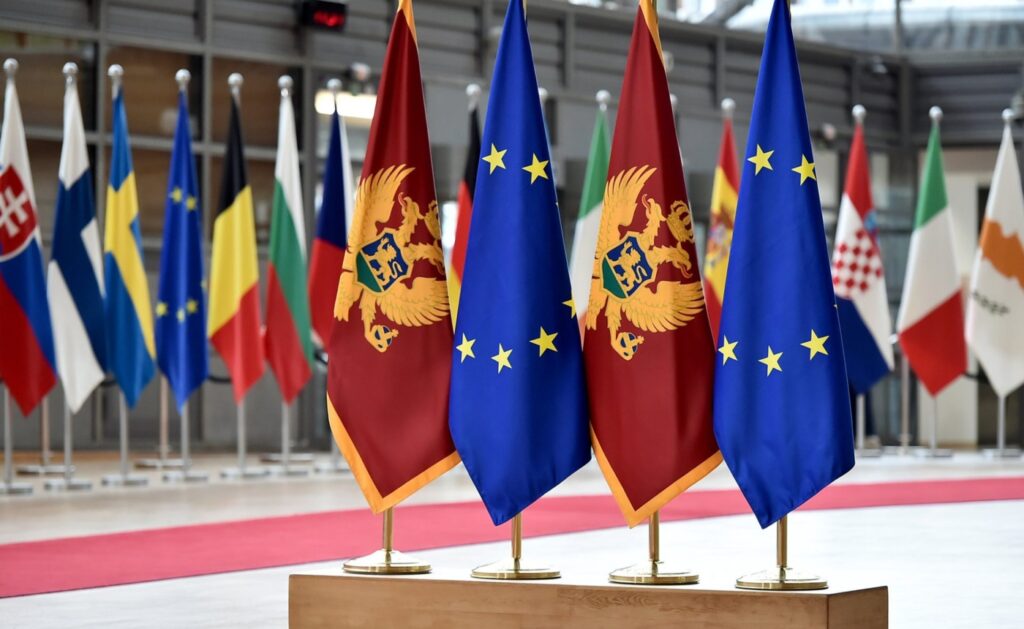
The official story of Montenegro’s EU path is compelling in its neatness. A small NATO member of 600,000 people, geographically embedded in the Adriatic, ideologically committed to Western integration, closes its negotiating chapters by the end of 2026 and enters the Union as its 28th member by 2028. Brussels gets a success story. Podgorica gets the euro. The Western Balkans gets proof of concept. Everyone benefits.
The problem with neat stories is what they leave outside the frame.
Montenegro is not simply a pro-European state waiting to cross the threshold. It is a coalition government that functions, structurally, as a managed contradiction, one in which the pro-European executive depends for its parliamentary survival on forces whose defining political history is hostility to everything that executive claims to represent. That contradiction has not been resolved. It has been bracketed, managed, and imported into the accession timeline itself. When Montenegro enters the EU, it will not enter as the country Minister Maida Gorcevic describes in interview, aligned at 100 percent with the Common Foreign and Security Policy, already living by European values. It will enter as the country it actually is: a state in which the speaker of parliament spent decades calling NATO “brute force,” publicly defended Vladimir Putin, used Kremlin terminology to describe Russia’s invasion of Ukraine as a “special military operation,” and met the Russian ambassador as recently as July 2025 to praise Moscow’s historical support for Montenegrin statehood.
That man, Andrija Mandic, is not a marginal figure. He leads the For the Future of Montenegro bloc, holds the parliamentary speakership, and was guaranteed four ministerial portfolios as the price of coalition support for Prime Minister Milojko Spajic’s government. His party program, until recently, included withdrawal of recognition of Kosovo’s independence, lifting of EU sanctions against Russia, and withdrawal from NATO. In 2016, he was indicted alongside two Russian nationals for allegedly organizing a coup designed to halt Montenegro’s NATO accession and install a pro-Moscow government. Putin, at a Belgrade conference in 2019, called him a hero. Mandic was there to receive the compliment in person, while under indictment. The accession process has not neutralized him. It has legitimized him, his political space now extending to meetings with the Speaker of the British Parliament, the President of the European Parliament, and figures in Washington’s MAGA orbit. The West, hungry for the optics of a successful Balkan enlargement, has been willing to accept his silence as conversion. It is not conversion. It is a holding pattern.
The coalition mechanics make this concrete. In June 2024, the Montenegrin parliament passed the Jasenovac resolution, officially framed as historical commemoration, structurally a coalition invoice. It was a condition set by Mandic’s bloc in exchange for continued government support, introduced in full knowledge of what it would cost in Zagreb. Croatia declared Mandic persona non grata. The episode did not derail accession talks. Brussels absorbed it and moved on. This is not a failure of oversight. It is a decision to prioritize geopolitical deliverables over institutional thresholds, a conscious strategic compromise dressed as procedural flexibility.
The contradiction is not confined to the government. It now shapes public opinion, media narratives, and the legislative process itself. Anti-EU and anti-NATO narratives have become more visible and effective across Montenegro’s media environment, contributed to by Serbian media groups and party networks that operate inside the country with resources and reach that no accession chapter addresses. Public support for EU membership fell to 39 percent in 2024, this at the moment of the EU’s strongest-ever rhetorical backing for Montenegrin accession. The European Commission’s response has been to deploy 50 officials to Podgorica to do the administrative work the Montenegrin state cannot or will not do, waving through legislation of questionable quality (as multiple analysts and civil society observers report) because the geopolitical imperative to finalize accession now overrides the technocratic imperative to do it properly. One political scientist with direct experience of the talks described the government’s operating assumption plainly: beyond not causing bigger problems, it doesn’t have to do anything serious, because Brussels will take it in regardless.
The honest name for this process is not enlargement. It is enrollment.
The Hungary comparison is not incidental; the actors in Podgorica are drawing it themselves. The Greater Serbia nationalist parties, which spent years campaigning on anti-Western rhetoric, now claim EU accession as their own. Not because their worldview has changed, but because Viktor Orban demonstrated something more instructive than any reform chapter: Hungary did not break the EU from the outside. It redefined what the EU tolerates from within. Mandic’s bloc is not pursuing EU membership despite its values. It is pursuing membership because of what the Hungarian decade inside the Union has shown membership can accommodate. The speakership of parliament is not a ceremonial prize. It is an institutional base from which to block, delay, leverage, and, once the coalition agreement delivers the promised ministerial portfolios, administer. Veto power held by a government that does not fully embrace EU values is not a theoretical risk. It is a demonstrated mechanism, with a decade of Hungarian case law to study.
The geopolitical case for speed is real and should not be dismissed. A Montenegrin success story would be a direct setback for Vucic, who in December 2025 proposed that the entire Western Balkans region join the EU simultaneously, in practice a transparent attempt to delay his own country’s accession while retaining regional influence by binding it to Montenegro’s slower neighbors. That Serbia’s president fears a Montenegrin success is itself an argument for one. EU membership would also more effectively shield the Western Balkans from Russian influence than any number of partnership frameworks, and Montenegro’s Adriatic position carries genuine strategic weight. These arguments are not wrong. They are simply insufficient answers to the question of what enters the EU when Montenegro enters.
A country’s political culture does not transform at the moment of treaty signature. The Serbian Orthodox Church remains the most powerful institutional actor in Montenegrin civil society, and its allegiances run through Belgrade. After accession, the Serb-leaning versus Montenegrin-identity conflict will not dissolve. It will continue, now inside the EU’s institutional architecture, likely amplified by Brussels-against-sovereignty narratives that Mandic’s bloc has already demonstrated it knows how to deploy. The reform deficit accumulated during the rush will not prove reversible once accession conditionality disappears. Post-entry leverage is, historically, a fraction of pre-entry leverage. Europe knows this. It has watched Hungary for a decade. It is choosing to proceed regardless.
Montenegro deserves EU membership. It deserves it on the terms that membership is supposed to mean: genuine rule of law, independent judiciary, free media, and a political culture committed to the values the accession treaty encodes. What it is being offered, and what it is in danger of receiving, is something narrower, a stamp of approval applied over a coalition whose most powerful partners have not changed who they are, only who they are willing to be seen with.
The accession ceremony will be brief. The consequences will not.
The Tirana Examiner covers Albanian and Balkan affairs for a transatlantic readership.