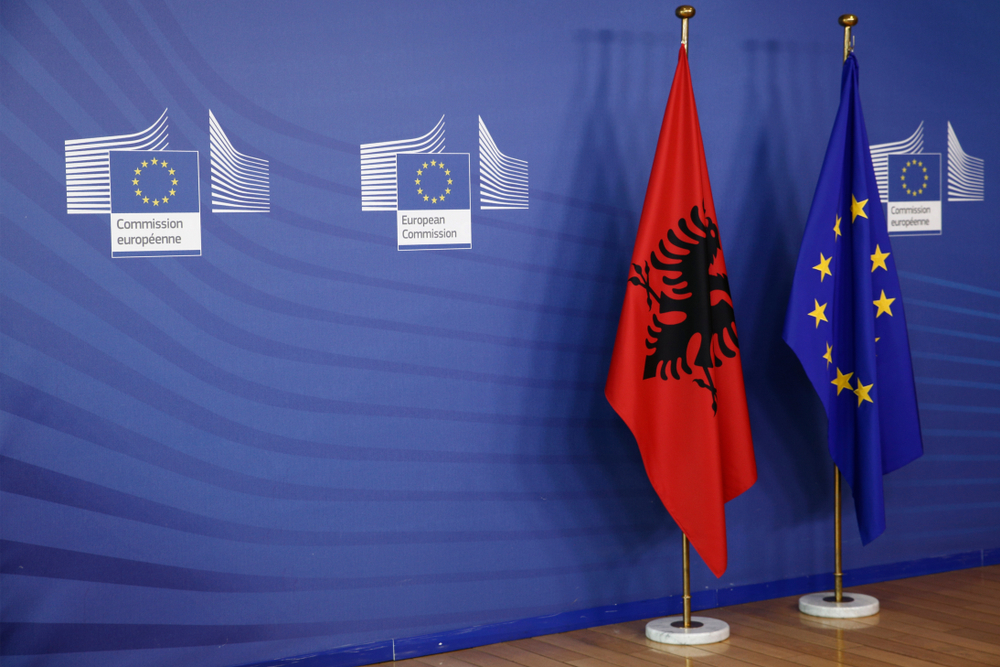
The Commission’s reply to A2CNN contained one sentence on corruption and organised crime in Albania. Read against SPAK’s fifteen-month enforcement record, against the standard the Commission applied to previous accession waves, and against the Commission’s own positive IBAR assessment tabled in parallel with the reply, the sentence reveals less an assessment than a reflex.
Albatros Rexhaj (Tirana)
In its written response to A2CNN journalist Fjorela Beleshi, the European Commission produced one sentence on corruption and organised crime in Albania. The sentence is familiar enough that it usually passes without comment. It should not.
Albania, the formulation reads, must continue to strengthen its enforcement record against corruption, including at high levels, and against organised crime, including drug trafficking. The line has appeared, with only minor variation, in Commission communications about Albania for years. In April 2026, sent in parallel with a positive IBAR assessment the Commission itself tabled, recycled without adjustment into the fifteenth month of the most sustained organised-crime prosecution campaign in the region, that continuity is worth interrogating.
Read carefully, the sentence does not hold. It contradicts the Commission’s own positive IBAR assessment. It fails to register what Albania’s enforcement apparatus has done over the period the benchmark is meant to measure. It reproduces a regional stereotype in a parenthetical. It sits in tension with a principle of law the Commission claims to enforce. And it applies, to Albania, a standard the Commission did not apply to any member state currently inside the Union. What follows is not a complaint. It is a reading.
Part I: The sentence against the evidence
The IBAR contradiction
The Interim Benchmark Assessment Report tests Albania’s performance precisely in the Fundamentals cluster, which includes rule of law and the enforcement dimensions the sentence names. The Commission has just submitted to the Council what it itself describes as its positive assessment on the fulfilment of the IBAR, together with a draft EU Common Position for Cluster 1. That is the Commission’s own characterisation, in the same reply to A2CNN. An institution that describes its own assessment as positive is, by that characterisation, saying the benchmarks in this area were met at a level sufficient to move the file forward.
If that is the Commission’s own position, what is “continuing to strengthen” measuring? If the enforcement record against corruption and organised crime had been found insufficient, the Commission would not have described its assessment as positive and the draft Common Position would not have been tabled. If the Commission’s assessment is positive, the “must continue to strengthen” clause cannot simultaneously describe a shortfall in the same dimension. Either the sentence has become ritual, or the Commission’s own verdict on itself has become ritual. The two cannot both be substantive at the same time.
The Commission does not reconcile this. It puts them side by side in the same reply and expects both to carry weight. They cannot.
The absent record
The sentence also does not engage with what Albania’s enforcement apparatus has actually done in the last fifteen months. As Marinela Pole documented in these pages on 15 April, the record is cumulative and measurable, and the shift it represents is structural, not cosmetic.
In 2025 alone, SPAK reported asset seizures and confiscations of approximately 45.4 million euros, including cryptocurrency holdings. Operation URA produced 52 arrest warrants across Albania and Italy, dismantling multiple cross-border criminal groups. In Saranda, investigations moved against a cannabis network that included serving and former police officials. In Fushë Krujë, a politically exposed network was dismantled. In Vlora, a trafficking structure linked to nearly two tonnes of narcotics was disrupted, with state officials exposed in the chain. The operation announced last week against a Latin America to Western Europe narcotics network produced 11 arrest warrants and approximately 12 million euros in frozen assets across more than 200 holdings.
The operational architecture producing these outcomes matters as much as the numbers. SPAK, the National Bureau of Investigation, and the Special Court are operating as a single enforcement chain, supported by Europol, Eurojust, and partner jurisdictions. Financial investigation and asset seizure have moved from secondary tools to central methods. What the record shows is not isolated activity. It is accumulation: sustained institutional pressure that compounds across cases.
A sentence written about this period ought to be able to register it. The Commission’s sentence does not. A reader encountering only the sentence would have no way to know the record exists. The Commission may reply that the benchmark is forward-looking rather than retrospective, and that what matters is the direction of future progress, not the accumulation of past output. That reply does not save the formulation. A benchmark that is genuinely forward-looking still has to calibrate against a baseline, and the baseline has shifted. The Commission’s sentence does not acknowledge that a shift has occurred. It recycles prior-period language as though the intervening period had produced nothing worth naming. That is not a forward-looking benchmark. It is a static one.
Part II: What the language itself does
The specified tag
“Including drug trafficking” is a choice. Organised crime in the Western Balkans is a single system operating across multiple verticals: trafficking in persons, cyber crime, financial crime, arms movement, sanctions evasion, high-value fraud, money laundering. The Commission could have named any of these. It could have used an umbrella formulation. It could have named none of them. It chose drug trafficking.
That choice is not analytical. It reproduces the regional stereotype most often attached to Albania. The same specificity does not appear in Commission language addressed to capitals where the same criminal verticals operate and where enforcement output is demonstrably thinner. In those cases, the formulation is usually generic. For Albania, the parenthetical narrows. It is language doing categorisation work, not analytical work, and it keeps Albania inside a category regardless of what Albania’s enforcement record shows.
The presumption the Commission does not acknowledge making
The “including at high levels” clause carries an assumption the Commission does not state but cannot avoid. For Albania to “strengthen its enforcement record against high-level corruption,” high-level corruption must exist at a scale that the current enforcement effort is insufficient to address. The Commission is not asking Albania to build the capacity to respond if such corruption is found. It is asking Albania to produce more prosecutions against a phenomenon the Commission treats as given.
This is where the formulation runs into a principle the Commission is supposed to uphold. The Commission is not a court, and its benchmarks are policy instruments rather than adjudicative findings. That distinction is real and should be acknowledged. But the distinction does not dissolve the problem. In a legal order built on presumption of innocence, guilt is established case by case through adjudication. It is not assumed in the aggregate and then made the basis of a policy demand placed on a candidate country’s judiciary. The Commission’s formulation sits in tension with that principle. It treats the existence of unprosecuted high-level corruption as a working assumption, and it makes prosecution against that assumed pool a benchmark for accession.
A candidate country cannot satisfy this benchmark without producing prosecutorial output that matches the Commission’s unstated estimate of the pool. If the pool is assumed large and the output is modest, the benchmark reads as unmet. If the pool is assumed large and the output is large, the benchmark reads as satisfied. In either case, the benchmark is calibrated against an unverified premise rather than against the record. A legal system asked to produce outputs that validate an external estimate faces pressures on its independence that the principle of judicial independence was designed to prevent.
The Commission would not accept this framing applied to its own member states. No serving government inside the Union is told that it must “continue to strengthen its enforcement record against high-level corruption” as a policy condition, with the accompanying assumption that such corruption exists at a scale its prosecutions have failed to match. That framing is reserved for candidate countries. It is a framing the acquis itself does not contain.
The incentive structure the benchmark does not examine
The benchmark’s second difficulty is operational. “Enforcement record” is measurable externally only through outputs that can be counted: arrests, indictments, pretrial detentions, convictions. The Commission cannot count judicial independence from outside. It cannot count case quality. It cannot count whether evidence was gathered lawfully or whether proceedings respected due process. What it can count is volume.
Volume, therefore, is what a system under benchmark pressure has incentives to optimise toward. These are not established mechanisms, and the pushback here is about risk structure rather than demonstrated causality. But the risk structure is identifiable and worth naming. A prosecutor operating under this kind of benchmark pressure faces incentives to open high-profile cases against politically exposed figures even where the evidence may not be fully trial-ready. To seek pretrial detention as a default rather than as a narrow exception, because detention is visible from outside and reads as seriousness. To push indictments forward on reporting-cycle timelines. To treat acquittals as institutional embarrassments rather than as a system functioning correctly.
Each of these behaviours becomes strategically rational when volume is the visible metric and other metrics are not. Each is in tension with the rule of law the benchmark claims to measure. And each carries human cost the benchmark does not ask about. People held in pretrial detention for months or years on cases that later collapse. Reputations and careers affected by indictments that do not result in conviction. Under a measurement regime that counts activity rather than outcome, the indictment counts. The detention counts. The enforcement activity counts. Whether the person was subsequently convicted, acquitted, or had charges dropped is not a variable the benchmark, as formulated, visibly tracks.
At its sharpest, this risks producing a measurement regime that functions as a production quota with the vocabulary of rule of law attached. The Chief Justice of the Supreme Court’s recent initiative on pretrial detention standards exists precisely because the system has expanded detention to a point that raises systemic concerns. That initiative is a signal from inside the Albanian judiciary that the system is producing outputs the system itself wants to review. The Commission’s benchmark, as currently written, has no obvious way to credit that corrective work. A benchmark that asks only “how much enforcement” cannot register a judicial institution asking “is the enforcement being conducted well.” That asymmetry is the problem, and it is a problem the Commission should want to know about.
Part III: The asymmetry
Regional asymmetry
A full comparative audit of organised-crime enforcement output across the Western Balkans would require more space than this piece can give, and the data is unevenly published across the region. But the direction of travel is visible enough to make a point. Serbia retains enforcement capability but carries persistent concerns, documented in successive Commission reports, about prosecutorial independence and the ability to carry high-profile cases through to uncontested conclusion. Montenegro has produced historic cases against former senior figures but is processing them through institutions still under strain. North Macedonia operates under prosecutorial and investigative capacity constraints that its own authorities have acknowledged. Bosnia and Herzegovina’s enforcement fragments across state, entity, and cantonal jurisdictions, a structural feature the Commission has flagged repeatedly. Kosovo has expanded cross-border cooperation, with financial investigation tools still developing and no asset-seizure campaign of comparable scale yet emerging.
The observation that matters is narrower than a ranking. The Commission’s “must continue to strengthen” register does not appear with the same intensity, and specifically does not appear with the same parenthetical on drug trafficking, in Commission language addressed to other capitals in the region where the same criminal verticals operate. If the benchmark were a genuine enforcement-output measure, the language ought to calibrate across the region in proportion to the record. The parenthetical does not. That narrower asymmetry is enough to raise the question of what the formula is actually tracking.
The standard the Commission did not apply before
The sharpest asymmetry, however, is not regional. It is historical. The Commission is asking Albania to satisfy pre-accession conditions more demanding than those accepted for several earlier entrants whose records in the relevant areas were visibly weaker.
Bulgaria and Romania acceded on 1 January 2007 with rule of law and anti-corruption shortcomings that were openly acknowledged at the time. The Commission’s response was not to delay accession until those shortcomings were resolved. It was to accede both countries and create the Cooperation and Verification Mechanism as a post-accession monitoring tool. Enforcement records were built inside the Union, under supervised cooperation, after membership. Romania’s DNA produced its landmark cases, including those against former Prime Minister Adrian Năstase and later against Liviu Dragnea, in the years after accession. Pre-accession, DNA’s record was thinner than SPAK’s current record is today. Bulgaria’s anti-corruption architecture was weaker than Albania’s is now.
Croatia acceded on 1 July 2013 with Chapter 23 benchmarks still active and a monitoring framework running past accession. The earlier 2004 wave, including Slovakia, Hungary, the Czech Republic, and Poland, acceded with institutional weaknesses that have since produced full-scale rule of law crises inside the Union.
In September 2023, the Commission formally concluded the Cooperation and Verification Mechanism for Bulgaria and Romania, declaring the benchmarks sufficiently met inside the framework of membership. That is the Commission’s own verdict: the post-accession monitoring model worked. The model exists. It was invented, applied for sixteen years, and closed out by the Commission itself. It is available.
The Commission chose not to offer it to Albania. Instead, it is asking Albania to meet, pre-accession, a standard that the Commission accepted post-accession from two member states whose records in the relevant years were visibly weaker than Albania’s is now. That is not a merit-based distinction. That is a policy choice presented as a merit test.
The merit-based principle the Commission invokes in every enlargement speech requires that the test be the same. If SPAK’s record in 2025 is weaker than DNA’s was in 2005, the Commission should say so and explain how. If it is stronger, the Commission should explain why a record that would have cleared the 2007 bar does not clear the 2027 bar. In either case, the question has to be engaged. The sentence under examination does not engage it. It proceeds as though the comparison does not exist.
Part IV: What the sentence actually does
The Commission’s sentence, read against its evidentiary context and against the institutional record of the Commission itself, is not a finding. It is a formula. Formulas are administratively useful because they keep institutional positions stable across reporting cycles, regardless of what the underlying subject does. The cost of that stability is that the formula eventually stops describing the subject. It describes itself.
Tirana has been inside this formula long enough that the formula has outlived its evidentiary basis. Recycling it in April 2026, in a document paired with the Commission’s own positive IBAR assessment, sent in a period when Albania’s enforcement apparatus is producing the most sustained organised-crime pressure in the region, applied to a candidate held to a standard no current member state was held to, is not rigour. It is the opposite. It is language that has stopped being tested against the thing it claims to evaluate.
The merit-based enlargement process, as the Commission itself describes it, cannot function if the benchmarks are not updated when the candidate updates, and if the benchmarks are not applied uniformly across candidates and across time. When Tirana produces the work, the language should register the work. When the comparable work produced by Bulgaria and Romania was treated as sufficient for post-accession monitoring, the same offer should be available to Albania, or the Commission should explain the principled basis on which it is withheld. When a benchmark risks inverting the presumption of innocence, the benchmark should be rewritten, not exported.
None of this is a challenge to the enlargement process. It is a defence of the process the Commission claims to run. If merit is the principle, the language has to match the merit. If it does not, the principle is not merit. It is something else, and it should be named.
The one sentence in the Commission’s reply to Fjorela Beleshi will not, on its own, determine Albania’s path. But it is a window. It shows a Commission using language that its own verdicts, its own history, and its own legal principles no longer support. The fix is not to defend Albania from the language. The fix is to hold the Commission to the standard the Commission claims to apply.